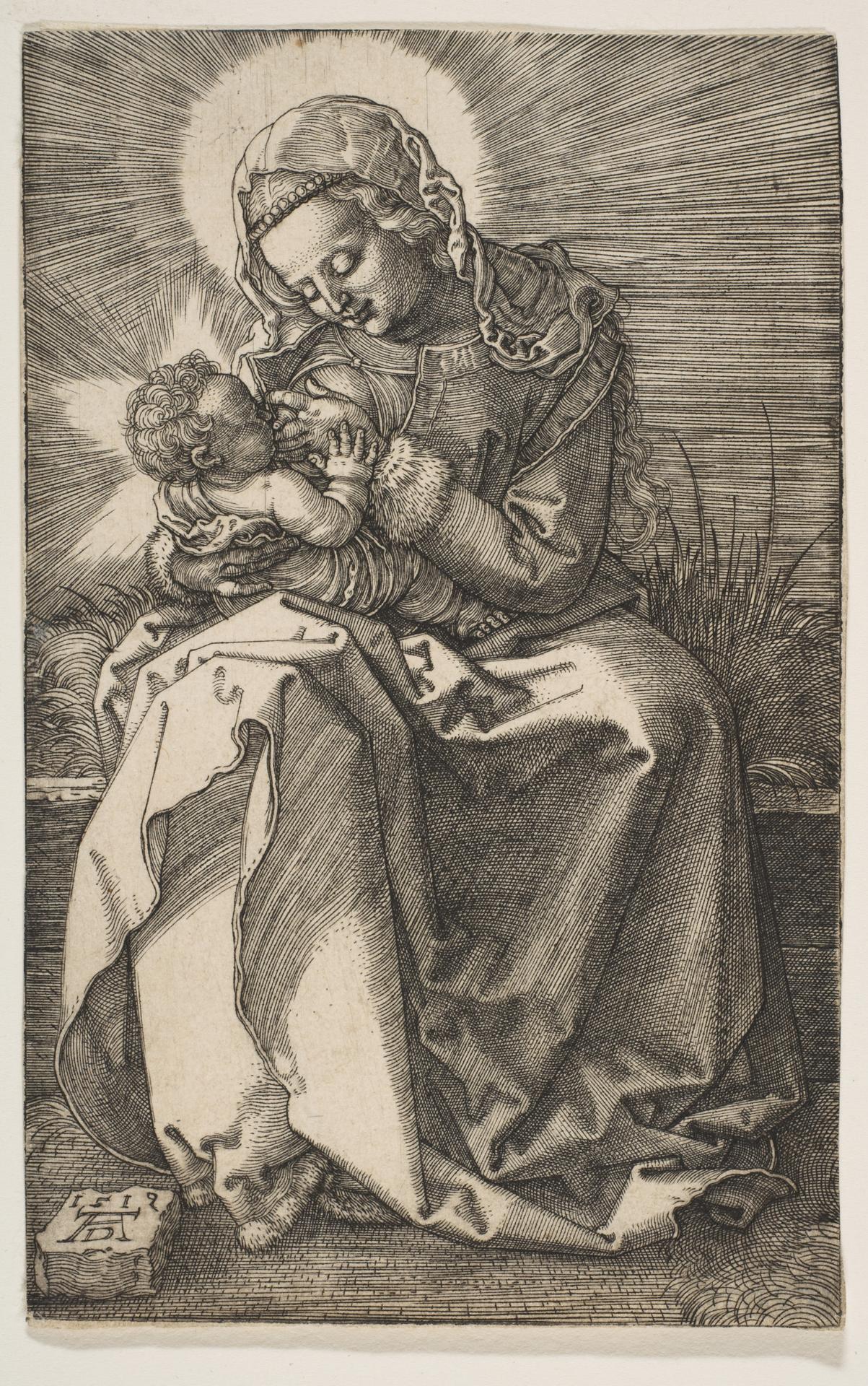
The Virgin Nursing the Christ Child
Original title: The Virgin Nursing the Christ Child
kurzbeschreibung
The Virgin Nursing the Christ Child is an engraving by Albrecht Dürer, created in 1519. It depicts the Virgin Mary kneeling and nursing the Christ Child, a tender moment of maternal care. The work showcases Dürer's mastery of line and shading in the medium of engraving.
Description
The composition is centered on Mary, who kneels and holds the Christ Child on her lap. Her gaze is directed lovingly at the child, who appears calm and still. Both figures are dressed in traditional garments, rendered with fine lines and cross-hatching. A radiant halo surrounds Mary's head, emphasizing her sanctity, while the background is composed of subtle tonal variations. The image is monochromatic, using only shades of gray achieved through intricate line work.
Context
Dürer created this engraving in 1519, a period when he was at the height of his artistic powers in Nuremberg. The subject of the Virgin and Child was a common theme in Christian art, reflecting the era's devotional practices. Dürer's engravings were widely disseminated across Europe, contributing to his reputation as a leading printmaker of the Northern Renaissance.
Impact
The engraving evokes a sense of intimacy and serenity through the quiet interaction between mother and child. The delicate lines and soft shading create a gentle, almost tender atmosphere, drawing the viewer into the sacred moment. The halo and symmetrical composition reinforce the divine nature of the scene while maintaining a human warmth.
Technique
This work is an engraving, a technique in which lines are incised into a metal plate, inked, and then printed. Dürer employed sharp, precise strokes and cross-hatching to model form and texture, particularly in the folds of the garments and the background. The monochrome palette is a direct result of the printing process, using only black ink on paper to produce varying tones.
AI-generated description text
Source: Metropolitan Museum of Art · Public domain (CC0)