Judah and Tamar
Original title: Judah and Tamar
kurzbeschreibung
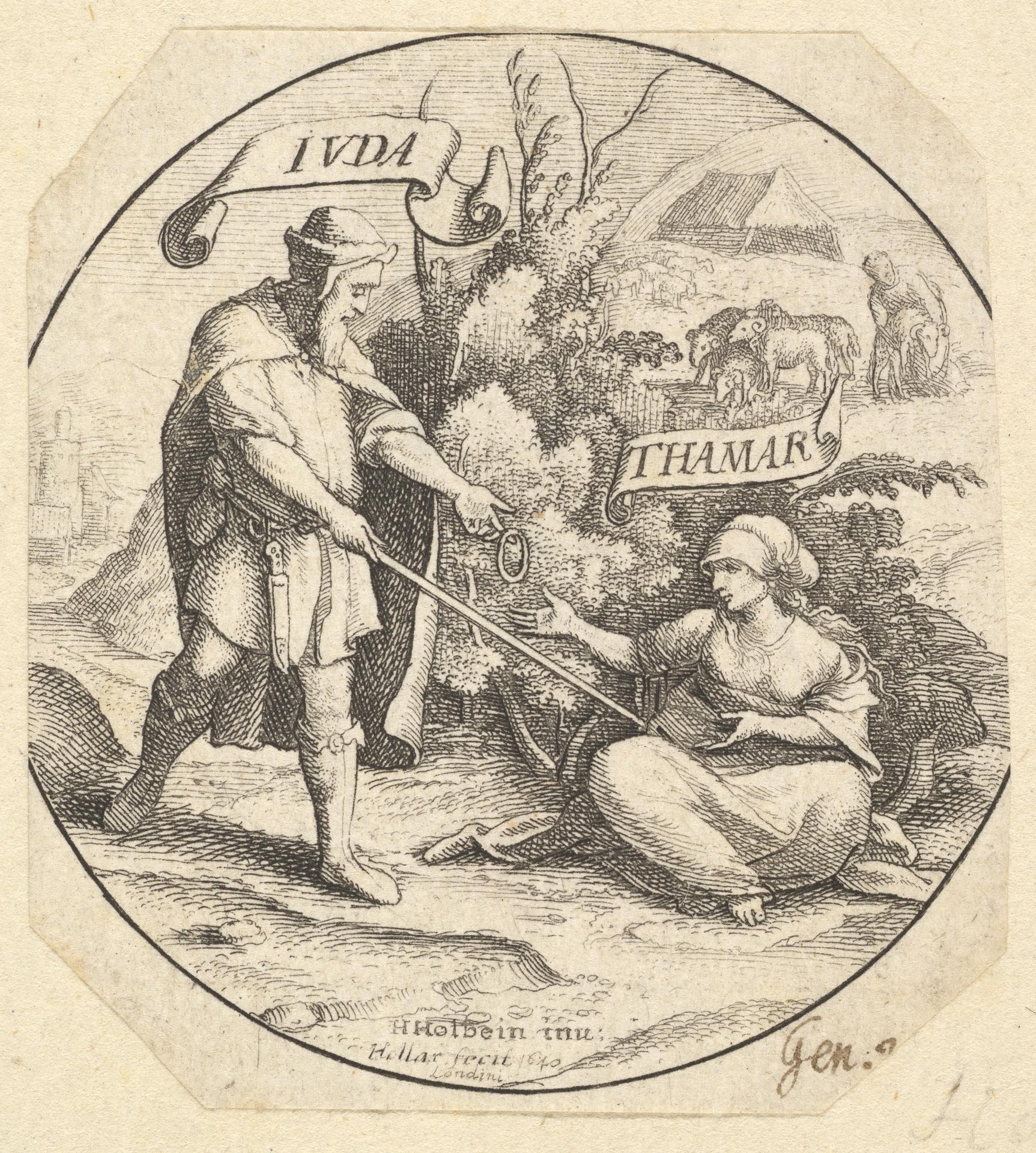
Unlike other sheets from Hollar's biblical series, this 1640 etching pairs the Genesis story of Judah and Tamar with a rural setting. Judah stands at left with a staff, Tamar sits on the ground; their garments are traditional, and inscribed bands give their names. The subject survives in only one known state.
Description
Tamar sits at right, wearing a headscarf and holding a staff, while Judah leans toward her from the left with his own staff. Both are dressed in deeply folded robes. Trees, a farmhouse, and animals populate the rural ground. Above the figures hang two inscribed bands reading 'IVDA' and 'THAMAR'; below appear the notes 'Holbein inv.' and 'Hollar fecit 1640 Londini.' The round format keeps the two figures close together.
Context
Hollar made this etching in 1640 in London, where he had emigrated from Prague. The invention belongs to Hans Holbein the Younger, as the inscription 'Holbein inv.' indicates. Within a series of biblical prints, this motif exemplifies the artist's small-scale, meticulous approach. It tells the Old Testament episode of Judah and Tamar from Genesis 38, a subject frequently taken up in the seventeenth century.
Impact
The clear arrangement within the circle and the precise linework produce a calm, narrative effect. Viewers of this small sheet can follow the biblical action in its rural surroundings. Despite the modest format, a remarkable wealth of detail remains visible, giving the image depth.
Technique
An etching, preserved in the only known state. The process allows fine, exact lines that render garments and landscape in detail. At just 5.5 × 5 cm, the sheet is unusually small and demands great technical precision.
AI-generated description text
Source: Metropolitan Museum of Art · Public Domain (CC0 1.0)