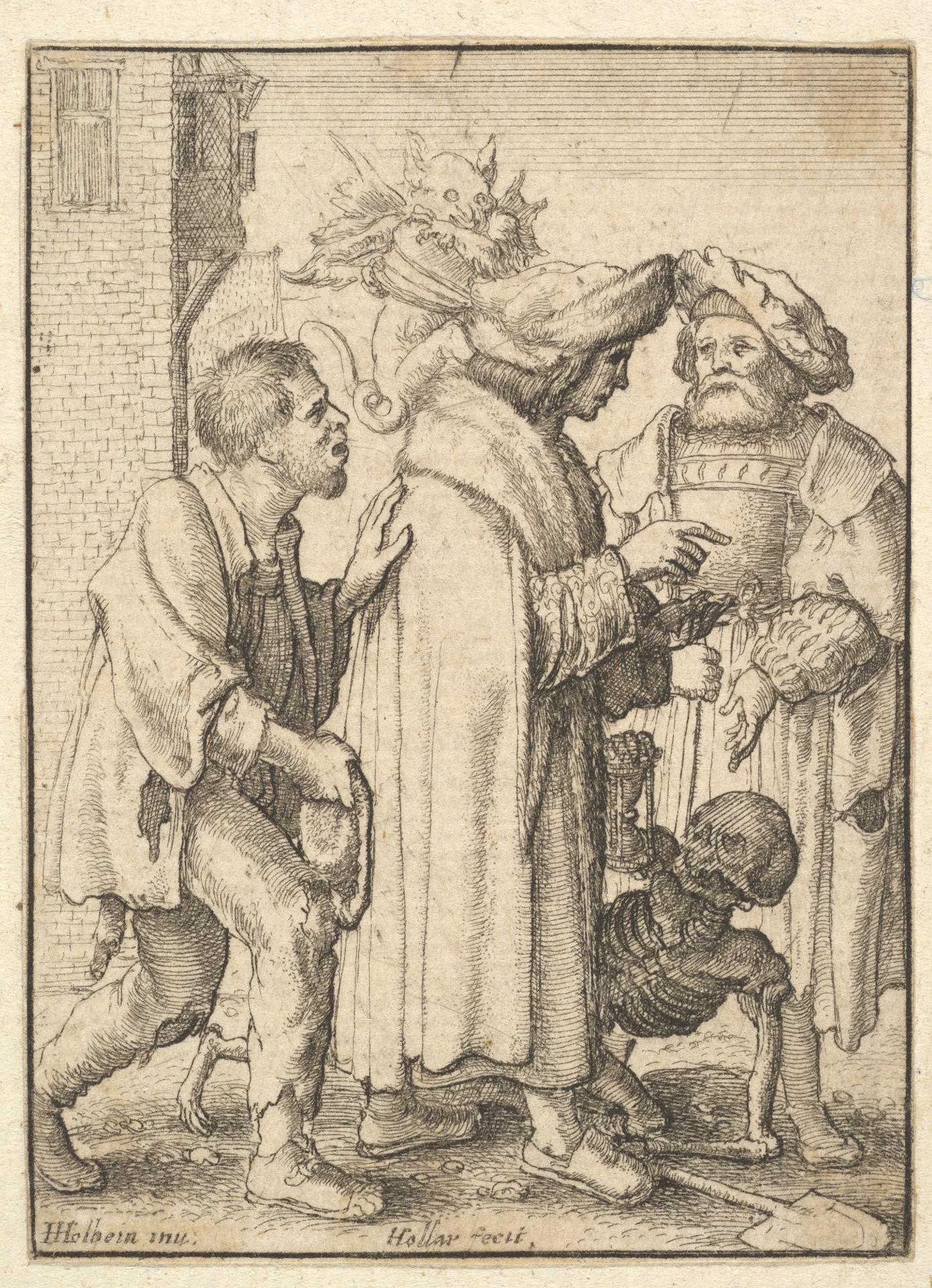
Rich Man, from the Dance of Death
Original title: Rich Man, from the Dance of Death
kurzbeschreibung
In 1651 Wenceslaus Hollar etched a scene from the Dance of Death: a plainly dressed man, a richly outfitted one in a fur coat and feathered hat, and a skeleton meet. The small black-and-white print measures 6.6 × 4.8 cm and belongs to Hollar's Dance of Death cycle.
Description
Three figures gather in an interior, with parts of buildings and windows suggesting the room behind them. At the left stands a man in simple clothing, turning to address the middle figure, who is lavishly dressed in a fur coat and a hat trimmed with feathers. At the right a skeleton kneels, supporting the central figure. Everything is rendered in monochrome, meticulous in detail and exact in its linework.
Context
For his Dance of Death Hollar drew on the famous sixteenth-century woodcuts by Hans Holbein the Younger. In 1651 Hollar was working in England for various noble households. The Dance of Death motif was widespread in the early modern period, holding up the transience of all earthly things regardless of social rank.
Impact
The small etching lives from its clear arrangement and delicate linework. The confrontation of wealth and death gives pause and invites reflection on one's own mortality. Clothing and skeleton are captured with an accuracy that feels almost documentary.
Technique
Hollar worked the plate as an etching in four states; this impression is the second, suggesting careful reworking. Etching allows fine, curving lines, which were used here for the detailed rendering of fabrics and faces. The format of only about 6.6 × 4.8 cm demanded precise handling of the tool.
AI-generated description text
Source: Metropolitan Museum of Art · Public Domain (CC0 1.0)