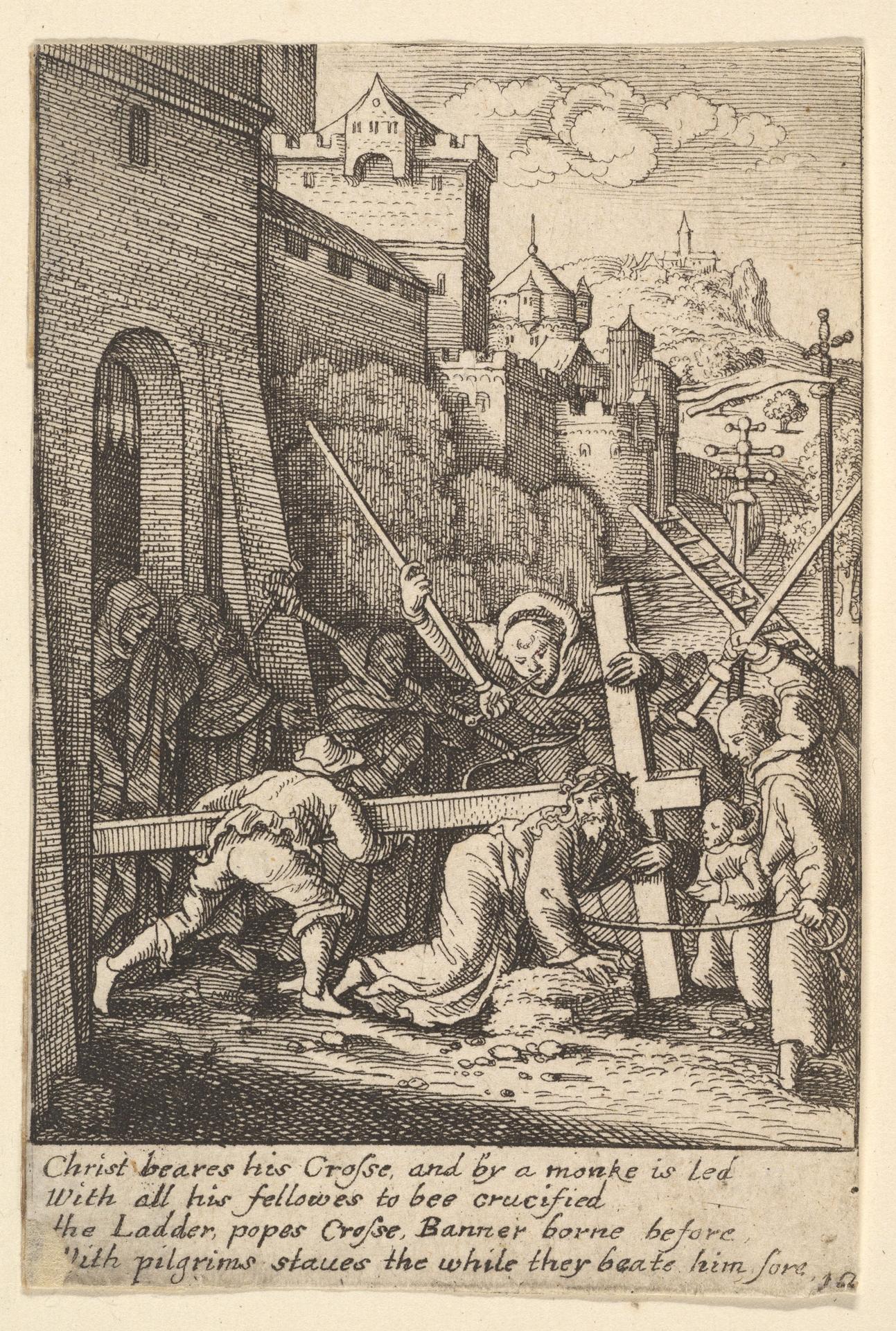
Carrying the cross
Original title: Carrying the cross
kurzbeschreibung
Beneath the weight of the cross, Jesus Christ kneels and struggles forward in this etching by Wenceslaus Hollar. The print was made between 1644 and 1652. Christ wears a long robe and a crown of thorns; several figures surround him, including a monk who points at the cross with a stick. A fortress or city wall with towers and buildings forms the background.
Description
Christ kneels in the foreground, the cross on his shoulders, and pushes himself forward. A long robe and a band of thorns across his brow are visible, while figures accompany or watch him. A monk points with a stick at the cross, directing the eye to the action. Behind rises a fortress or city wall with towers and buildings, giving the scene a historical setting. Fine, sharp lines emphasize movement and expression; the monochrome execution makes details stand out clearly.
Context
The etching was made in the mid-17th century, when Bohemian artists who had emigrated often worked in England or the Netherlands. Hollar was known for precise topographical views and detailed graphics, which often included biblical scenes or everyday depictions. The carrying of the cross is a common motif in Christian iconography that frequently illustrated suffering and redemption in the Baroque period. The sheet exists as a single print in only one state, which may suggest a limited edition or a specific commission.
Impact
Christ's kneeling posture and the heavy cross immediately evoke physical and emotional exertion. Sharp lines and a clear layout draw the eye to the main figure and create a calm but insistent mood. The monochrome execution reinforces the serious character; architecture and figures emerge precisely.
Technique
An etching in only one state—so only one version of the printing plate exists. The process allows fine, detailed lines, used here for garments, architecture, and faces. At 9 × 6 cm, the format is small; this points to an intimate, careful execution intended for a single print or a small collection.
AI-generated description text
Source: Metropolitan Museum of Art · Public Domain (CC0 1.0)