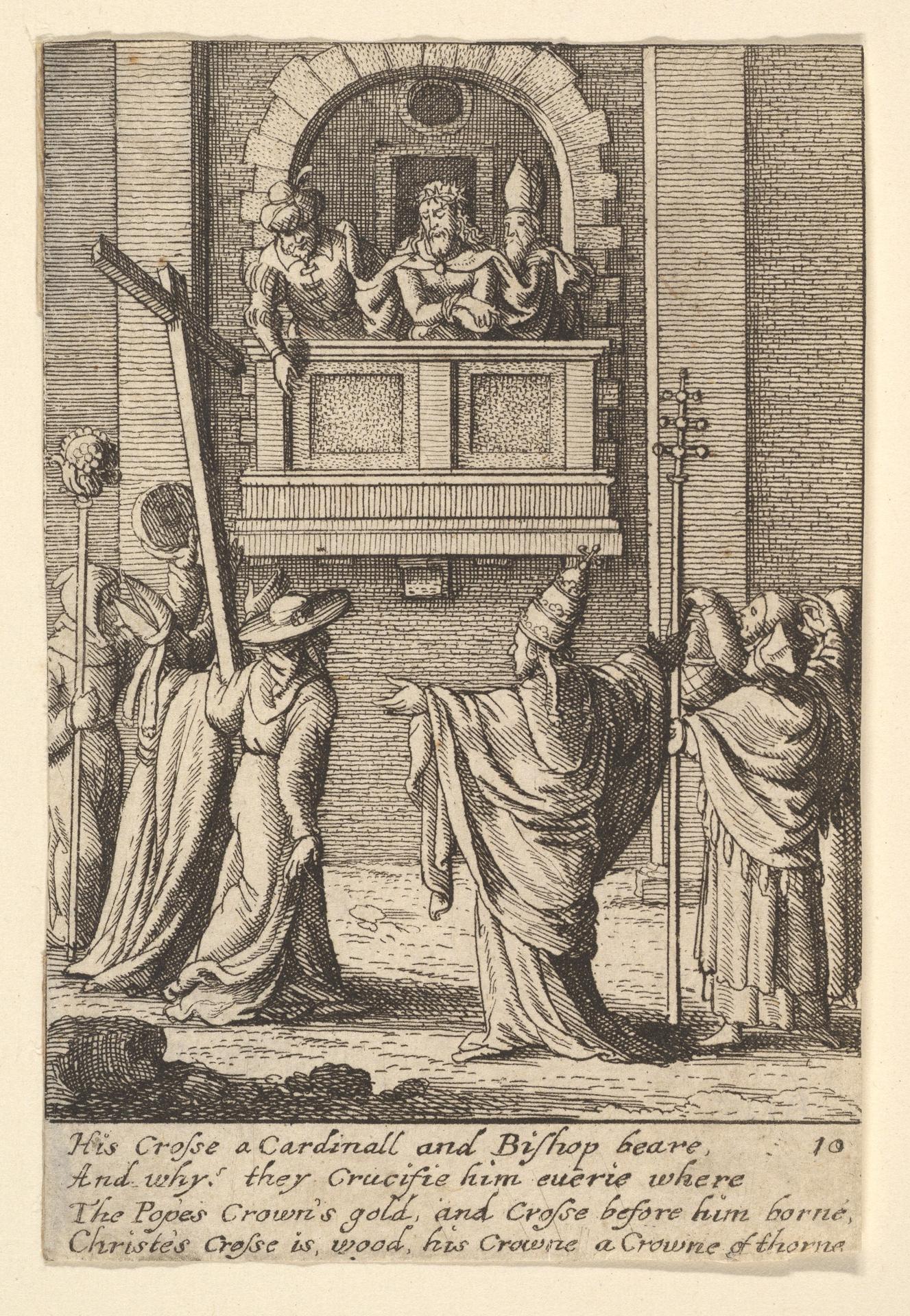
Ecce Homo (1644–52)
Original title: Ecce Homo
kurzbeschreibung
Christ stands between two accompanying figures — this motif was captured by Wenceslaus Hollar in an etching between 1644 and 1652. The small sheet measures 8.7 × 6 cm and exists in a single, unaltered print state (only state). It counts among the graphic works of the 17th century.
Description
At the center of the image, Christ stands in robes, carrying the cross on his back, his head encircled by a crown of thorns. On either side are arranged figures, each holding a cross. Behind them opens a semicircular niche in which further figures are suggested. The layout appears mirror-like in its order, the contours are sharp, the lines worked in detail — as is characteristic of etching. Light falling from the front emphasizes the outlines of the figures.
Context
Hollar, a native of Bohemia, created this sheet during his years in England or on the Continent, where he worked for various patrons. In this phase he was known for his precise and detailed printmaking. The Ecce Homo motif was widespread in Baroque art and took up the Passion of Christ.
Impact
The clearly structured, symmetrical arrangement directs the gaze to the central figure. The gray tones of the black-and-white reproduction and the direct light produce a calm, collected mood that invites quiet contemplation.
Technique
In etching, the drawing is scratched into a metal plate, which is then etched with acid. The impression was made in only one state (only state); no further reworkings or editions followed. The thin lines and hatching reveal Hollar's sure hand in handling this technique.
AI-generated description text
Source: Metropolitan Museum of Art · Public Domain (CC0 1.0)