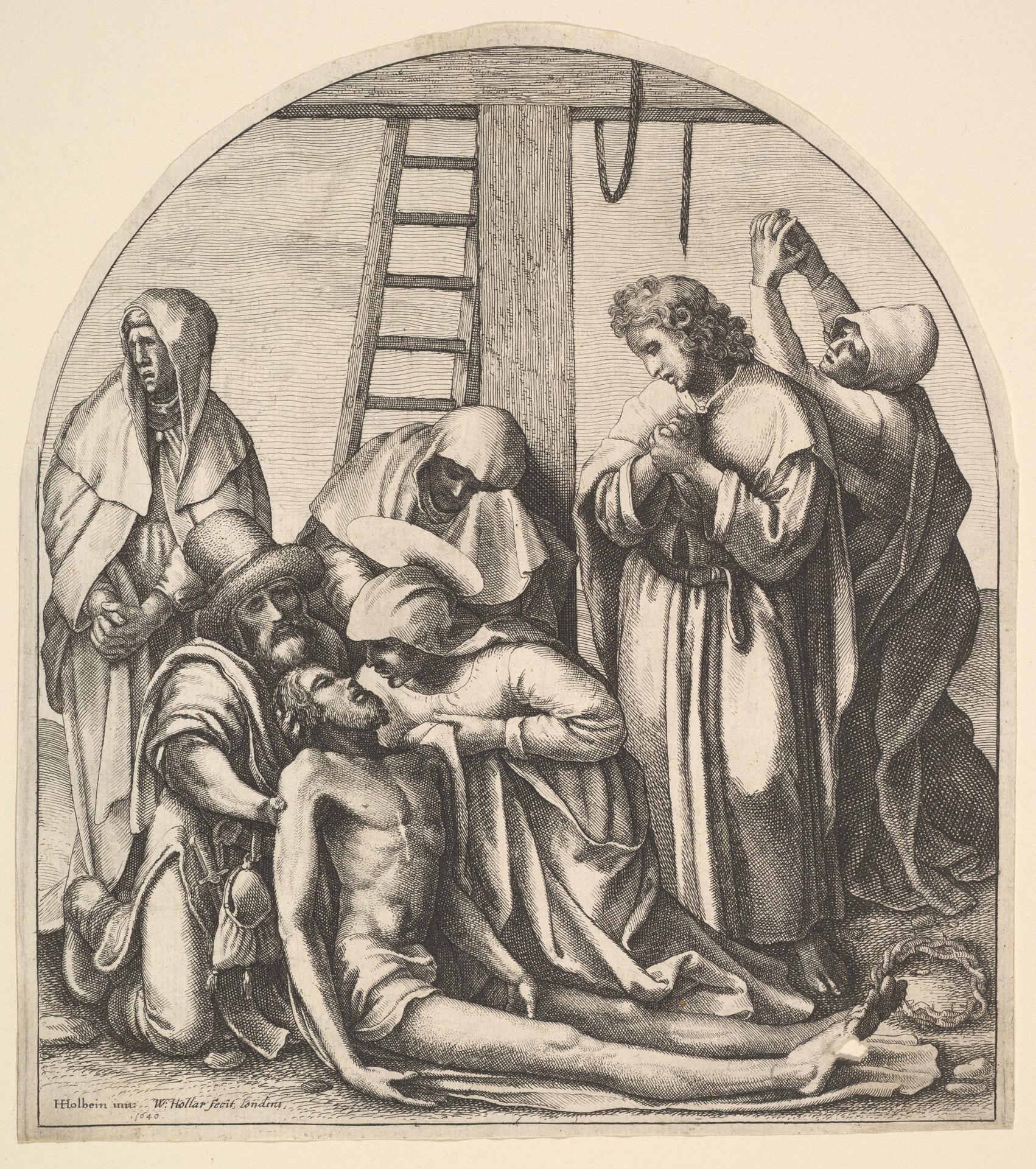
Descent from the Cross (1640)
Original title: Descent from the Cross
kurzbeschreibung
An etching from 1640 by Wenceslaus Hollar, this print pictures the descent of Christ from the cross. It survives in a single state and measures 19.7 x 17.5 cm. In the foreground lies the blood-covered body of Christ, surrounded by mourning men and women.
Description
Naked and streaked with blood, Christ rests in the foreground among men and women whose bearing shifts between grief and quiet awe. One man takes hold of the dead man's feet while other figures gesture with visible agitation. Behind them, the cross, a ladder and a hook complete the setting of the crucifixion. The figures' garments recall the Renaissance. Everything in the layout converges symmetrically on Christ, and the subject is rendered throughout with close attention to detail and a firm grasp of reality.
Context
Hollar, a Bohemian printmaker of the seventeenth century, was known for etchings worked down to the smallest detail. This sheet dates from 1640, an age when printed graphics circulated widely across Europe and religious subjects carried real weight. The artist worked in Prague and London, among other places, and produced many reproductions after other painters' designs.
Impact
Delicate strokes and deliberate shading give the sheet a grave, devotional mood. Because Christ suffers at the middle and the figures arrange themselves symmetrically around him, the eye goes at once to the drama. With no colour to distract, attention sharpens on the structure and on the feelings of those taking part.
Technique
As an etching, this print comes from an intaglio process: the drawing is scratched through an acid-resistant layer on a copper plate and the plate is then bitten. Only the one state of this print exists; no further reworking or editions are recorded. The method allows for faint lines and graduated tones, apparent in the garments and in the details of the bodies.
AI-generated description text
Source: Metropolitan Museum of Art · Public Domain (CC0 1.0)