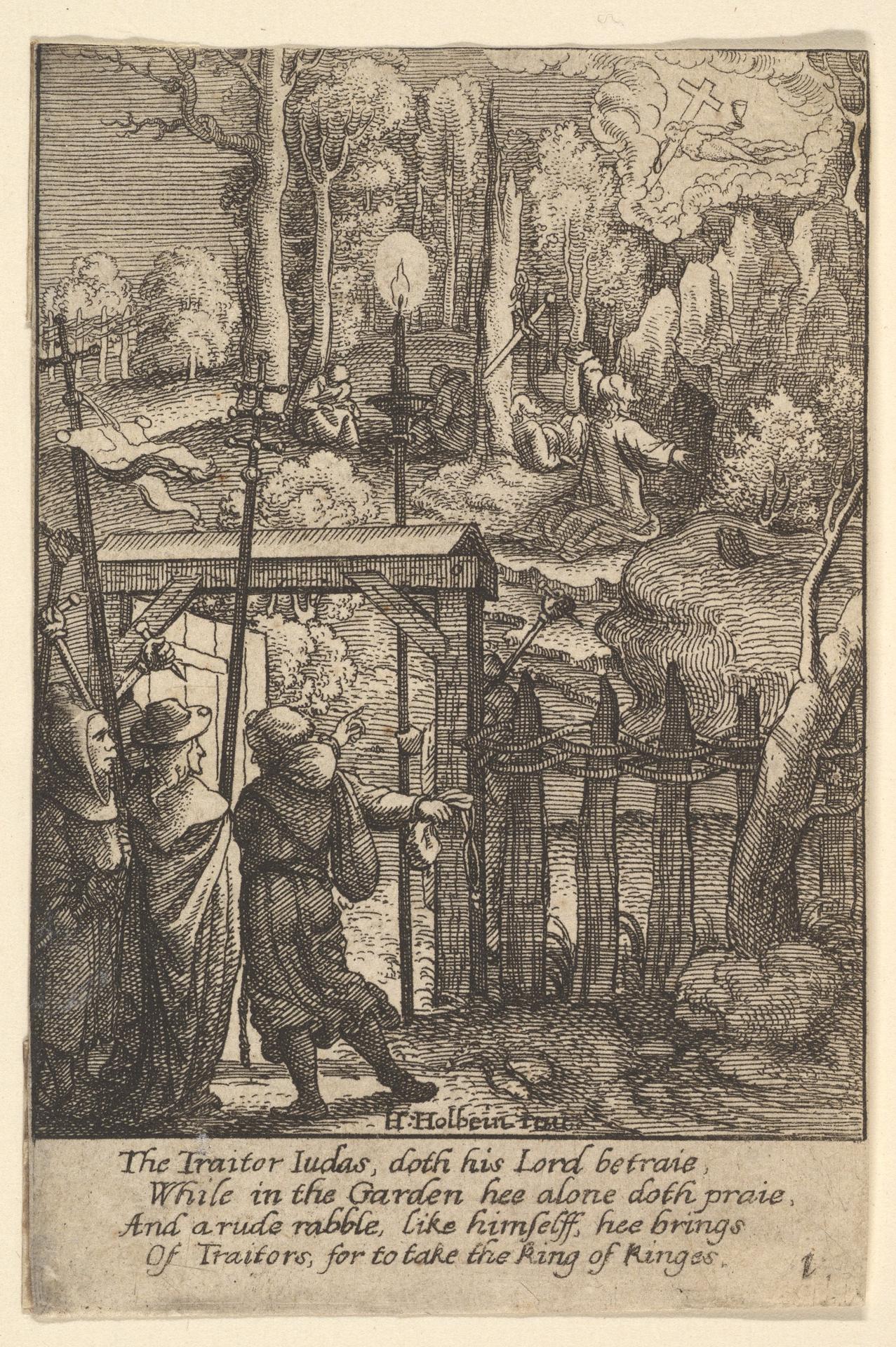
Jesus on the Mount of Olives
Original title: Jesus on the Mount of Olives
kurzbeschreibung
Between 1644 and 1652, Wenceslaus Hollar set down the Mount of Olives scene as an etching that survives in only one state. It shows Christ at prayer on the mount while Judas approaches with armed men.
Description
Three figures in the foreground make their way toward a temple-like structure. Two of them, armed with staves or axes, point left toward the building, while a third person on the right walks toward it. Trees and rocks step back through the landscape behind them. Above the building, clouds part to reveal a cross and a chalice, which give the image its religious meaning. An engraved Latin poem fills the lower edge and tells the story.
Context
Hollar worked from a design by Hans Holbein the Younger, a clear instance of seventeenth-century artists taking up earlier art. The years of production fell within the Thirty Years' War, a period when religious subjects carried great weight in art. Hollar, known for his detailed prints, worked in several European cities, including Prague and London.
Impact
A quiet but faintly threatening mood hangs over the sheet, catching the tension of the betrayal. Clean lines and the exact rendering of figures and terrain give the print a sober yet insistent presence.
Technique
Etching requires incising the drawing into a copper plate and then pulling impressions on paper. The finest lines and the rich working-up match Hollar's manner, which rests on precisely calculated engraving skill.
AI-generated description text
Source: Metropolitan Museum of Art · Public Domain (CC0 1.0)