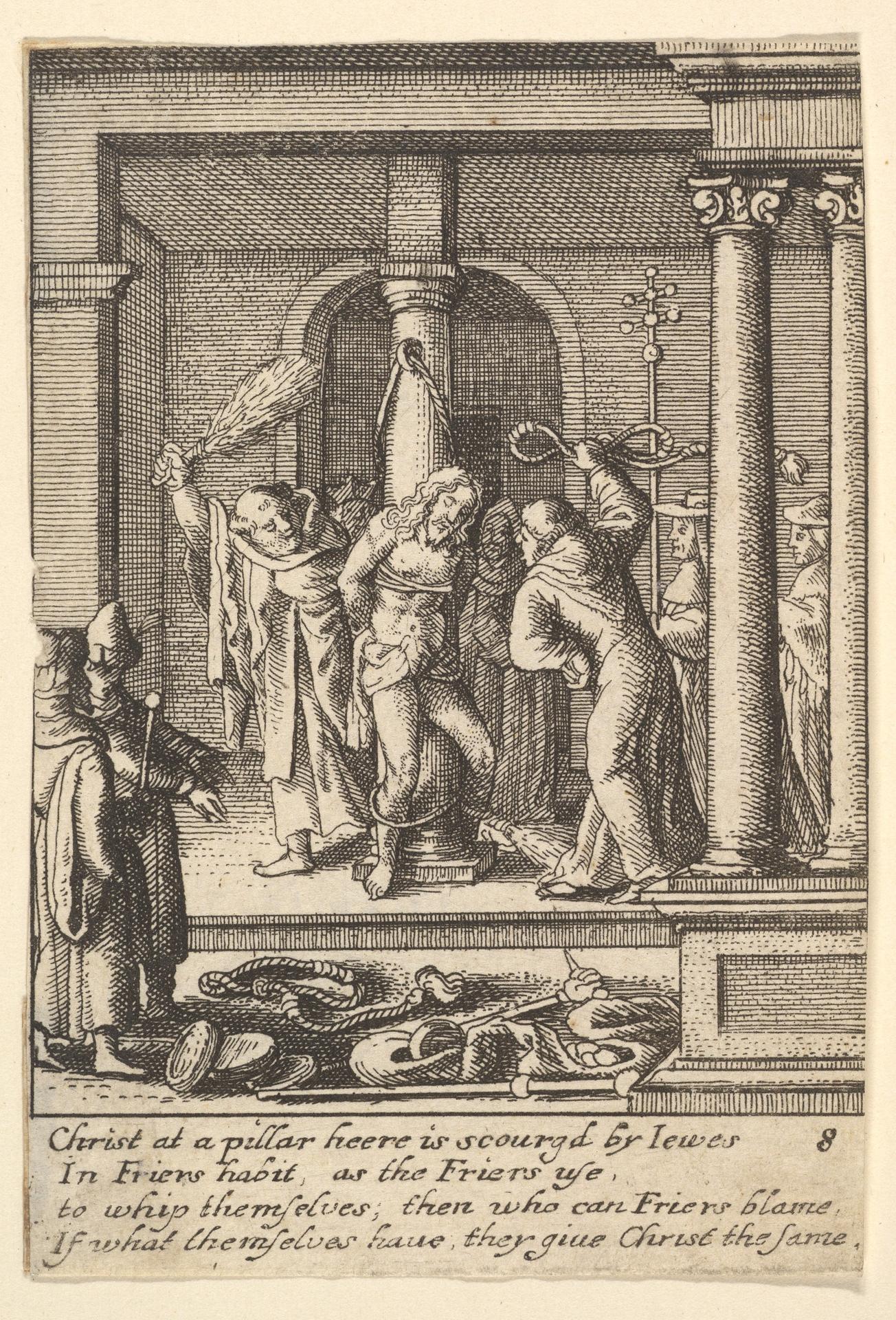
The Scourging
Original title: The scourging
kurzbeschreibung
Wenceslaus Hollar's etching The Flagellation (1644–52) relocates the biblical moment of suffering to an interior. Finely drawn lines and precisely placed hatching give the event a clear structure despite its violence, and the calm execution draws the viewer's eye across the sheet.
Description
Christ stands at the center, bound to a pillar, while several men strike him with whips. He is barefoot and simply dressed; columns and an arch suggest a temple-like setting. Whips and other instruments of torture lie scattered on the ground, and a man in a robe watches from the left. Beneath the scene, a text panel explains the action.
Context
This etching dates from the years of the Thirty Years' War, when Hollar was working in England and on the Continent. It belongs to a Passion series that the artist produced after his own designs or after models by other masters. Hollar was widely known for his detailed prints, which appealed to collectors and art lovers.
Impact
From the first glance, the calm linework and even hatching guide the viewer's gaze, so that the violent subject appears detached and almost still. Attention falls less on the immediate horror than on the symbolic meaning of the event.
Technique
The sheet is an etching in the only state, meaning that only one printing state exists. The process allows for fine lines and subtle gradations of gray produced by biting the plate with acid. This small-format print shows Hollar's characteristic precision in detail.
AI-generated description text
Source: Metropolitan Museum of Art · Public Domain (CC0 1.0)