Jesus before Caiaphas
Original title: Jesus before Caiaphas
kurzbeschreibung
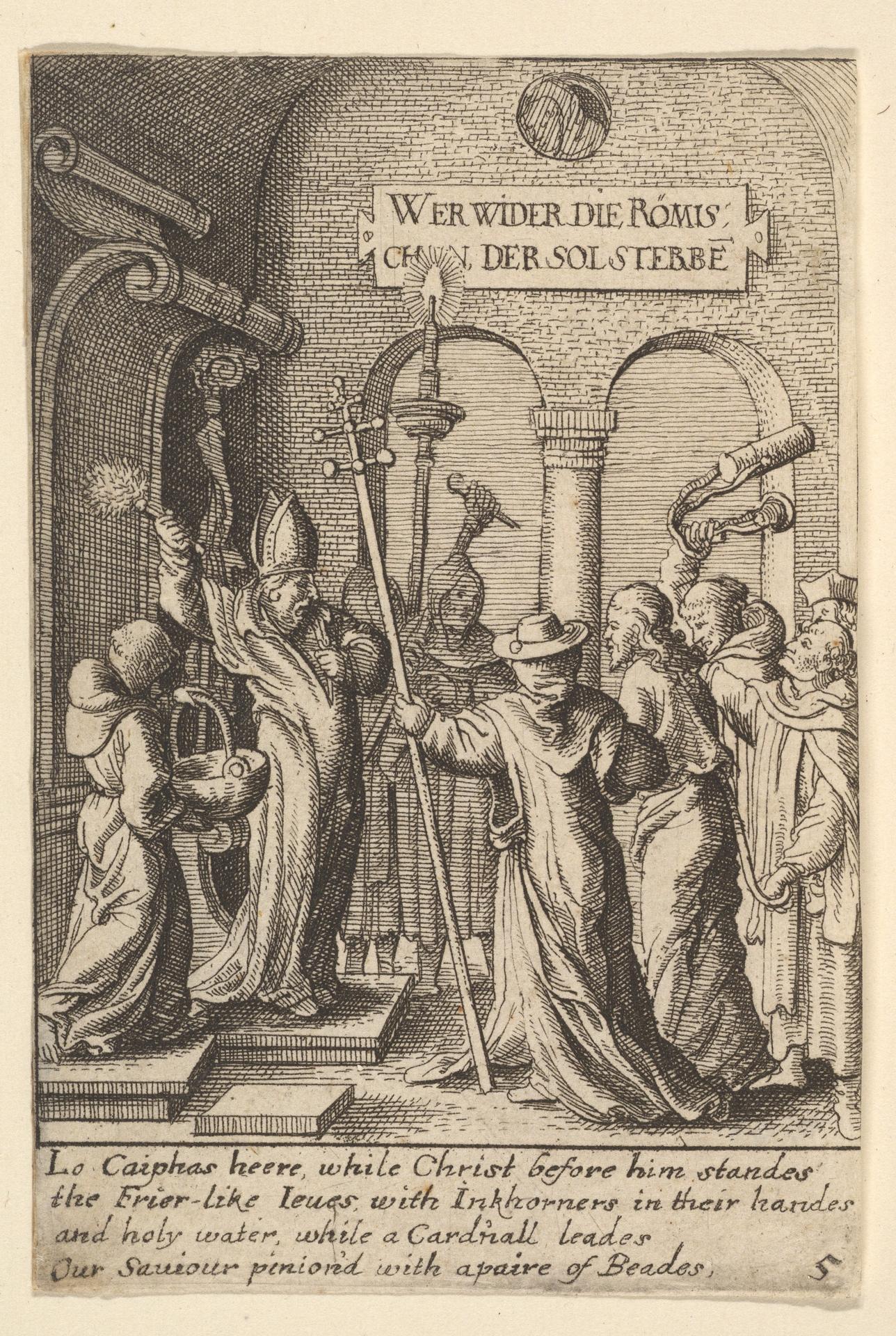
Unlike standard Passion scenes, this small upright print by Wenceslaus Hollar (1644–52) places the captive Jesus at the centre of a circle of ecclesiastical officials. A monk, a cardinal and a bishop appear as figures surrounding the high priest Caiaphas. The sheet belongs to a series of biblical subjects and ties the narrative to a clearly confessional agenda.
Description
A symmetrical layout sets Jesus in the middle, flanked by several figures. In front, a monk-like figure holds a horn and a flask; a figure marked as a cardinal carries a cross and chain. Further back stands a bishop-like figure, likewise with horn and flask. The setting is an interior with columns and an arch, above which hangs a sign bearing the words 'WER WIDER DIE ROMISCHEN SOL STEBBE'. Fine hatching shapes the monochrome image, and a Latin text closes it at the bottom.
Context
Hollar was working in England between 1644 and 1652, when this etching was made. Europe was marked by the Thirty Years' War, England by civil war, and religious divisions shaped daily life. The Prague-born artist was known for detailed prints on biblical and historical subjects. The inscription on the sign points to a confessional dispute that reads against the backdrop of Catholic-Protestant tensions.
Impact
Clearly structured and drawn with great care in its linework, the small sheet feels precise and dense. The officials with their attributes give the scene something ceremonial and at the same time distant. The inscription and the Latin accompanying text lend the image a didactic streak and invite reflection on what is shown.
Technique
Executed as an etching in its only state and printed on paper. In this process fine, exact lines are bitten into a metal plate and then transferred to the paper. The hatching and linework match Hollar's working method and demonstrate his assurance in printmaking.
AI-generated description text
Source: Metropolitan Museum of Art · Public Domain (CC0 1.0)