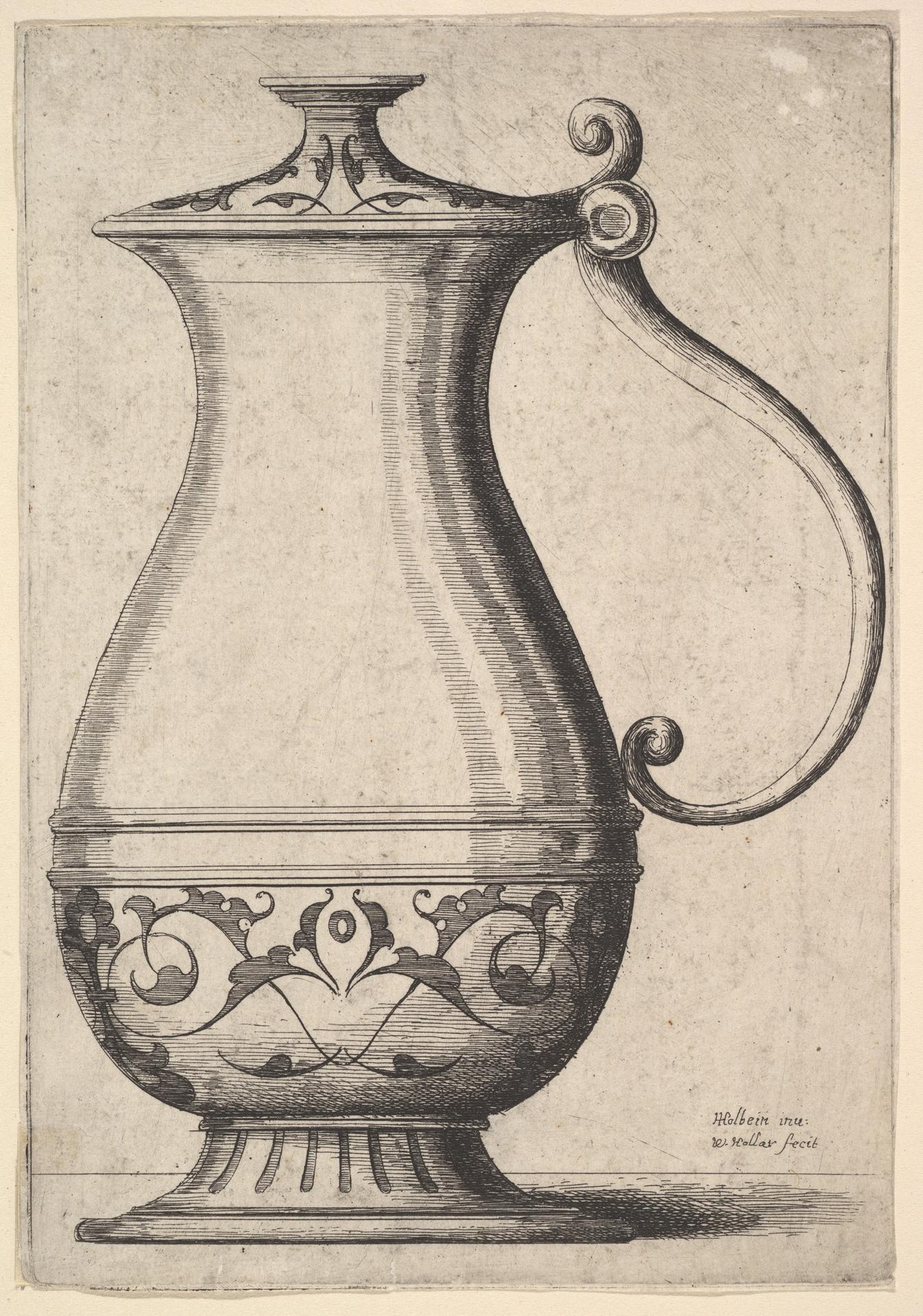
Jug with arabesques on the base
Original title: Jug with arabesques on the base
kurzbeschreibung
This 1645 etching by Wenceslaus Hollar presents an ornate jug adorned with arabesque patterns. Its balanced, symmetrical design places it among the careful prints of the Bohemian artist.
Description
At the centre stands a slender, cylindrical jug, its broad handle curving upward. Complex arabesques of floral and geometric motifs unfold along the upper and lower edges. The layout is strictly symmetrical, with no other figures or objects. Even light, without visible shadows, and the black-and-white rendering define the view.
Context
Wenceslaus Hollar, a printmaker from Prague, was known in the 17th century for his detailed etchings. He worked in England and on the European continent, where his precise reproductions of artworks and everyday objects were valued. This print was made in 1645, when Hollar was deeply engaged with ornamental studies and decorative art.
Impact
Clear lines and finely worked arabesques give the image a calm, symmetrical presence. The precision and ornamental richness invite close looking without making the arrangement feel overcrowded.
Technique
The etching exists in a single state and was printed on paper. This technique allows fine lines and precise hatching, which were used for the ornamental details. The plate measures 16.4 × 11.3 cm, the sheet 16.6 × 11.4 cm—barely larger.
AI-generated description text
Source: Metropolitan Museum of Art · Public Domain (CC0 1.0)