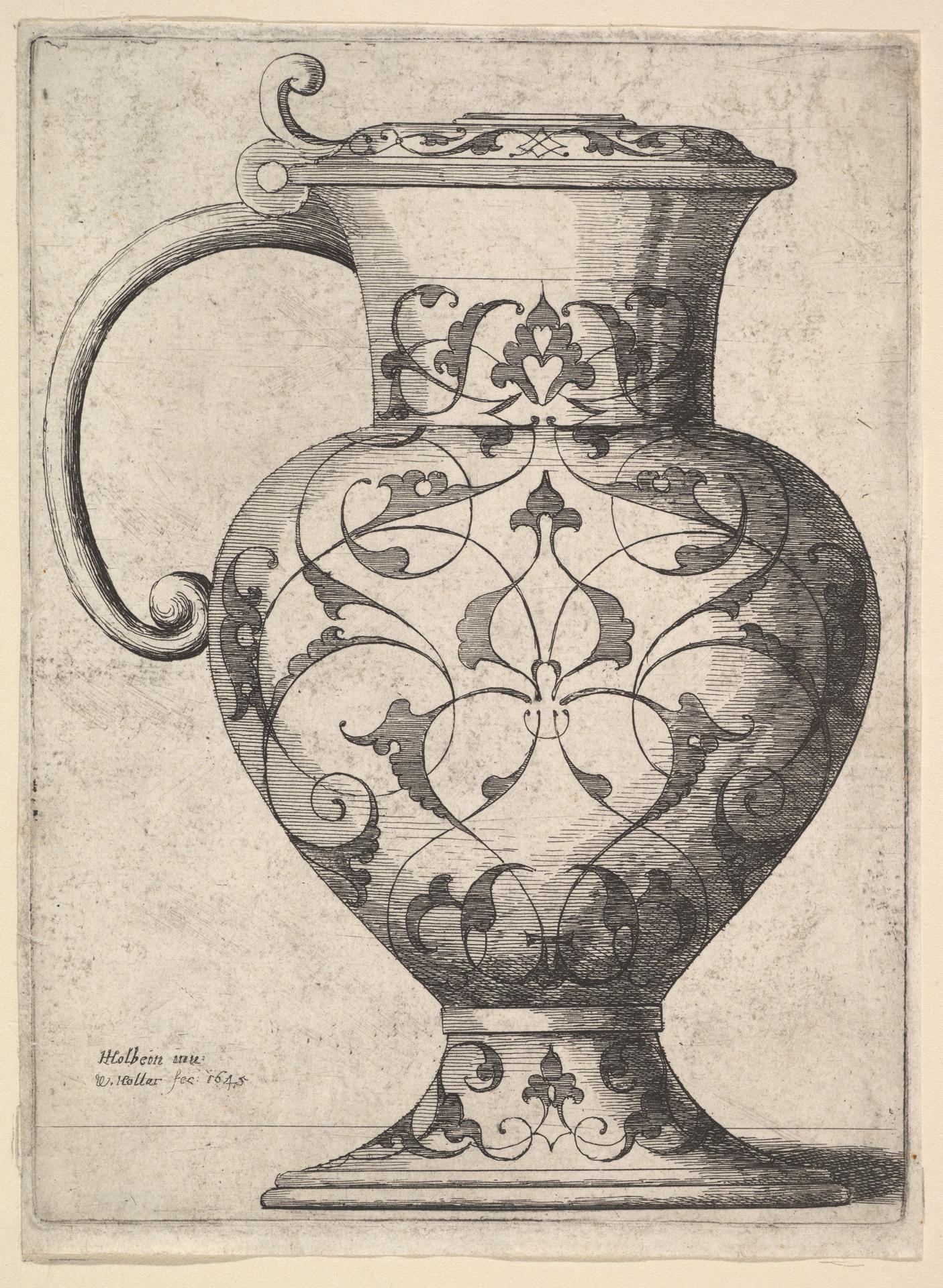
Jug decorated with arabesques
Original title: Jug decorated with arabesques
kurzbeschreibung
Dated 1645, Wenceslaus Hollar's etching shows a richly ornamented jug with a tall, curved handle. The print exists in a single state and measures 15.5 × 11.4 cm at the plate.
Description
A jug with a wide, sweeping handle fills the image; its entire body is covered in a regular pattern of foliage, tendrils, and blossoms. The handle, too, carries ornament that continues onto the upper part of the vessel. The jug rests on a broad, flat, and similarly decorated base. Variations in line depth create sculptural gradations in the monochrome print. At the bottom appear the signature “Halsbein” and the year 1645.
Context
Hollar (1607–1677), a Bohemian draughtsman and etcher, worked mainly in England and Antwerp; in 1645, the year this sheet was made, he was in Antwerp. Ornament studies of this kind often served craftsmen as models, but could also stand alone as ornament prints. Hollar was known as a reliable technician who could capture a wide range of subjects.
Impact
The evenly arranged, finely articulated ornament gives the vessel an almost jewel-like character. Crisp lines convey calm and let the eye linger on the virtuosity of the drawing.
Technique
The sheet was produced as an etching: the lines were incised into a metal plate and then bitten with acid. Differences in line depth yield fine tonal gradations in the printed image. Only one state of the work exists, suggesting careful execution and a limited edition.
AI-generated description text
Source: Metropolitan Museum of Art · Public Domain (CC0 1.0)