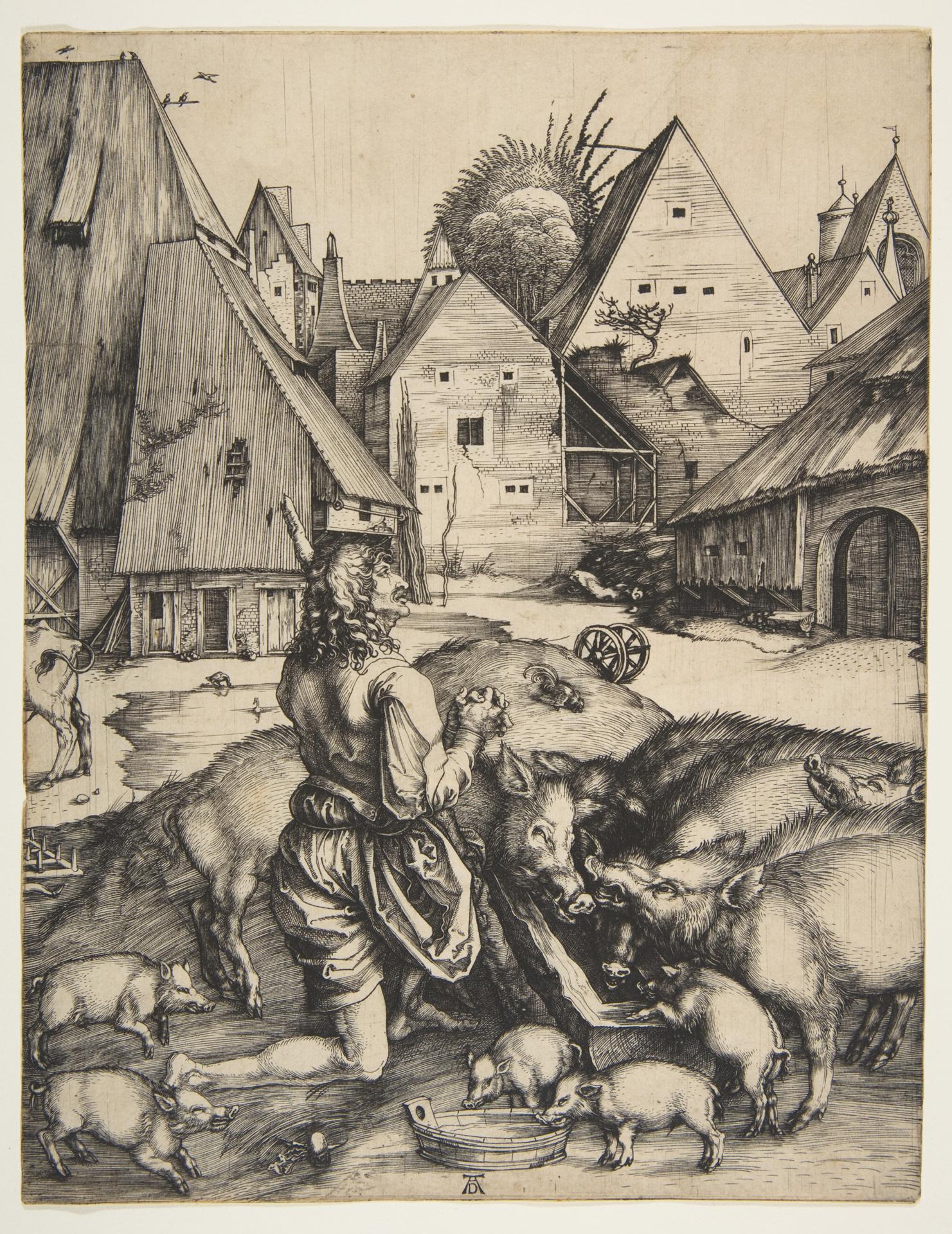
The Prodigal Son
Original title: The Prodigal Son
kurzbeschreibung
The Prodigal Son, an engraving by Albrecht Dürer dating to around 1496, depicts the biblical parable of the prodigal son in a rural setting. The scene shows the repentant son among swine, a moment of humility and realization. Dürer's intricate engraving technique captures both the human figure and the surrounding farmyard with remarkable detail.
Description
In the foreground, a young man in simple clothing kneels among a group of pigs, one hand holding a handkerchief to his face. The pigs are shown in various poses, with some drinking from a trough. Behind them, a large thatched-roof farmhouse rises, partially obscured by a tall plant. A path leads through the yard, where additional figures and animals, including a horse and more pigs, are visible. The composition is horizontally arranged, with the protagonist centrally placed, and the lighting is even, without strong shadows, typical of engravings.
Context
Dürer created this engraving during his early years as a printmaker, shortly after his return from his journeyman travels to Italy, where he had absorbed Renaissance ideas. The subject of the prodigal son was a popular moralizing theme in Northern European art of the period, reflecting contemporary religious and social concerns. The work is one of several engravings from this period that showcase Dürer's growing mastery of the medium.
Impact
The engraving draws the viewer's eye to the emotional core of the prodigal son's despair, set against a meticulously detailed rural backdrop. The contrast between the young man's inner turmoil and the peaceful farmyard creates a poignant tension. Dürer's precise lines and careful composition invite close inspection, revealing the narrative's moral depth.
Technique
Dürer used engraving, a technique that involves cutting lines into a metal plate with a burin, to create this print. The fine, cross-hatched lines produce subtle tonal variations and detailed textures, particularly in the rendering of the pigs' bristly coats and the foliage. The even lighting and lack of strong contrast are characteristic of Dürer's early engraving style, which prioritized clarity and precision.
AI-generated description text
Source: Metropolitan Museum of Art · Public domain (CC0)