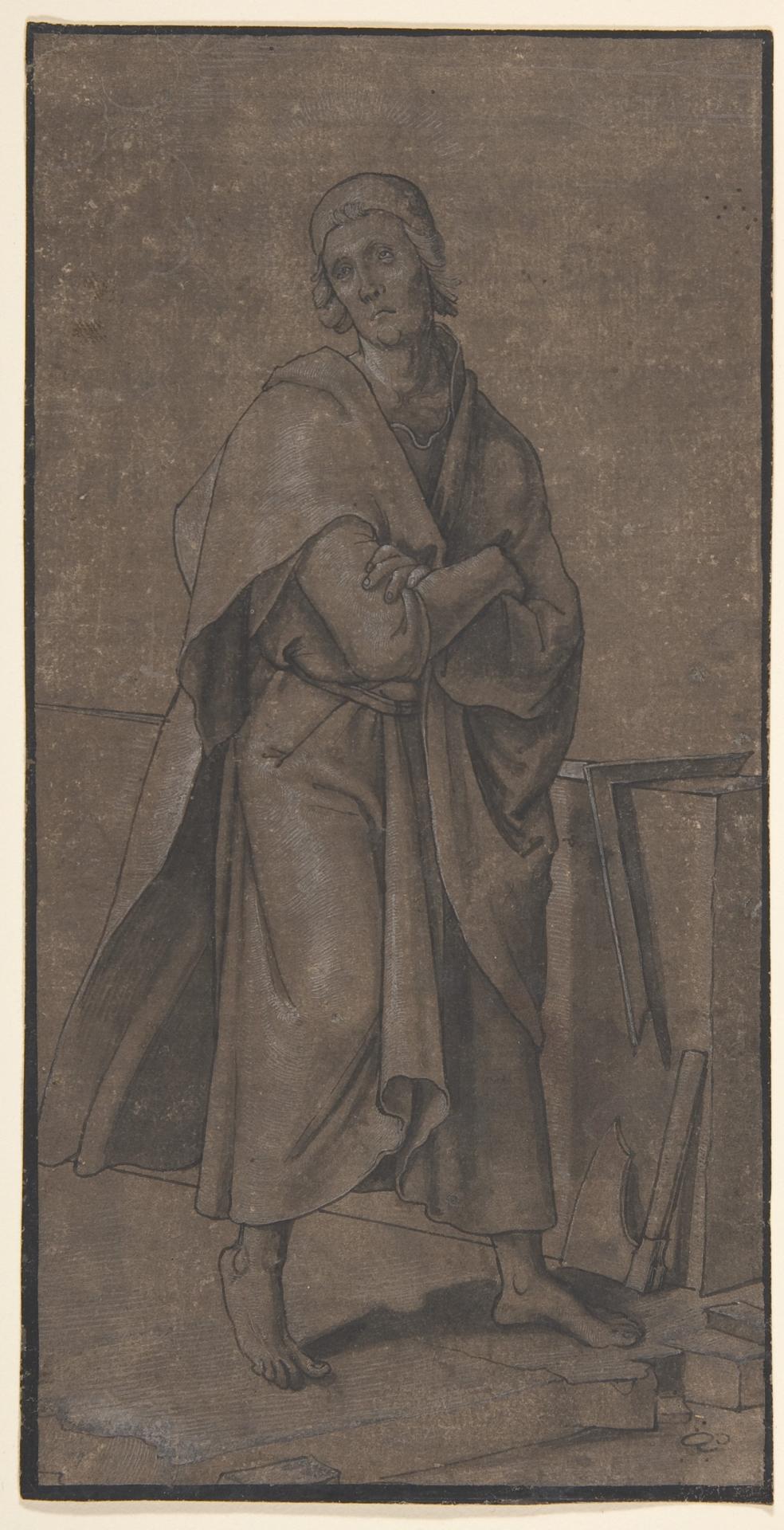
Saint Thomas (1527)
Original title: Saint Thomas
kurzbeschreibung
Hans Holbein the Younger drew Saint Thomas in 1527: a man standing upright in a plain robe. The sheet is worked on paper with pen and black ink, then extended with brush and gray wash and with white gouache for the highlights.
Description
Saint Thomas stands upright, his head turned slightly to the left, his hands folded before his body. A head covering sits over the long-sleeved robe; the legs are slightly bent and the feet stay bare. At the edge of the sheet, pieces of wood and part of a piece of furniture are suggested. Gray tones govern the image, lightened by white accents; the figure fills most of the surface, the arrangement feels balanced, and the light falls evenly across the form.
Context
Holbein drew this sheet in Basel in 1527, before he moved to England. It was probably intended as a model for a larger painting or a print, perhaps in connection with an altarpiece project. The artist was known for his carefully observed portraits and religious pictures, shaped by close attention to nature.
Impact
Quiet comes off the sheet: the balanced arrangement and the evenly spread light give it something contemplative. Because the color is limited to gray with white heightening, the figure gains a certain weight despite the small format.
Technique
Pen and black ink carry the lines, brush and gray wash lay in the shadows, white gouache sets the lights. Out of this interplay comes a fine modeling of the forms, which renders cloth and body in distinct ways.
AI-generated description text
Source: Metropolitan Museum of Art · Public Domain (CC0 1.0)