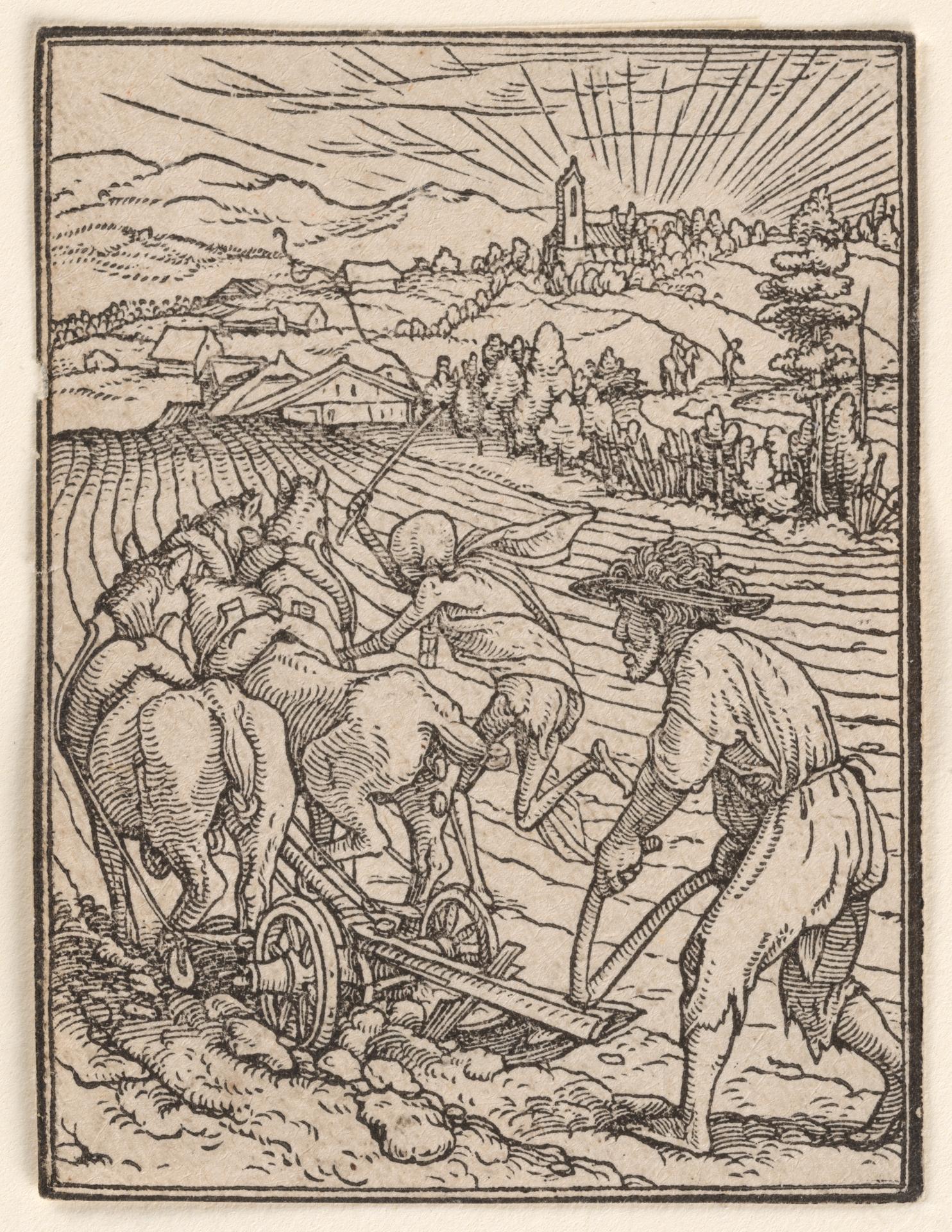
The Peasant (or Ploughman), from "The Dance of Death"
Original title: The Peasant (or Ploughman), from "The Dance of Death"
kurzbeschreibung
Hans Holbein the Younger made this woodcut around 1526; it first appeared in print in 1538. Part of the Dance of Death series, the sheet presents a bearded peasant at the plough, with a rural landscape opening behind him, village and church included.
Description
A bearded man drives the plough in the foreground, a horse hitched ahead of it carrying a second figure. Beyond the labour, rolling ground with trees spreads out, and a village and church can be made out. Sunlight breaks through at the upper right, its rays only hinted at. The arrangement runs across the sheet, drawing the eye from the tilled field toward the village in the distance.
Context
The Dance of Death series belongs to an age of religious tension and social change in Europe. Holbein was then working in Basel as a painter and printmaker. The blocks lay unused for several years before the first publication in Lyon in 1538. The peasant takes his place in a sequence where death treats every rank alike.
Impact
The print comes across as calm and grave, almost hushed. The sparing black and white and the clear lines give it something matter-of-fact, close to a record. A tension arises between the heavy field work and the peaceful surroundings, touching on the transience of all earthly things.
Technique
For printing, the design was cut into a woodblock and then pulled onto paper. Gradations of grey come from the depth and density of the lines. With fine parallel hatching Holbein worked out shadow and volume, as was usual in Renaissance printmaking.
AI-generated description text
Source: Metropolitan Museum of Art · Public Domain (CC0 1.0)