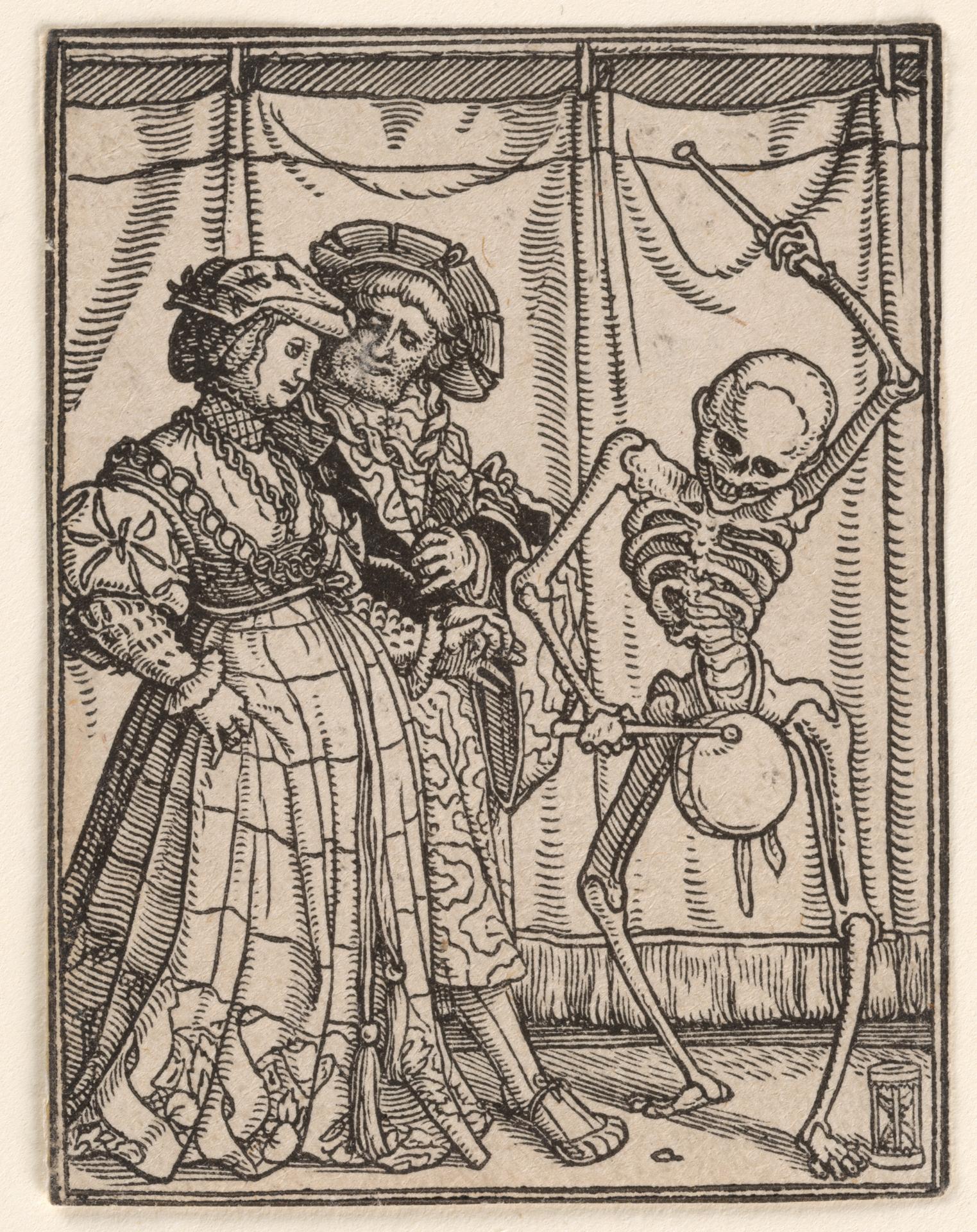
The Noblewoman, from 'The Dance of Death'
Original title: The Noblewoman, from "The Dance of Death"
kurzbeschreibung
Made around 1526 and published in 1538, this woodcut by Hans Holbein the Younger belongs to his Dance of Death cycle. It presents a noblewoman walking beside a skeleton that carries a spade and shovel. The sheet sets the transience of all earthly things before the viewer and takes its place in a series that gathers every rank of society.
Description
On the left stands a richly dressed noblewoman in an expensive gown, her head topped by an elaborate headdress. Facing her on the right, a skeleton holds a spade and shovel. Curtains frame the space, and in the lower right corner an hourglass points to time running out. The arrangement is balanced, with the two figures set in relation to each other. Sharp contrasts and delicate lines let the fabrics and small details stand out clearly.
Context
Created in an age of religious upheaval, the Dance of Death cycle stresses the fleeting nature of life and the equality of all people before death — a concern of the Reformation movement. Holbein worked on these woodcuts during his first stay in Basel; they appeared in Lyon in 1538. The sheet of the noblewoman forms part of a series that parades every level of society, from the pope down to the peasant. Holbein's Dance of Death became one of the most influential picture cycles of the Renaissance and left a lasting mark on the iconography of the theme.
Impact
The elegant lady faced with the bare skeleton reads as a forceful reminder of mortality, and the carefully rendered clothing only heightens that effect. Clear lines and a balanced layout give this small sheet a remarkable presence and dignity.
Technique
For the woodcut the design was cut into a wooden block and afterwards printed onto paper. Precise contrasts and fine lines attest to Holbein's assured command of the process, which allowed fabrics and facial features to be reproduced in faithful detail.
AI-generated description text
Source: Metropolitan Museum of Art · Public Domain (CC0 1.0)