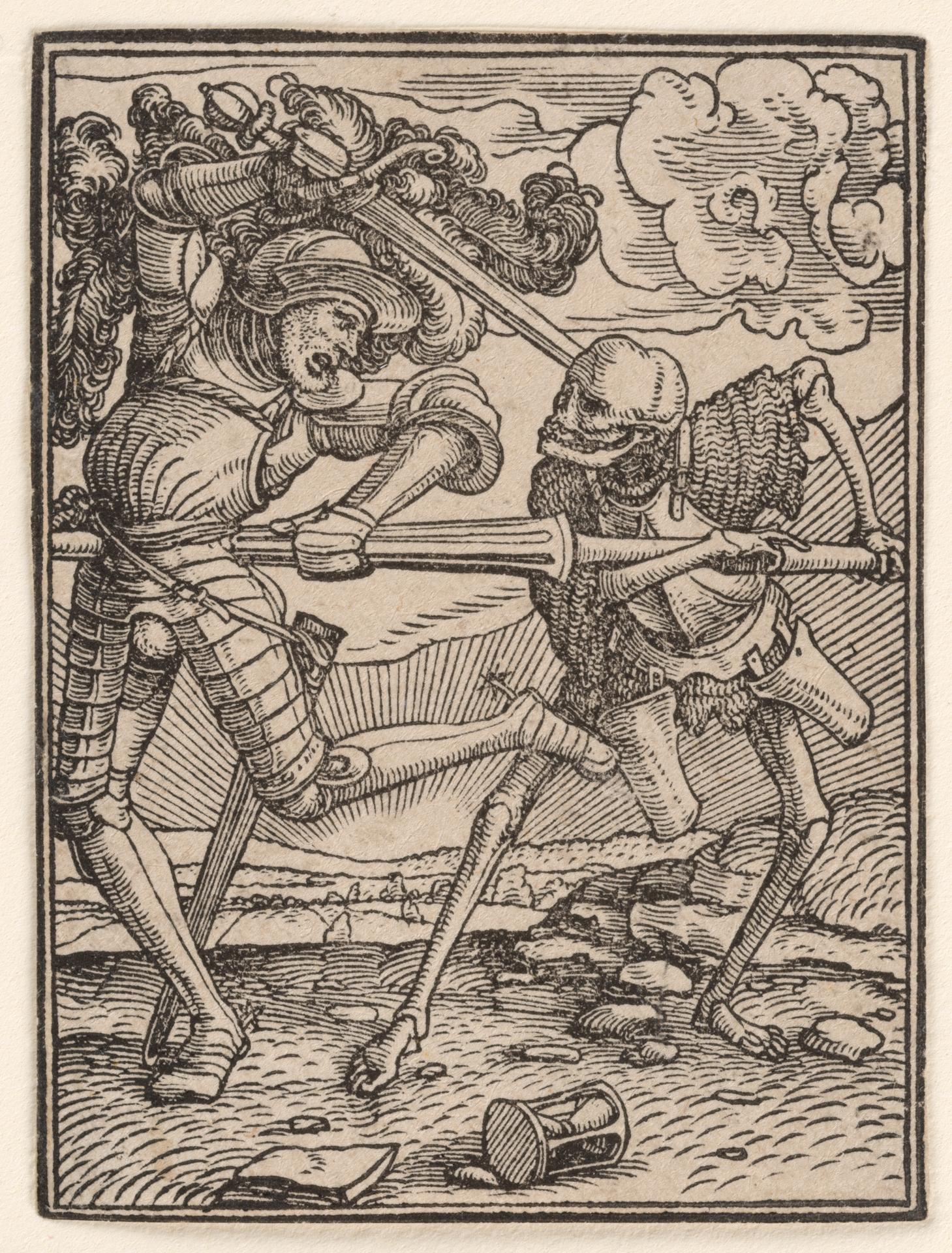
The Knight, from "The Dance of Death"
Original title: The Knight, from "The Dance of Death"
kurzbeschreibung
Two armored figures face each other in combat; one of them embodies Death, who catches the knight in the midst of battle. This print belongs to Hans Holbein the Younger's Dance of Death series, created around 1526 and first published in 1538.
Description
On the left, a fighter with lance extended; on the right, his opponent with shield and lance. Both armors are covered with interlace and ornament, and the right helmet bears a feather. The ground remains bare, showing clouds, and broken pieces lie on the ground, likely remains of vessels. The layout feels balanced, the coloring monochrome, and the light falls evenly, revealing no shadows.
Context
In the 1520s, when religious upheavals and social tensions shaped the era, Holbein created the Dance of Death series. First published in Lyon in 1538, the woodcuts quickly spread widely. Like every estate, the knight—a representative of his class—is surprised by Death, a common motif of the late medieval Dance of Death tradition.
Impact
The richly decorated armors and the symmetrical arrangement give the print a solemn, almost theatrical note. By having Death overtake the knight in battle, the scene conveys a poignant reminder of mortality, emphasized further by the stark surroundings.
Technique
Woodcut is a relief printing process: the design is cut into a woodblock and then printed on paper. Holbein used delicate lines and hatching to bring out details of the armors and surfaces—an approach characteristic of Renaissance printmaking.
AI-generated description text
Source: Metropolitan Museum of Art · Public Domain (CC0 1.0)