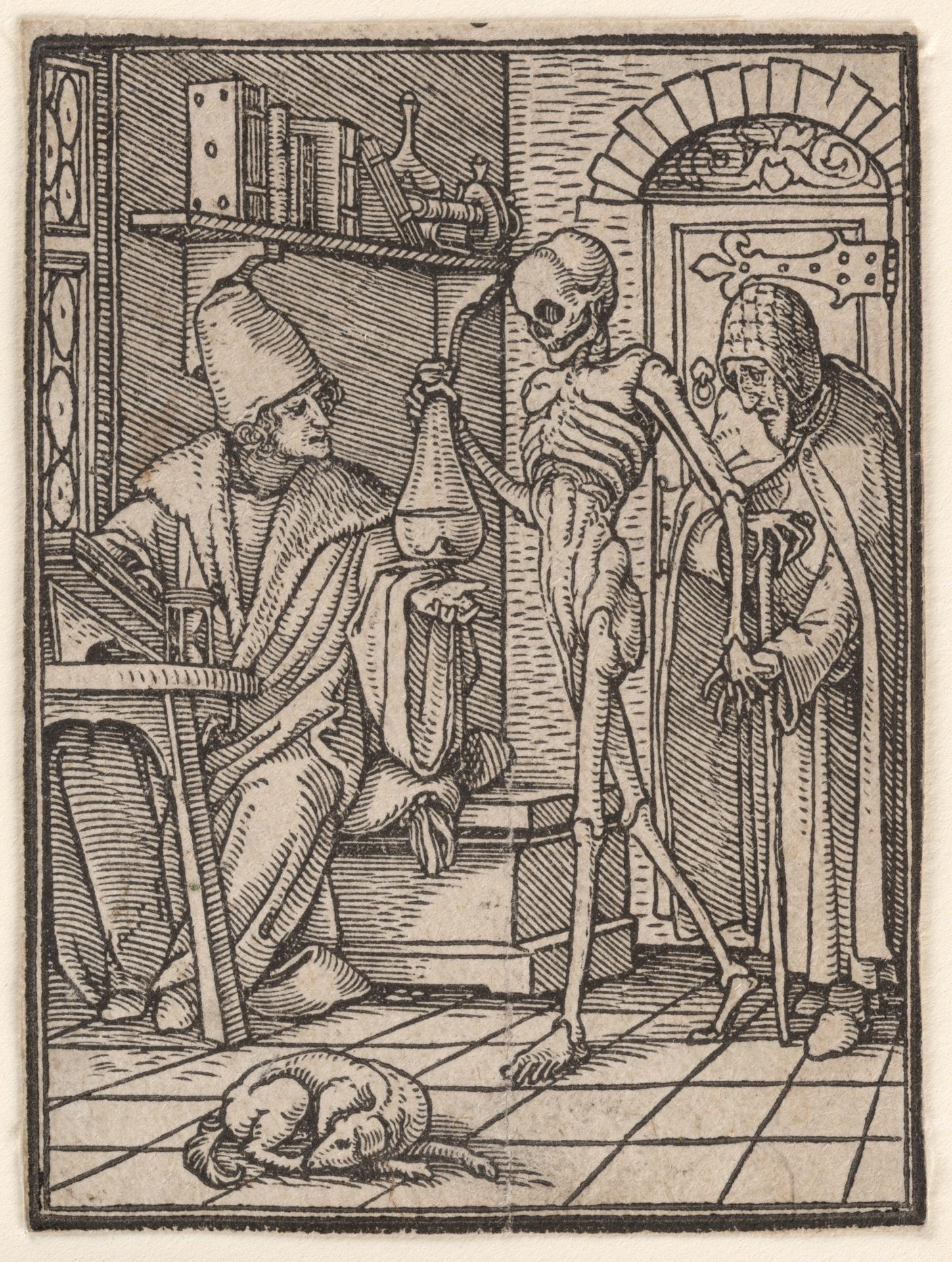
The Doctor (or Physician), from "The Dance of Death"
Original title: The Doctor (or Physician), from "The Dance of Death"
kurzbeschreibung
Hans Holbein the Younger cut this woodcut around 1526 for his series 'The Dance of Death'; it first appeared in print in 1538. An elderly physician sits in his study while a skeleton steps up to him. The sheet joins the vanitas tradition to a sharp critique of the medical profession.
Description
In the foreground a skeleton holds out a flask and turns toward a bearded man in a long robe, seated on a chair with a watch in his hand. The man, evidently a doctor or scholar, leans on a crutch. Behind him stand a bookcase, a globe and other objects; a dog lies at the bottom. Crisp outlines and hard contrasts set the figures off against the room.
Context
The woodcut series 'The Dance of Death' was made in Basel around 1526, where Holbein worked during the Reformation. It was first published in Lyon in 1538 and spread widely from there. The series draws on the late medieval tradition of the danse macabre, which stresses that all estates are equal before death, and satirically targets the failings of the age, above all the vanity of scholars and physicians.
Impact
An uneasy tension builds between the doctor's quiet scholarly world and the nearness of death. The precise arrangement and delicate lines draw the eye to this meeting of life and mortality and leave a pensive mood.
Technique
For this print the design was cut into a wooden block and then printed on paper. With parallel hatching Holbein achieved fine detail and shading, as is typical of his graphic work.
AI-generated description text
Source: Metropolitan Museum of Art · Public Domain (CC0 1.0)