Anamorphic Drawing of a Stag
Original title: Anamorphic Drawing of a Stag
kurzbeschreibung
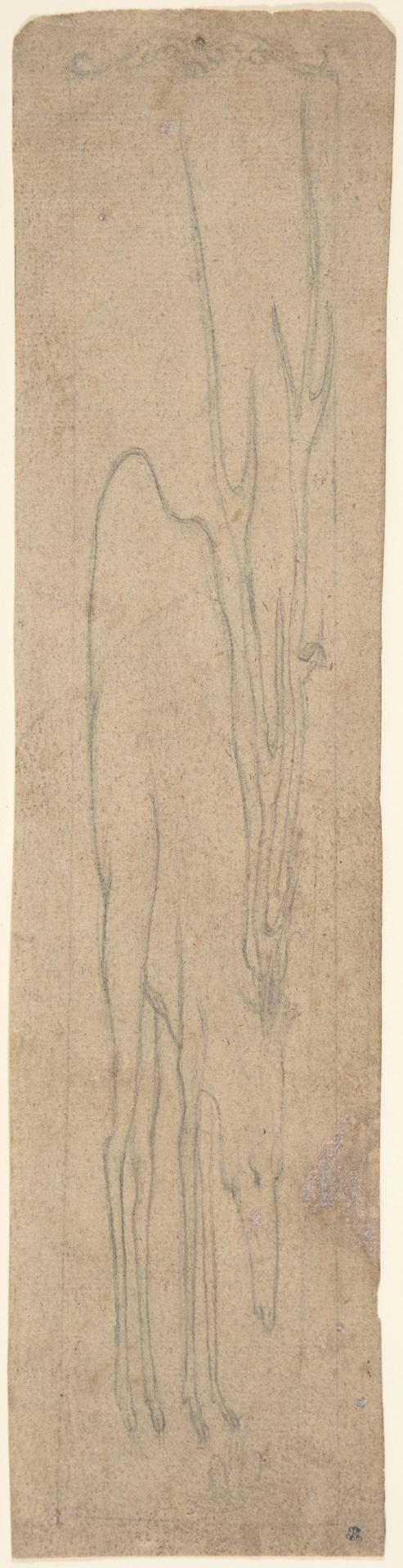
An unknown German draughtsman of the sixteenth century set down a stag here in anamorphic distortion. The sheet is drawn in black chalk on light-brown paper and measures 31.7 x 7.7 cm. It shows a stag in profile with branching antlers, a shape that only resolves into a recognisable animal when seen from a particular angle.
Description
A stylised stag stands in profile, head and body tilted slightly to the left. The long, forked antlers are pushed forward and read almost as an ornament. Thin, flowing lines run through the sheet and give it the feel of a technical sketch. There is no background and no other object; only the black chalk on the light-brown, faintly patinated paper.
Context
Anamorphic pictures were widely enjoyed in the Renaissance and the sixteenth century, since they joined mathematical precision to artistic play. Such works often entered princely cabinets of art and curiosities as oddities. This sheet comes from the German-speaking lands, though nothing is recorded about what it was made for. Black chalk was then a common medium for studies and drafts.
Impact
The distortion sets up a tension between abstract line and legible subject, prompting the viewer to hunt for the right viewing angle. For all the estrangement, the stag's slender, nearly elegant body stays graceful and precise. The restriction to line and the warm tone of the paper gives the sheet a quiet, concentrated presence.
Technique
The drawing was made in black chalk on light-brown paper, a typical drawing material of the sixteenth century. The thin, flowing lines suggest a careful and controlled handling of the chalk. The anamorphosis required a precise geometrical construction, which the drawing carries out technically.
AI-generated description text
Source: Metropolitan Museum of Art · Public Domain (CC0 1.0)