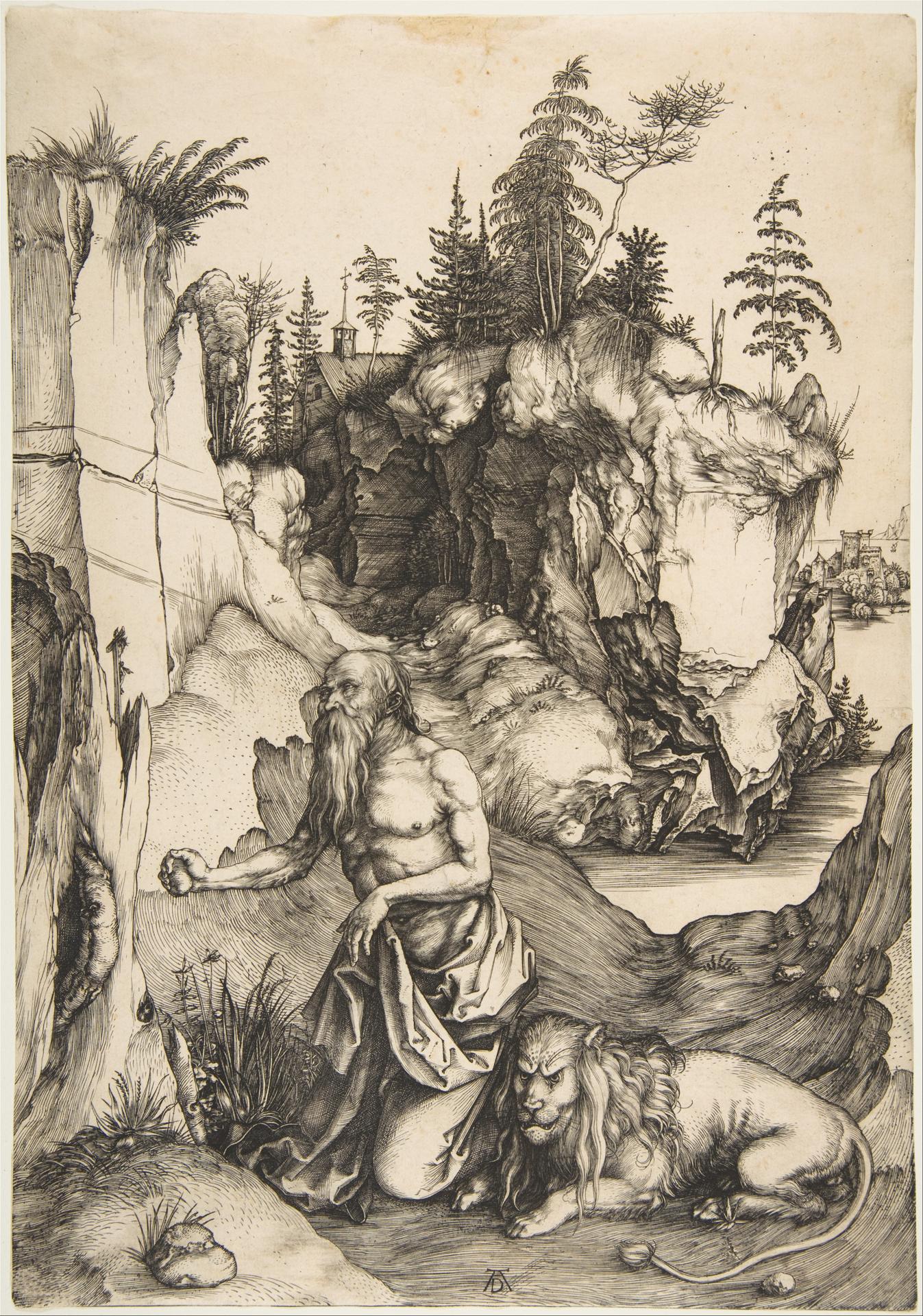
Saint Jerome Penitent in the Wilderness
Original title: Saint Jerome Penitent in the Wilderness
kurzbeschreibung
Albrecht Dürer's engraving, created around 1496, depicts Saint Jerome in penitence in the wilderness. The saint sits on a rock, barefoot and clad in a simple tunic, gazing thoughtfully into the distance. The composition includes a lion resting beside him and a detailed landscape background.
Description
The engraving shows Saint Jerome seated on a rocky outcrop, his bare feet and loose, shoulder-baring tunic emphasizing his ascetic life. He looks away with a contemplative expression, his long white hair and stubbly beard suggesting age and hardship. A lion lies calmly on the ground to his right, a traditional companion in depictions of the saint. The background features rocky terrain, trees, a small chapel, and a distant village, all rendered in fine detail. The light falls evenly from above, creating soft tonal gradations across the scene without dramatic shadows.
Context
This work dates from Dürer's early career, around 1496, a period when he was establishing himself as a master printmaker in Nuremberg. Saint Jerome was a popular subject in Northern Renaissance art, often associated with scholarly and penitential themes. Dürer's engraving reflects the influence of Italian art, which he had encountered during his first trip to Italy (1494–1495), particularly in the landscape and the naturalistic rendering of the figure.
Impact
The image exudes a quiet, contemplative mood, drawing the viewer into the saint's solitary meditation. The meticulous detail and balanced composition invite close inspection, while the serene landscape and gentle light evoke a sense of spiritual peace. Dürer's technical mastery gives the scene a tangible, almost tangible texture, enhancing its emotional resonance.
Technique
This is an engraving, a technique in which the artist carves lines into a metal plate with a burin, then inks and prints the plate. Dürer's use of fine, cross-hatched lines creates subtle gradations of light and shadow, capturing the textures of rock, foliage, and fabric. The even lighting and lack of harsh contrast demonstrate his precise control over the burin, a hallmark of his early printmaking skill.
AI-generated description text
Source: Metropolitan Museum of Art · Public domain (CC0)