Print of Designs for a Pommel, Quillons, and Locket
Original title: Print of Designs for a Pommel, Quillons, and Locket
kurzbeschreibung
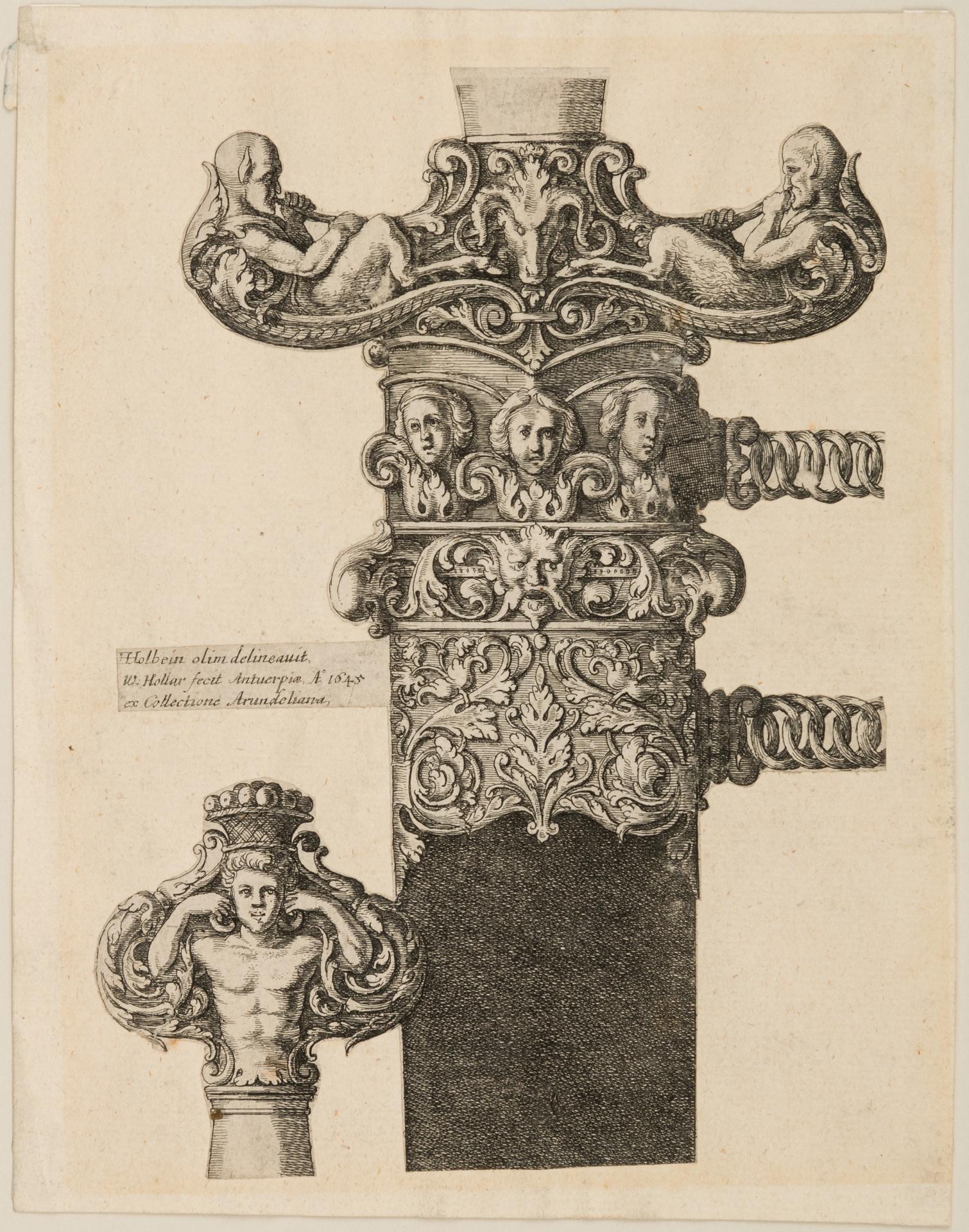
Hans Holbein the Younger drew these designs for a sword pommel, crossguards and an ornamental cap in 1645, using ink on paper. The sheet dates from the Renaissance and gathers several detail studies for weapon decoration on a single page.
Description
A central pommel packed with dense floral ornament draws the eye first; two figures in calm poses flank it. Below them runs a row of three faces woven into the pattern. The crossguards reaching out to either side also carry rich plant motifs. Near the bottom, a figure with outstretched arms holds a further element. The arrangement is symmetrical, and the drawing stays in monochrome greys.
Context
Holbein (1497/98–1543) was a leading painter and draughtsman of the Renaissance, known as court painter to Henry VIII of England. The date 1645 is puzzling, since the artist had already died in 1543 — perhaps a later copy or a print after his designs survives here. Sketches like these served goldsmiths and armourers as working models.
Impact
The eye is pulled toward the pommel that fills the sheet, then follows the side branches out to the accompanying figures. The even layout settles the gaze, while precise lines give the ornaments graphic sharpness. Despite the small format, the sheet unfolds a clear, almost constructive tension.
Technique
Ink on paper allows a fine, controlled line. The grey values come from varying ink density and hatching that suggests shadow and gives the sheet depth.
AI-generated description text
Source: Metropolitan Museum of Art · Public Domain (CC0 1.0)