Parable of the Good Shepherd
Original title: Parable of the Good Shepherd
kurzbeschreibung
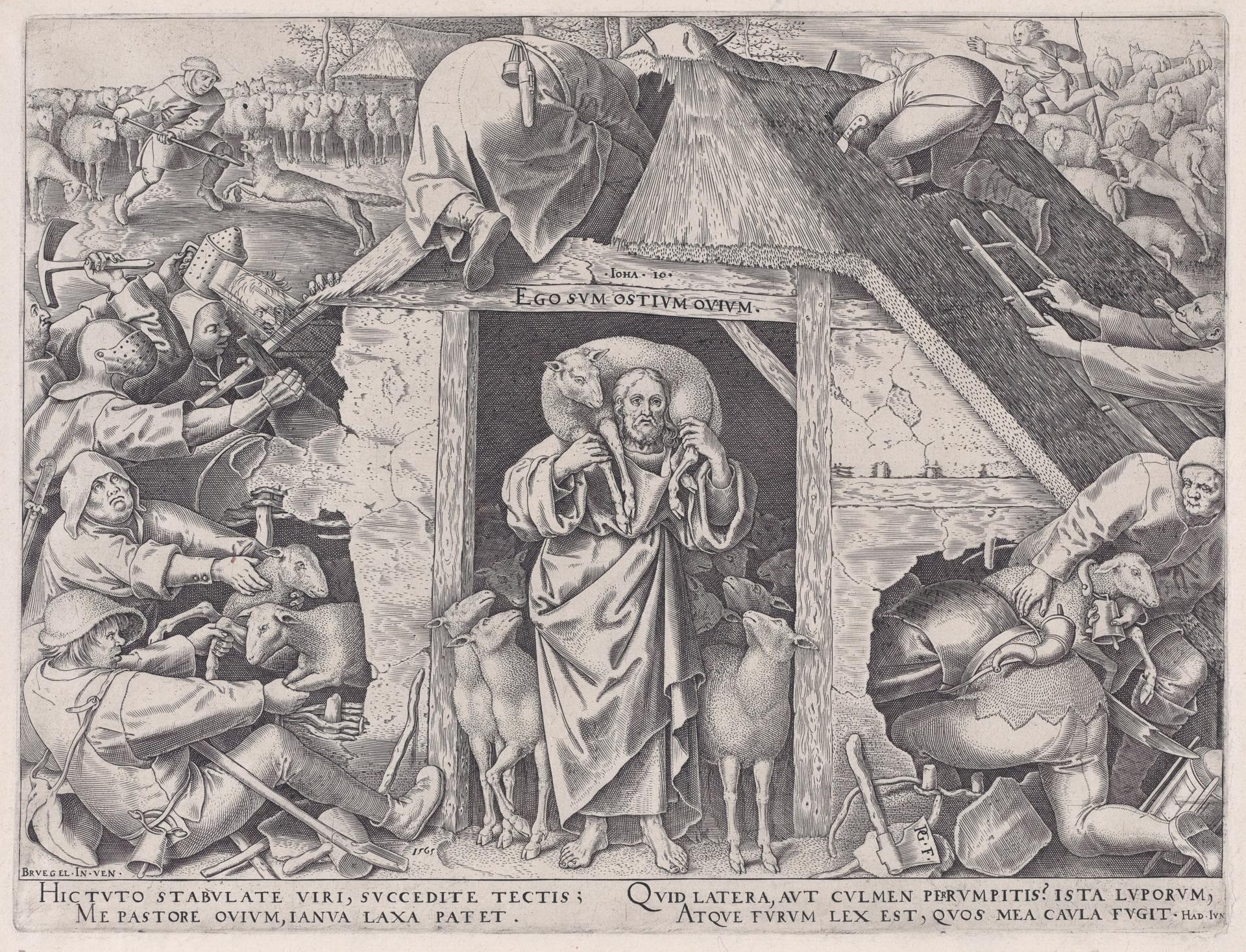
Unlike many contemporary prints of the parable, Philips Galle's 1565 engraving emphasizes the coexistence of everyday shepherding and the biblical word: Jesus Christ stands amid a flock of sheep and surrounding people in a rural setting.
Description
The layout is mirror-like: at the center, Jesus Christ, dressed in a robe, holds a sheep in each hand. A banderole above him bears the words 'EGO SUM OSTIVM OVIVM'. On both sides, people and sheep go about their tasks, herding and shearing. A richly articulated landscape with further figures and animals stretches into the distance. Latin texts along the bottom edge likely contain biblical passages or explanations.
Context
Philips Galle, a sixteenth-century Flemish engraver and publisher, is known for his reproductive prints after Renaissance designs. His sheet of 1565 falls into a period when biblical subjects were frequently taken up in printmaking. The parable of the Good Shepherd (John 10) illustrates Christ's care for the faithful and was a highly popular motif.
Impact
The mirror-like arrangement and evenly drawn lines give the print a calm balance. The precise portrayal of rural life lends the biblical theme a grounded, everyday quality that invites lingering before the image.
Technique
As an engraving, the sheet belongs to the intaglio processes: the lines are incised into a copper plate. The monochrome rendering with fine hatching creates a plastic effect and an even distribution of light characteristic of Renaissance printmaking.
AI-generated description text
Source: Metropolitan Museum of Art · Public Domain (CC0 1.0)