Festival of Fools
Original title: Festival of Fools
kurzbeschreibung
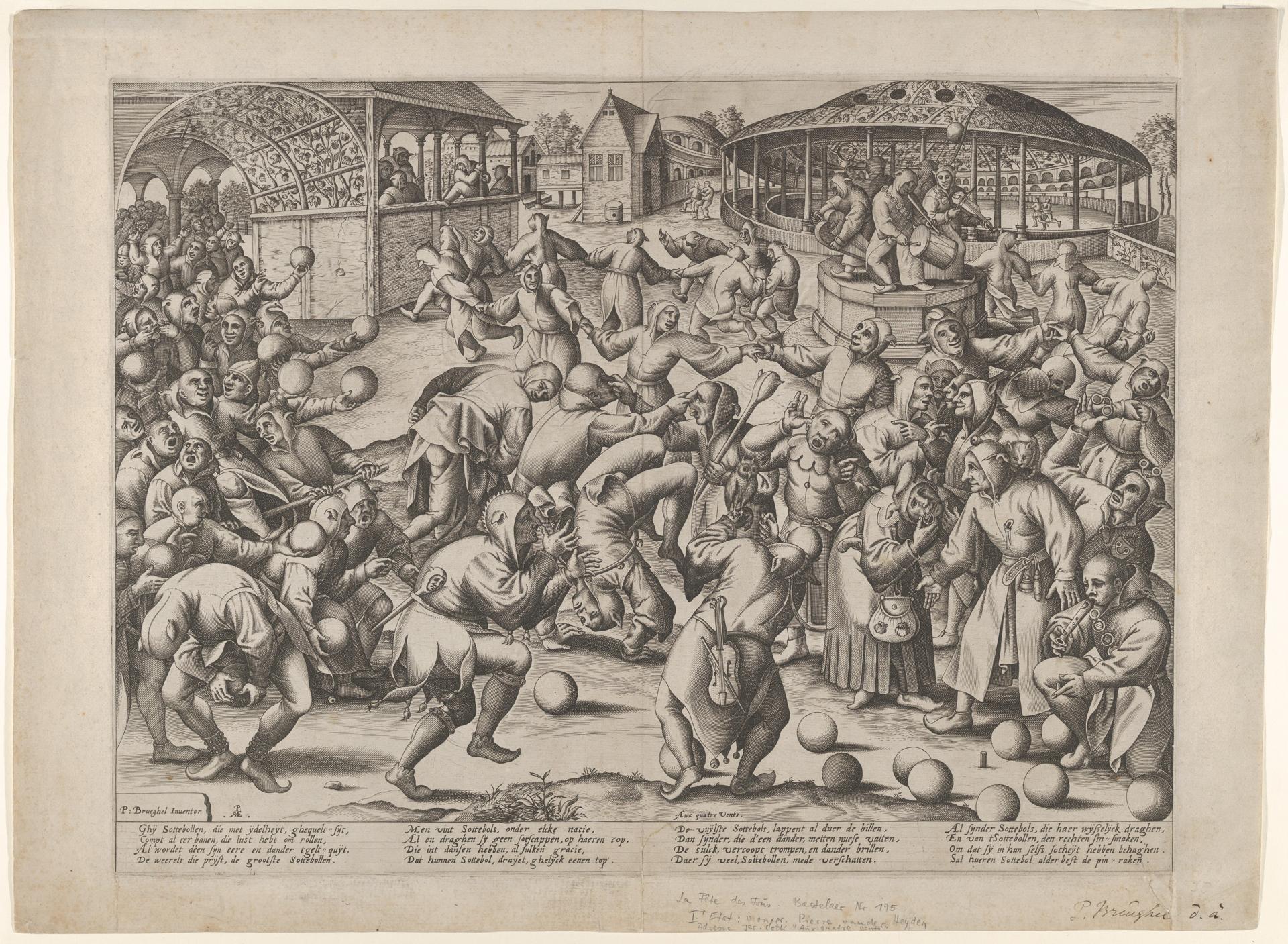
Pieter Bruegel the Elder's engraving Fest der Narren, made after 1570, presents a boisterous celebration with musicians, dancers and onlookers arranged in a symmetrical layout. This impression is the second state of three.
Description
Figures move through what appears to be a festival or game, some carrying balls in their hands. Up front, people in traditional garments dance or play. A stage with instrumentalists forms the backdrop, while spectators on the left watch the activity. The arrangement is symmetrical, with the stage as its focal point. Tones are muted and monochrome, as expected in an engraving. Light falls evenly, without strong shadows or highlights.
Context
After 1570 Bruegel turned increasingly to popular scenes and moralizing allegories. At the time the Netherlands were marked by political and religious unrest, which left its trace in his critical images of society. No commission is recorded; his prints were often circulated by publishers such as Hieronymus Cock, who valued moralizing subjects. The motif of fools draws on a widespread pictorial tradition dealing with human folly and vice.
Impact
The detailed, lively rendering creates a mood of exuberant festivity that draws the viewer into the action. The symmetrical layout gives the print a calm order that contrasts with the apparent disorder of the figures. Overall, the work reads as a moral lesson on the transience and folly of human pleasures.
Technique
Lines and hatching shape the figures and architecture, with tonal values arising from the density of the engraving. The image was incised into a copper plate and then printed on paper. The second state of three shows reworkings that increase the detail of figures and building. The monochrome reproduction and precise linework are characteristic of sixteenth-century printmaking.
AI-generated description text
Source: Metropolitan Museum of Art · Public Domain (CC0 1.0)