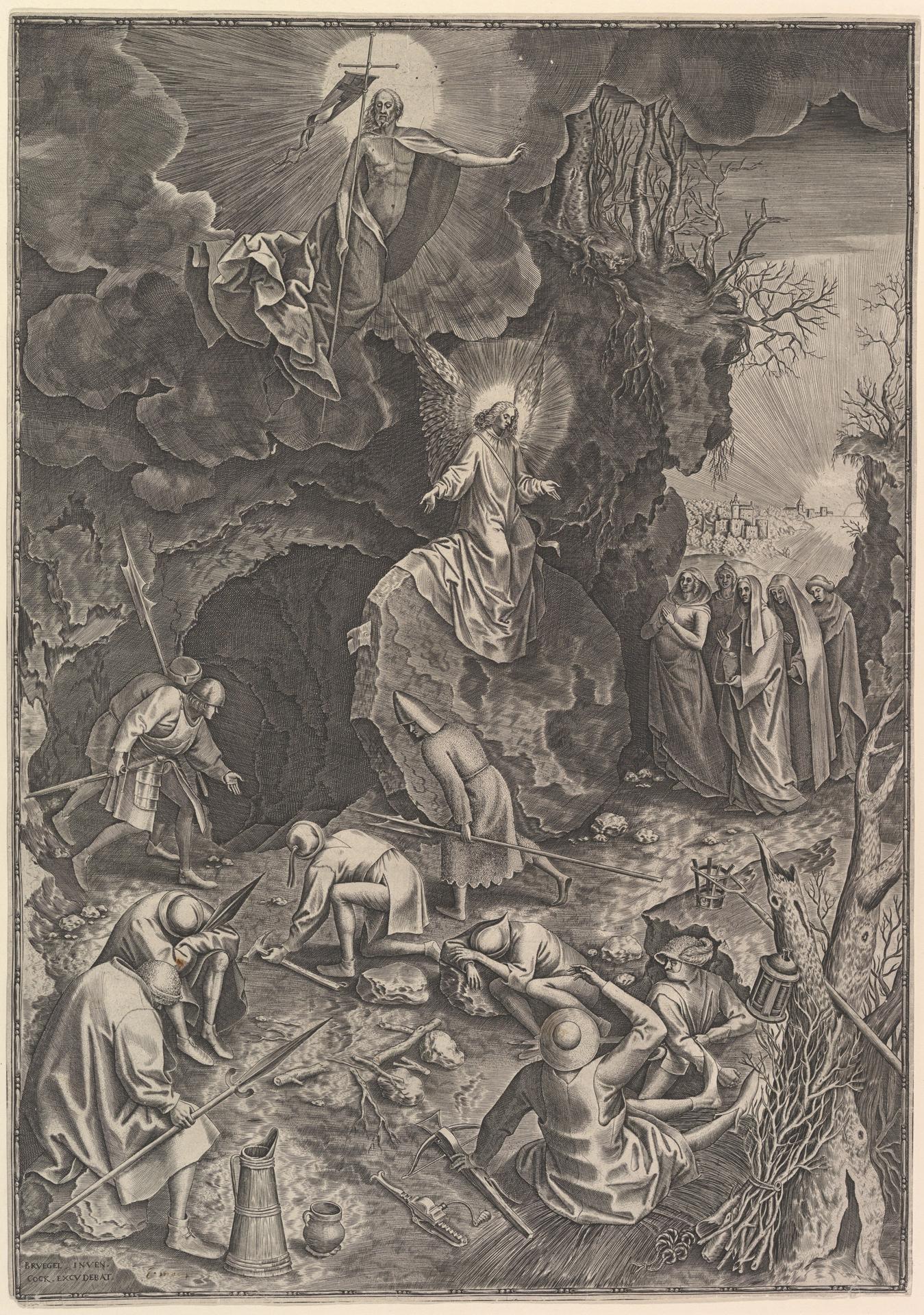
The Resurrection (ca. 1562–63, Met-Objekt 1970)
Original title: The Resurrection
kurzbeschreibung
Philips Galle's engraving The Resurrection, made around 1562–63, presents Christ's rising in a crowded scene. The sheet survives as the first of three states and was hand-coloured with gold, red, green, blue, yellow, brown and white.
Description
Christ stands triumphant at the centre, arms raised, against a radiant backdrop; a long robe wraps him and a golden sheen falls across his figure. Below, an angel in bright garments has spread its arms on a rock. In the foreground several figures appear in varied poses—some grieve and seem confused, others admire or marvel; a few hold tools or jugs. On a hill in the distance, more people watch the event. Dark greys and blacks dominate the sheet, while the hand-coloured areas in gold, red, green, blue, yellow, brown and white pick out individual passages.
Context
Philips Galle worked in the sixteenth century as a Flemish engraver and publisher in Antwerp. Religious printmaking was widespread in northern Europe at the time and served both devotion and the dissemination of art. The Resurrection scene follows the iconography of Catholic art that still prevailed in the Netherlands before the iconoclasm. The later colouring of prints was a common practice to enhance their value and impact.
Impact
From the dark ground, strong colour accents stand out and draw the eye deliberately to the central figures, reinforcing the sacred character. The monumental figure of Christ is set in tension with the detailed, agitated secondary figures, creating a dramatic effect. Triumph and human emotion flow into one another and engage the viewer emotionally.
Technique
In an engraving, the design is cut into a copper plate with a burin. This impression belongs to the first of three states and was afterwards hand-coloured with gold, red, green, blue, yellow, brown and white. The colouring was applied irregularly, accenting certain areas to emphasise light effects and symbolic meanings.
AI-generated description text
Source: Metropolitan Museum of Art · Public Domain (CC0 1.0)