The Promenade after Dürer
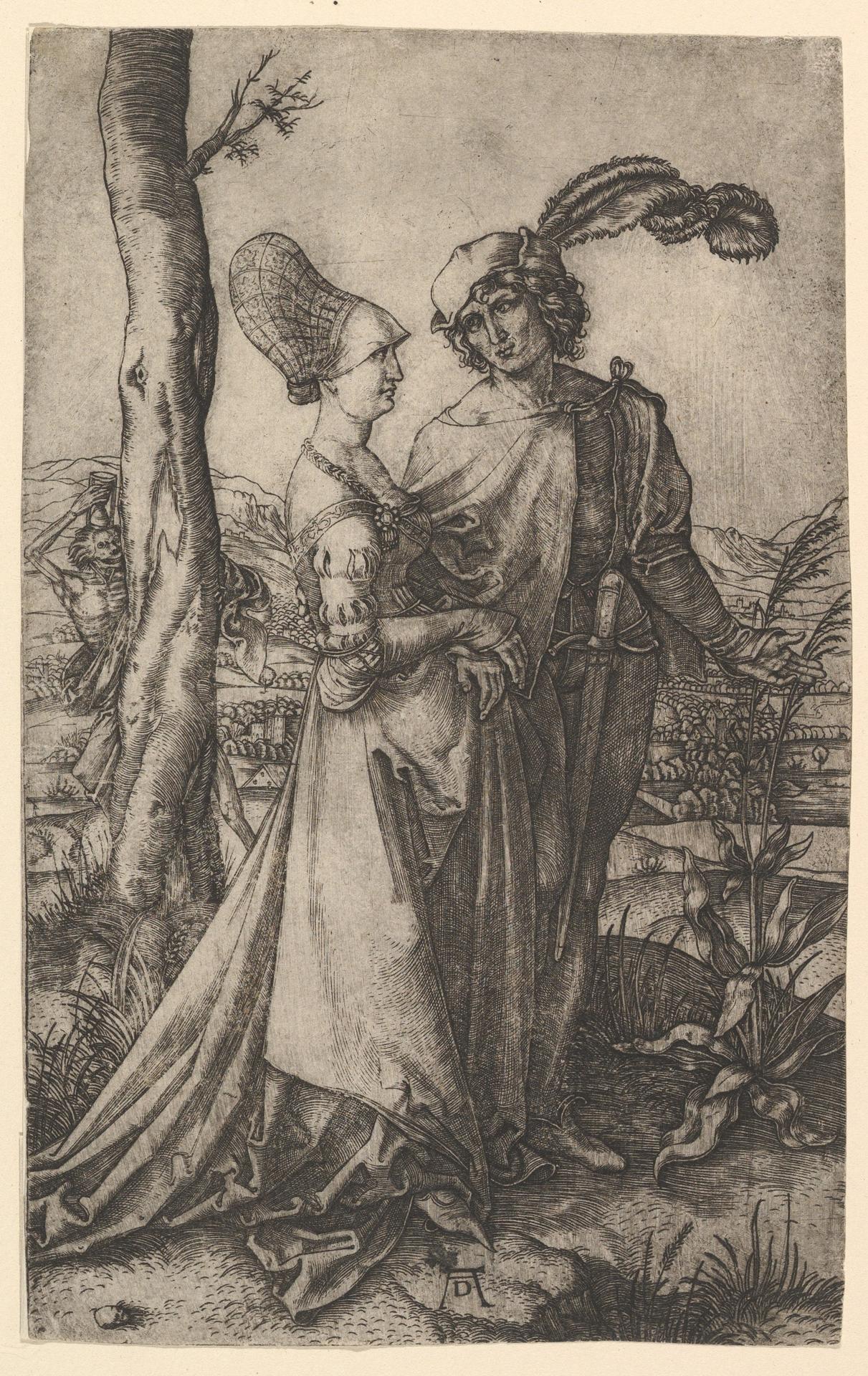
Original title: Lord and lady walking with figure of death hiding behind a tree, holding an hourglass, The Promenade after Dürer
kurzbeschreibung
A finely dressed couple strolls while the allegorical figure of Death, holding an hourglass, hides behind a tree. Marcantonio Raimondi engraved this print between about 1500 and 1534 after a composition by Albrecht Dürer. Only one state of the plate is known.
Description
Two figures walk side by side in the same direction. The one on the left wears a striking headpiece and a gown with long sleeves and a train; the one on the right has a feathered hat and a robe with a sash. A tree stands behind the left figure, and from behind it another figure peeks out, holding an hourglass. Fields and trees suggest the background. The layout feels symmetrical, with the couple in front and the figure of Death behind. Precise lines render clothing and landscape in detail.
Context
Raimondi, an Italian engraver of the Renaissance, was known for reproductive prints after works by other artists. The motif goes back to a drawing or print by Albrecht Dürer, who treated death as a constant companion of humankind. The print was probably made during Raimondi's stay in Rome, where he became famous for his exact engravings after Dürer. The hourglass stands for the transience of life, a common vanitas symbol of the time.
Impact
Calm yet unsettling, the print works because death lurks inconspicuously in the background. The symmetrical arrangement and fine linework give it a clear, almost graphic elegance. A contrast arises between the couple's composed demeanor and the hidden figure of death, inviting reflection on mortality.
Technique
Lines are incised into a metal plate—an intaglio process, engraving. Evenly and precisely drawn lines characterize Raimondi's style; they model garments, foliage, and background. That only this single impression of the state is known underscores the print's technical and art-historical significance.
AI-generated description text
Source: Metropolitan Museum of Art · Public Domain (CC0 1.0)