Christ and the Woman Taken in Adultery (1579)
Original title: Christ and the Woman Taken in Adultery
kurzbeschreibung
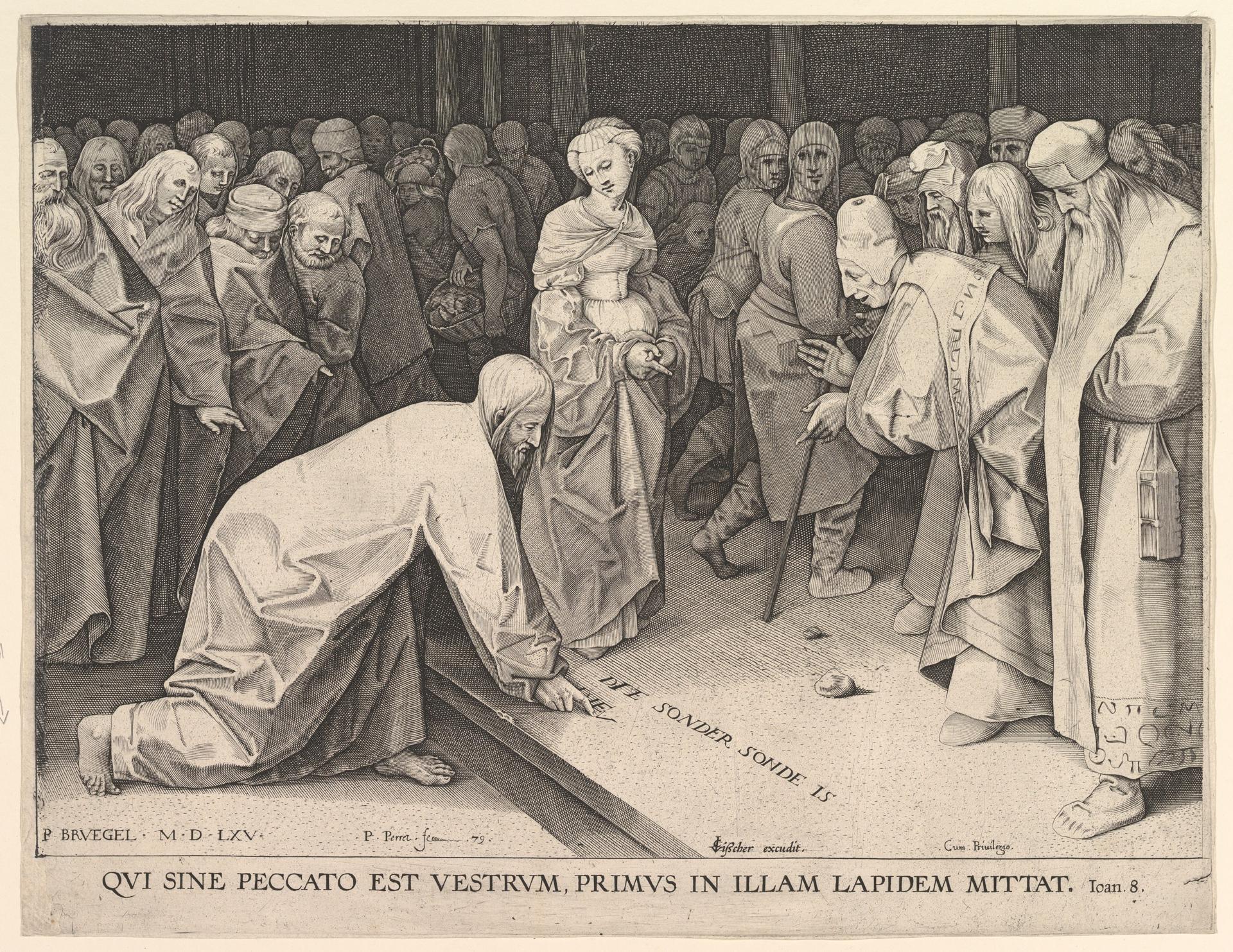
Pieter Perret's engraving Christus und die Ehebrecherin, made in 1579, presents the biblical episode in which Christ defends a woman accused of adultery before an assembled crowd. The sheet is a black-and-white print and represents the second state.
Description
The layout is balanced and built around a central axis, with the kneeling woman and Christ as the main figures. Deeply bowed in a long robe, she faces Christ, who kneels before her holding a book. Other figures stand around the pair, their gazes turned in various directions and their expressions varied. The setting recalls a Renaissance courtroom, and those present wear corresponding dress. Light falls evenly, strong shadows are absent, and the very precise linework brings out the surfaces of fabrics and faces.
Context
The Fleming Pieter Perret made the engraving in 1579 after an invention by Maarten van Heemskerck, a renowned Dutch painter of the Renaissance. Biblical subjects were widespread in printmaking at the time, whether for religious instruction or for collectors. Especially in the Reformation era the theme of the adulteress enjoyed great popularity, since it touches on questions of mercy and judgment.
Impact
The balanced arrangement and the composed bearing of the figures give the image a dignified, almost solemn undertone. Through the dense, exact linework the encounter between Christ and the woman comes into focus, and the inner tension of the moment becomes perceptible.
Technique
The sheet was produced as an engraving: lines are cut into a metal plate, which is then printed. Fine hatching creates tonal values and shapes garments and faces with great precision. The present impression is the second state, which points to later reworking of the plate.
AI-generated description text
Source: Metropolitan Museum of Art · Public Domain (CC0 1.0)