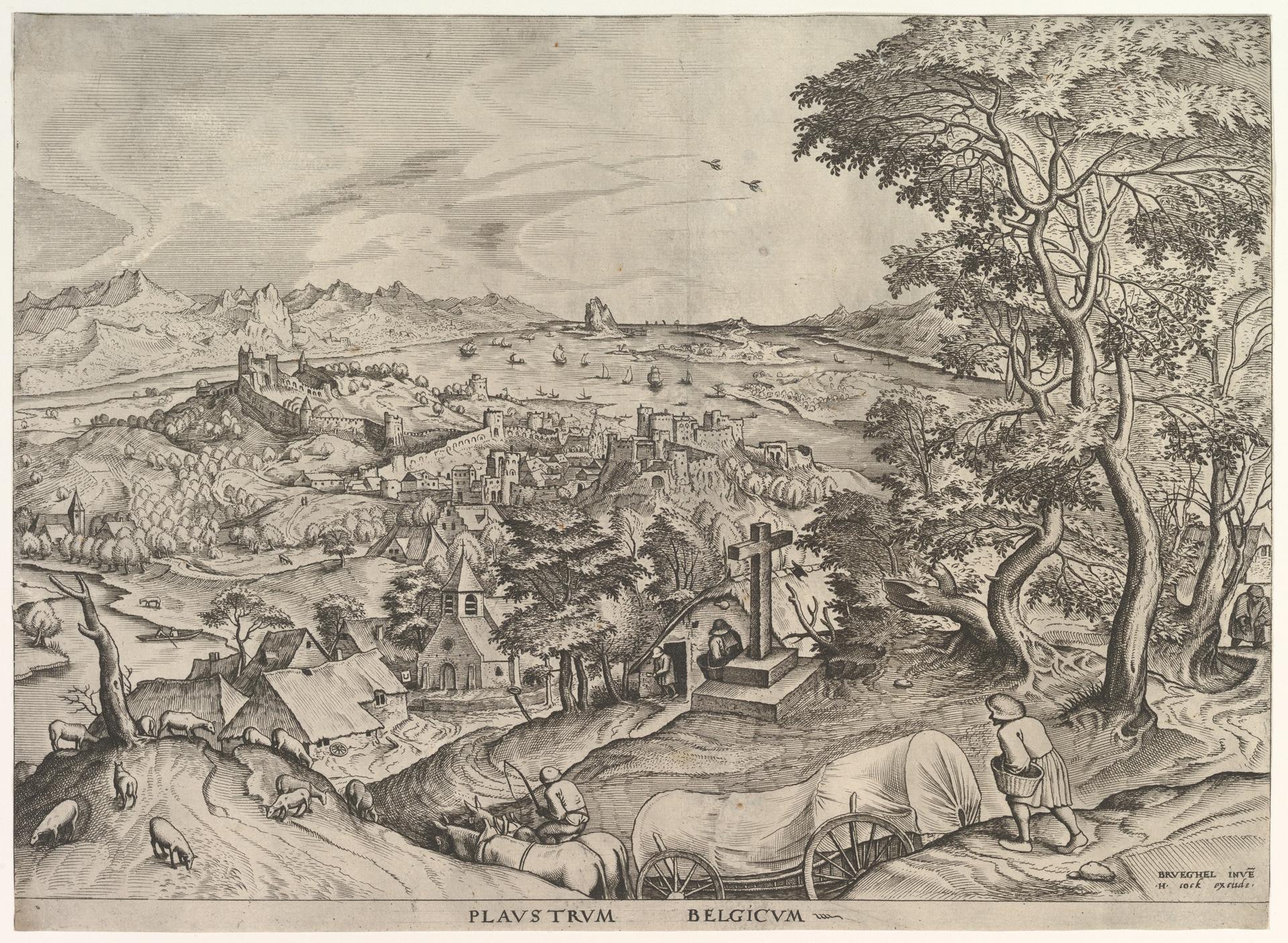
The Belgian Wagon (Plaustrum Belgicum), from "The Large Landscapes"
Original title: The Belgian Wagon (Plaustrum Belgicum), from "The Large Landscapes"
kurzbeschreibung
Where many landscape prints of its day let the terrain carry the picture, this sheet by Johannes van Doetecum I puts the Belgian wagon itself at the heart of a wide view. Made around 1555–56, it belongs to the series "The Large Landscapes". The image was executed as an etching, finished with engraving.
Description
A horse-drawn wagon, two figures and a few grazing pigs fill the foreground of this view. Beyond them a Belgian village spreads out, its profile shaped by a church with a bell tower and a dense cluster of buildings. Trees, hills, mountains and a river break up the surrounding land, while a city with towers rises at the horizon. Birds fly above the cloudy sky. Everything stays monochrome, lit evenly, with landscape and architecture rendered in faithful detail.
Context
Designs by Pieter Bruegel the Elder, published by Hieronymus Cock in Antwerp, served as the models for "The Large Landscapes". Johannes van Doetecum I, a Netherlandish engraver, worked alongside his brother Lucas and reproduced many landscapes of the period. In the sixteenth century, rural life in the Spanish Netherlands increasingly became a subject in its own right in art.
Impact
Balance and everyday incident give the print a quiet, idyllic air. The precision of the detail invites close looking and draws the viewer near to the surroundings it records.
Technique
Etching and engraving were both used for this impression, the second state of two. Combining the two techniques allows fine lines and hatching to describe textures and atmospheric effects with nuance. The sheet measures 35 x 45 cm, the plate 32.3 x 42.7 cm.
AI-generated description text
Source: Metropolitan Museum of Art · Public Domain (CC0 1.0)