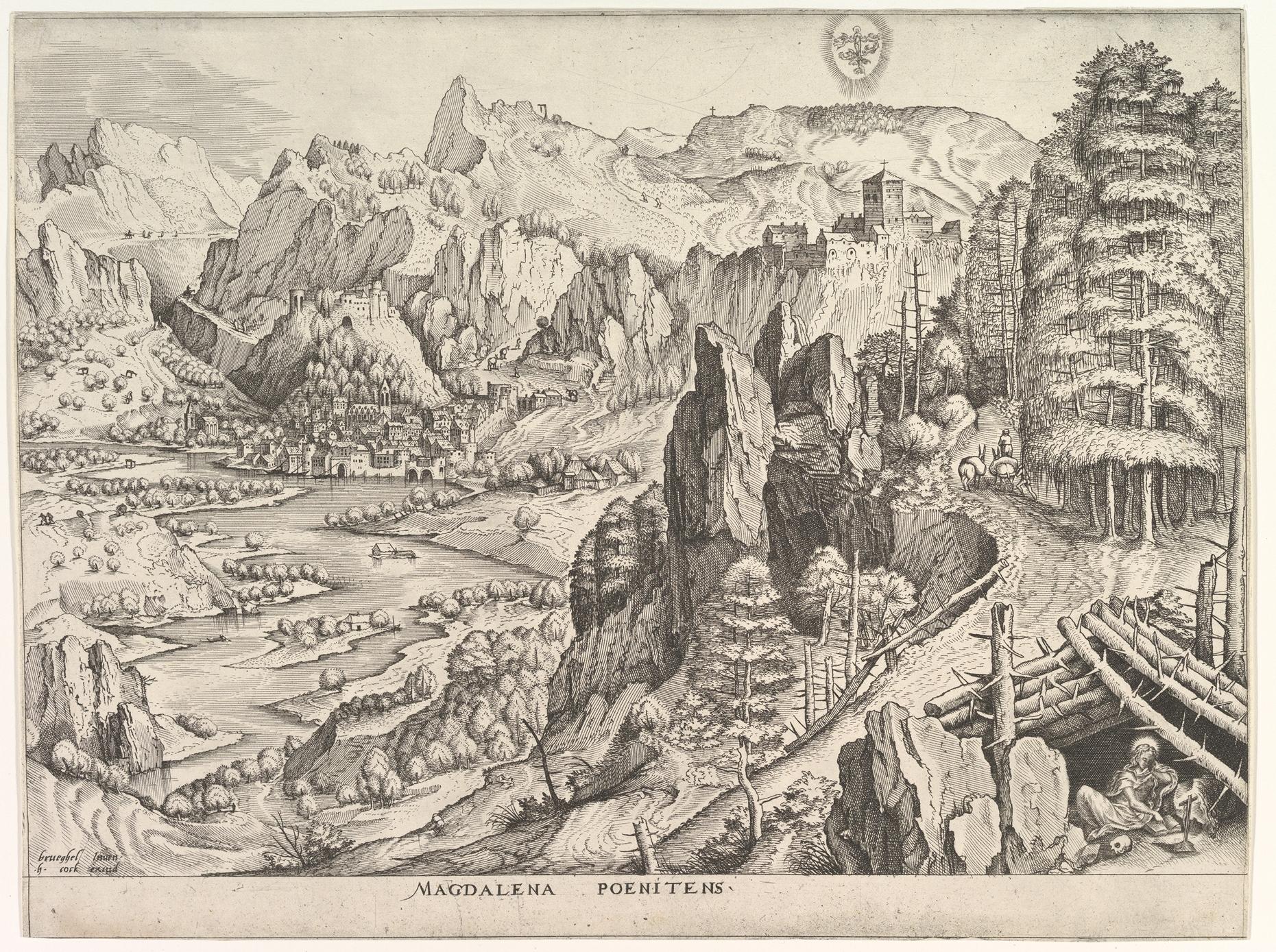
The Penitent Magdalene (Magdalena poenitens), from "The Large Landscapes"
Original title: The Penitent Magdalene (Magdalena poenitens), from "The Large Landscapes"
kurzbeschreibung
Johannes van Doetecum I created the etching 'Die büßende Magdalena' (The Penitent Magdalene) around 1555–56 as part of the series 'Die großen Landschaften' (The Large Landscapes). It shows Saint Magdalene kneeling in an expansive landscape. The print combines etching and engraving.
Description
In the lower right corner Magdalene kneels, set within a richly articulated landscape of mountains, rocks, trees and a river. A village with buildings and a tower rises in the distance, and above it a castle sits on a hill. A symbol with a cross and sun rays appears in the upper area, pointing to the religious context. The horizontal orientation and the perspectival lines guide the eye through the terrain. The monochrome rendering with even lighting is typical of the etching technique.
Context
The series 'Die großen Landscapes' was made in the Netherlands in the mid-16th century and executed by Johannes van Doetecum I together with his brother Lucas. Designs by Pieter Bruegel the Elder, who greatly shaped landscape depiction of that time, served as models. Such landscape series were highly popular with collectors and helped establish landscape as an independent subject.
Impact
A calm, contemplative mood emanates from the print, created by the wide landscape and the small, inward-looking figure of Magdalene. The delicate lines and even shading build spatial depth and draw the viewer into the scene. Religious motif and naturalistic landscape combine into a harmonious, balanced whole.
Technique
Etching with additional engraving – this combination allows the fine lines and precise shading. The process permits a detailed rendering of the landscape structures and the figure. The present impression is the first state of two, suggesting careful reworking of the plate.
AI-generated description text
Source: Metropolitan Museum of Art · Public Domain (CC0 1.0)