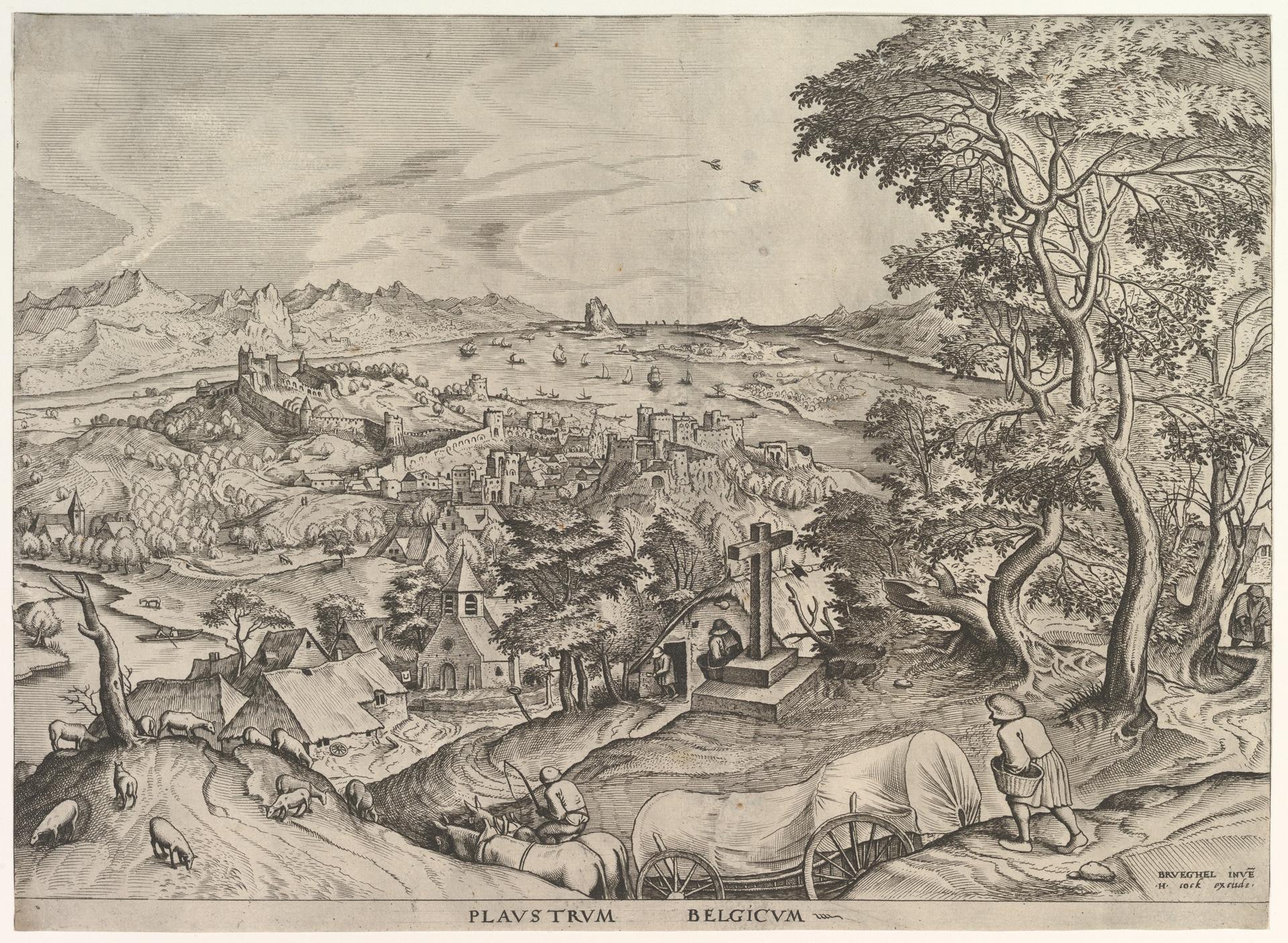
The Belgian Wagon (Plaustrum Belgicum), from 'The Large Landscapes'
Original title: The Belgian Wagon (Plaustrum Belgicum), from "The Large Landscapes"
kurzbeschreibung
This print, Der belgische Wagen (The Belgian Wagon), belongs to the series Die großen Landschaften (The Large Landscapes) and was made around 1555–56 as an etching and engraving by Johannes van Doetecum I. It presents a wide landscape with a horse-drawn wagon in the foreground; around it, agricultural work is underway, and behind rises the silhouette of a town.
Description
In the foreground a wagon is hitched to a horse, and beside it a person holds a bucket. Several buildings stand out, including a church with a bell tower and a town with a castle on a rise. Trees and bushes break up the surface, while distant mountains and a river are only suggested. A cloudy sky with a few birds stretches above the scene. The image remains monochrome, with evenly distributed light—a hallmark of the printmaking technique.
Context
The series Die großen Landschaften was produced in the Netherlands in the mid-sixteenth century. Johannes van Doetecum I engraved it together with his brother Lucas, often after designs by artists such as Pieter Bruegel the Elder. Such prints met a growing demand in the sixteenth century for landscape imagery, offering both topographical and idealized views. This sheet takes up motifs from Flemish landscape painting that were widespread in printmaking of the period.
Impact
Your eye first travels across the busy foreground with its wagon and figure, then follows the buildings and trees into the distance. The precise rendering of trees and buildings contributes to the calm, rural atmosphere. A harmonious contrast arises between the bustling foreground and the wide, quiet landscape, giving the print a sense of depth.
Technique
Etching and engraving are combined here, allowing fine lines and detailed internal drawing. The even lighting and monochrome execution follow the conventions of printmaking of the time. The sheet is in the second state, which suggests later reworking of the plate.
AI-generated description text
Source: Metropolitan Museum of Art · Public Domain (CC0 1.0)