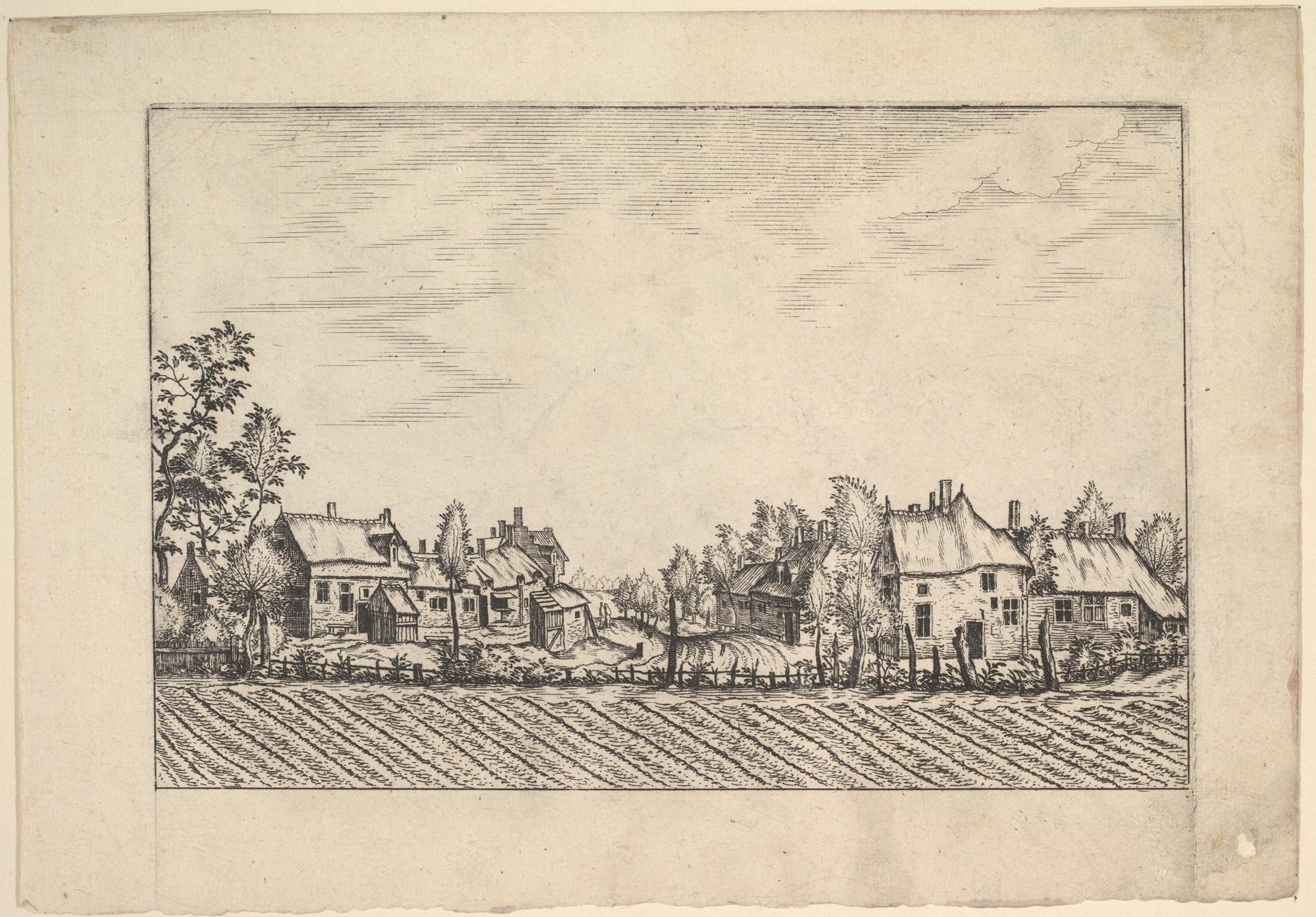
Farms, ploughed field in the foreground, from Praediorum villarum et rusticarum casularum icones elenoantissimae ad vivum in apre deformatae
Original title: Farms, ploughed field in the foreground from Praediorum villarum et rusticarum casularum icones elenoantissimae ad vivum in apre deformatae
kurzbeschreibung
Unlike many contemporary landscape etchings, this sheet by Johannes van Doetecum I foregrounds the ploughed field rather than the buildings. Made around 1559–61, the etching presents a rural view with a cleared arable field in the foreground and several houses behind it. It belongs to a series of landscapes and is in the first state of three.
Description
A cleared field fills the foreground, divided into carefully laid-out rows. Beyond it stand several houses with shingled roofs and variously designed windows, surrounded by trees and bushes. A plain, cloudless sky dominates the scene and is rendered with fine strokes. The black-and-white etching uses varying line thickness and length to convey the surfaces of trees, houses, and field.
Context
The etching was made around 1559–61 and is part of the series Praediorum villarum et rusticarum casularum icones, which documents rural estates and farmhouses. Johannes van Doetecum I was a Dutch engraver valued for his precise landscapes. In sixteenth-century Dutch art, interest in depicting the countryside grew, and this series is an example of that.
Impact
The etching feels calm and orderly, helped by the clear organization of the field and the even row of houses. The fine hatching and monochrome execution create a detailed yet restrained effect that invites close looking.
Technique
The sheet is an etching in the first state of three. The plate was worked with fine lines, with different line weights and lengths providing texture and shading. The dimensions are 6 7/8 x 9 13/16 inches (17.5 x 25 cm); the plate is trimmed at the bottom.
AI-generated description text
Source: Metropolitan Museum of Art · Public Domain (CC0 1.0)