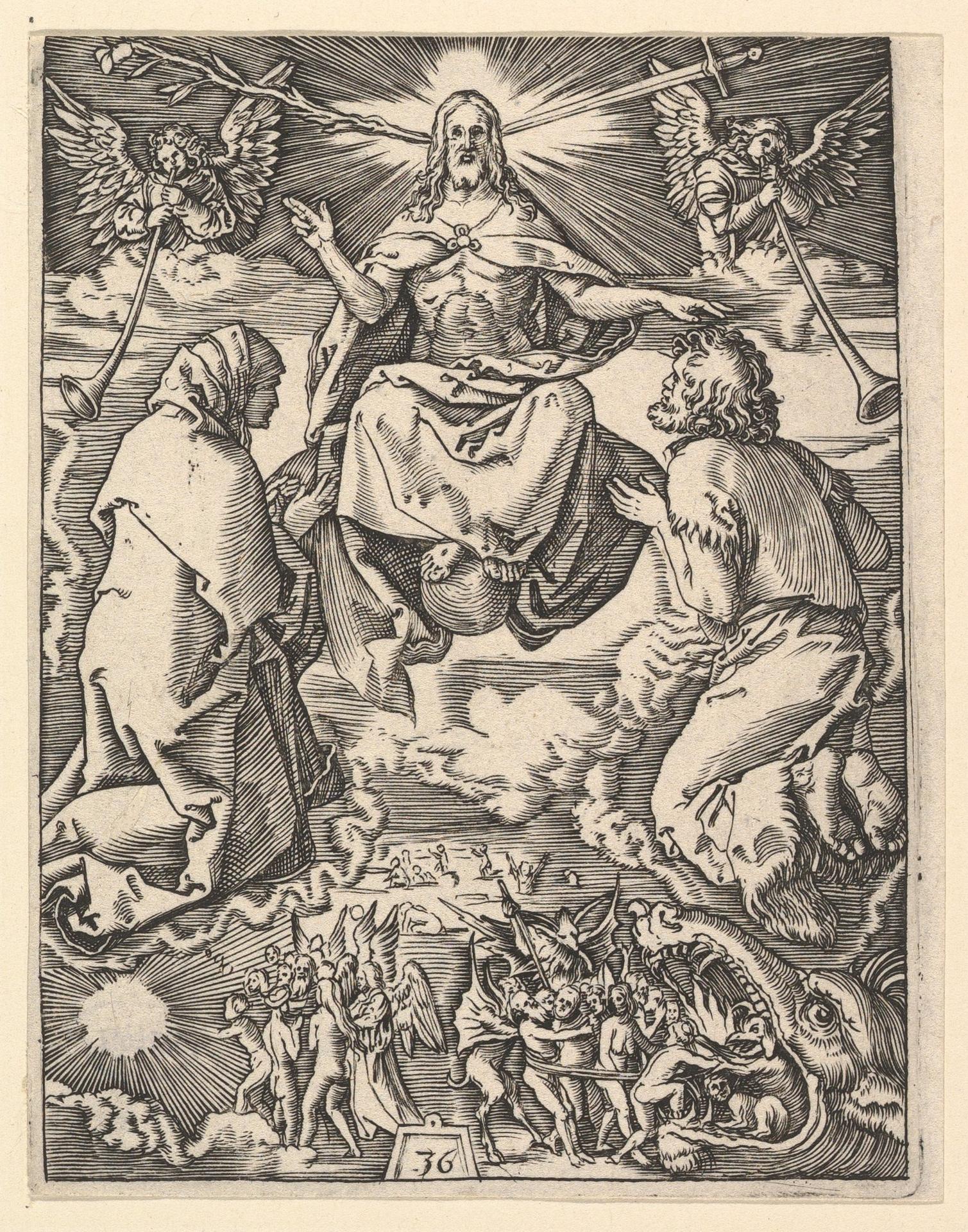
The Last Judgment; Christ with lily and sword at top, flanked by Virgin and St John the Baptist interceeding on behalf of the humans below, from "The Passion of Christ"
Original title: The Last Judgment; Christ with lily and sword at top, flanked by Virgin and St John the Baptist interceeding on behalf of the humans below, from "The Passion of Christ", after Dürer
kurzbeschreibung
Christ holds a lily while a sword pierces his garment: Marcantonio Raimondi presents the Last Judgment in a dense engraving from around 1500–34. Mary and John the Baptist step forward on either side to intercede for humanity. The print belongs to the 'Passion of Christ' series and is the third state of three. In a small space, the apocalyptic event crowds in with numerous details.
Description
Seated on a throne, Christ has a sword thrust through his robe and a lily in his hand. Angels flank him, one bearing an arrow, the other a sword. Below, two figures covered with plague boils appear, symbols of the disease. Along the bottom edge, people flee in every direction; some hover, others grapple with one another. The layout is symmetrical, modeled with fine hatching that creates depth and volume.
Context
Marcantonio Raimondi, an Italian Renaissance engraver, became famous above all for his reproductive prints after Albrecht Dürer. The 'Passion of Christ' series was made in the first half of the 16th century and carried Dürer's imagery throughout Europe. This engraving reveals how the German Renaissance influenced Italian printmaking. The sheet is part of the collection of the Metropolitan Museum of Art and is in the public domain.
Impact
The tight succession of figures and sharp lines generate an apocalyptic tension. Suffering and flight come across as immediate and insistent, without slipping into sentimentality. Symmetry and a clear hierarchy among the figures give the print a solemn severity.
Technique
An engraving: in this process, lines are incised into a copper plate and then printed. Raimondi used fine hatching and cross-hatching to bring out light and shadow. The present impression is the third state, suggesting later reworking of the plate.
AI-generated description text
Source: Metropolitan Museum of Art · Public Domain (CC0 1.0)