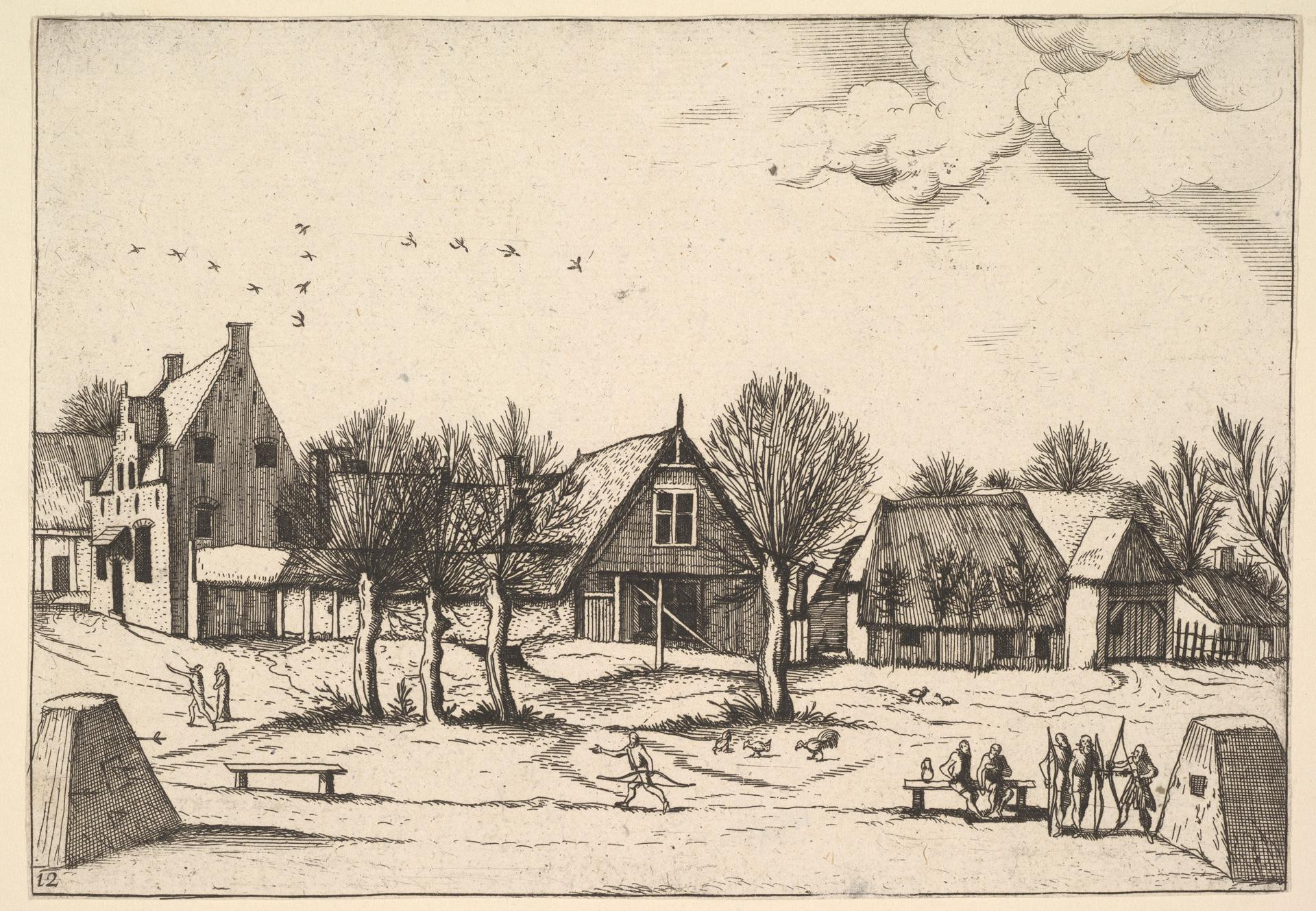
Country Village, archers in the foreground from Multifariarum casularum ruriumque lineamenta curiose ad vivum expressa
Original title: Country Village, archers in the foreground from Multifariarum casularum ruriumque lineamenta curiose ad vivum expressa
kurzbeschreibung
This etching by Johannes van Doetecum I, made between 1559 and 1561, presents a village idyll in which peasants move among thatched houses, some of them carrying bows and arrows. The black-and-white print belongs to a series of rural views.
Description
The eye is drawn first to the group in the foreground, where several figures stand and work in the open air, many with bows drawn or held. Behind them, farmhouses with reed roofs are staggered among trees and shrubs. Further into the image, more buildings appear, and a flock of birds crosses the lightly clouded sky. Soft light picks out the contours of the houses and figures; the image is in landscape format and becomes denser in the lower and middle zones.
Context
The print is part of the series Multifariarum casularum ruriumque lineamenta curiose ad vivum expressa, which gathers rural views of the Netherlands. Johannes van Doetecum I, a Dutch engraver and publisher, often worked with his brother Lucas. This etching is the third state of three and circulated in an edition aimed at collectors and enthusiasts.
Impact
A sense of calm emanates from this print; one almost wants to step into the scene. The confident linework and balanced layout create the clarity and harmony characteristic of sixteenth-century Dutch landscape art.
Technique
The etching was made by scratching the drawing into a ground layer, after which acid bites into the exposed lines; the impression on paper reproduces them in black and white. That this is the third of three states points to reworkings of the plate during printing.
AI-generated description text
Source: Metropolitan Museum of Art · Public Domain (CC0 1.0)