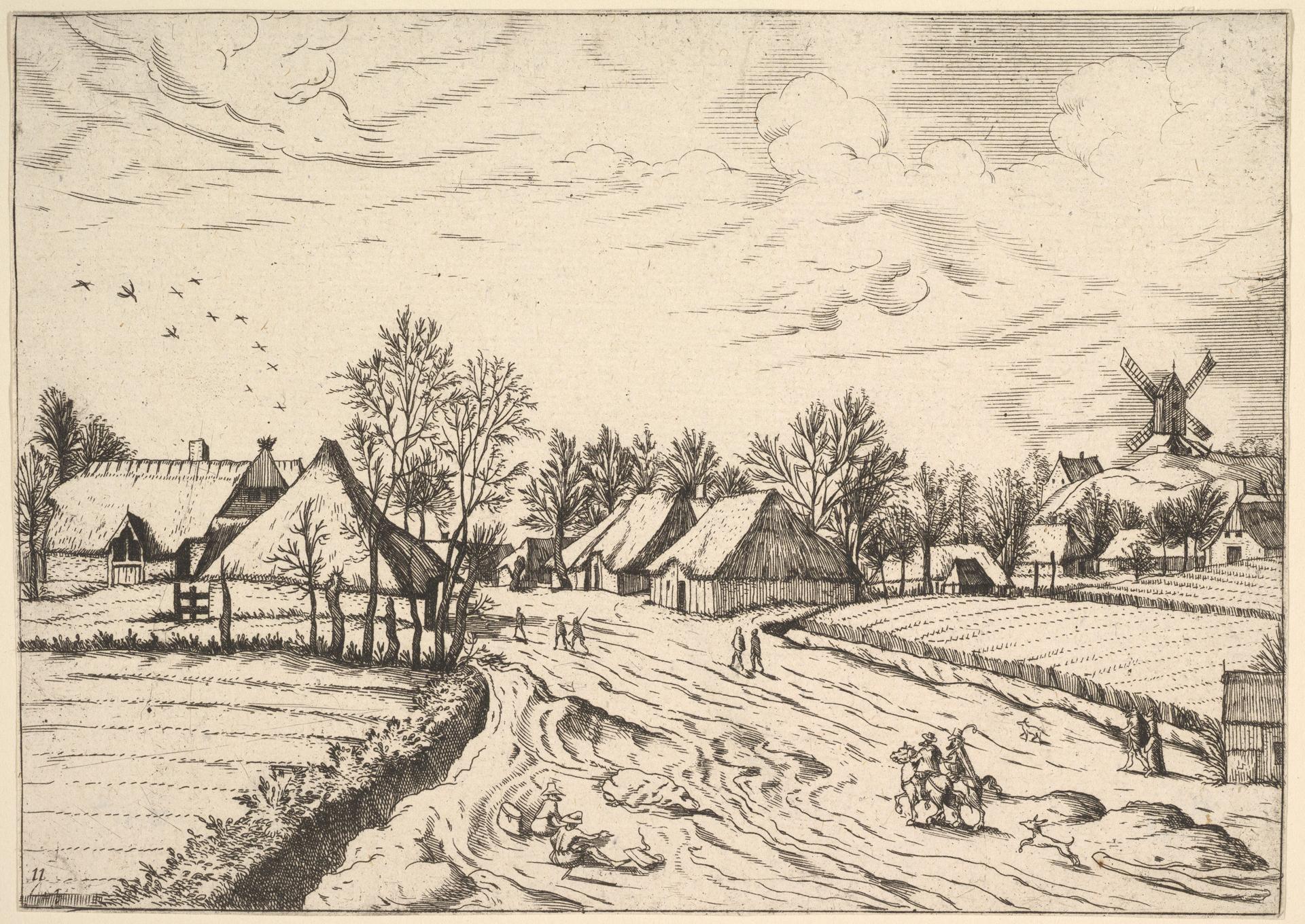
Country Village with Post Mill from Multifariarum casularum ruriumque lineamenta curiose ad vivum expressa
Original title: Country Village with Post Mill from Multifariarum casularum ruriumque lineamenta curiose ad vivum expressa
kurzbeschreibung
Several houses, a stream, and a windmill define the rural subject of this etching by Johannes van Doetecum I, made in 1559–61. The print belongs to the series 'Multifariarum casularum ruriumque lineamenta curiose ad vivum expressa' and is in the third of three states.
Description
In the foreground, a stream with wavy lines runs across the image, where two people walk toward each other. Beyond it are farmsteads with traditional roofs, while on the right a windmill stands on a rise. Buildings, trees, and a cloudy sky filled with birds occupy the rest of the space. The layout runs horizontally, and the mood remains quiet and rural. Everything is printed in black and white, the light is even, and the details are observed naturalistically.
Context
The series was published in 1559–61 by Johannes van Doetecum I, who presented a collection of rural views with it. Such prints were very popular in the sixteenth century, serving artists as models and collectors as desirable sheets. Formally, the motif follows the topographical approach to landscape that was flourishing in the Netherlands at the time. The existence of a third state indicates that the plate was revised again later.
Impact
Quietly and with precise detail, the print describes country life and invites the viewer to linger. Evenly drawn lines and a clear arrangement produce a still, contemplative atmosphere. Standing before it, one feels transported into an idealized rural world.
Technique
In etching, the lines were incised into an etched plate, allowing very fine and exact strokes with which masonry, roofs, and tree crowns could be captured. Printing was done from the plate onto paper. The presence of a third state points to subsequent reworking of the plate.
AI-generated description text
Source: Metropolitan Museum of Art · Public Domain (CC0 1.0)