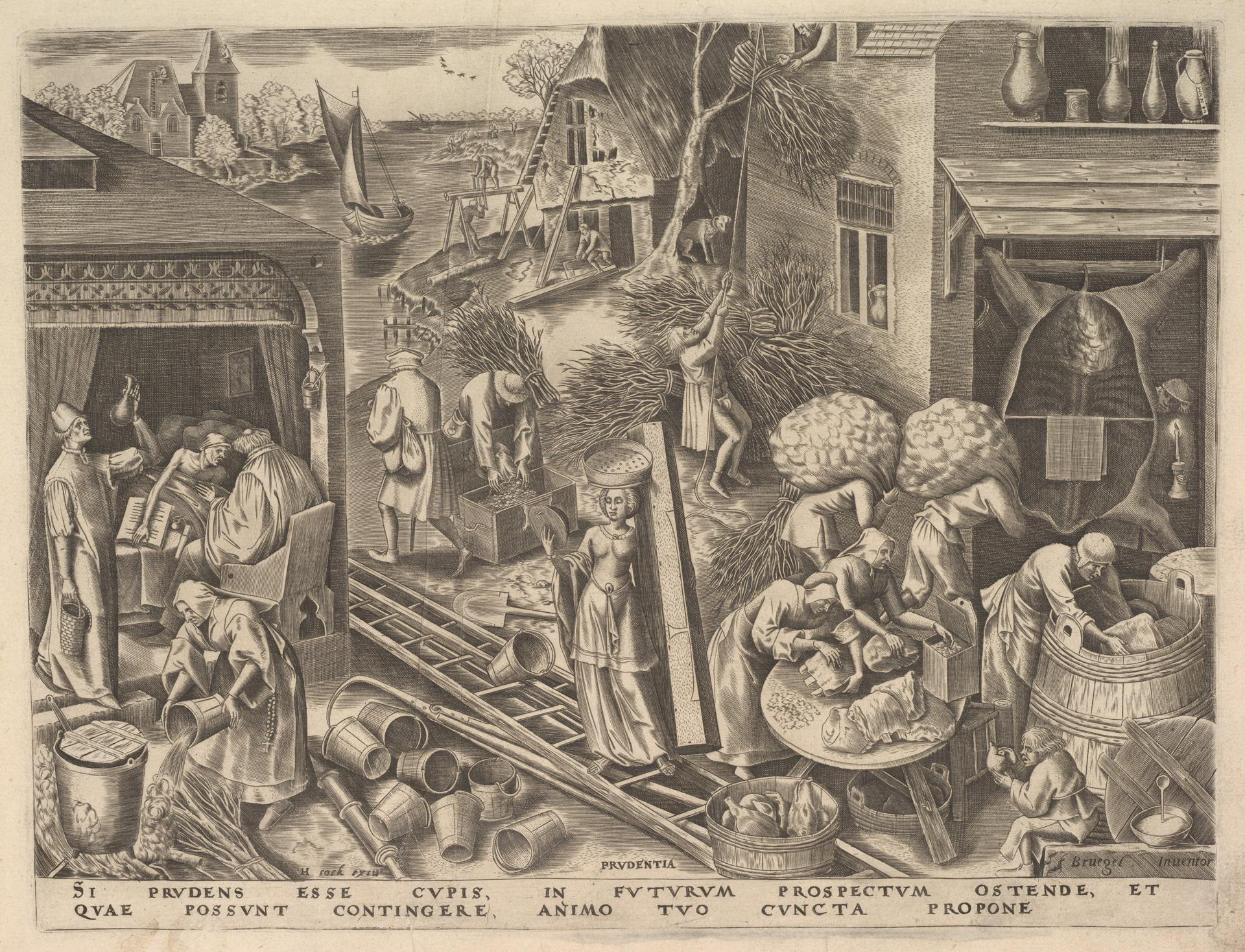
Prudence (Prudentia) from The Virtues
Original title: Prudence (Prudentia) from The Virtues
kurzbeschreibung
This copperplate engraving by Philips Galle was made around 1559–60 as part of his series The Virtues. It presents Prudentia, the personification of prudence, who can be recognised by her attribute, the helmet. The figure is paired with an elaborate scene of rural labour behind her. The sheet survives in the first of two states.
Description
Prudentia stands on a platform wearing a helmet, her gaze turned back over her shoulder. Beyond her, village life unfolds in busy detail: grain is gathered and stored, tools are worked on, goods are traded. Buildings, a river landscape and a ship close off the view. The layout packs in numerous small incidents, from simple vessels to a tower and a house.
Context
Philips Galle produced the series The Virtues in the second half of the sixteenth century, at a time when allegorical motifs circulated widely in printmaking. Such sheets were meant to offer moral instruction and were aimed at an educated audience. Galle worked in Antwerp, a centre of copperplate engraving, and was known for his careful, richly detailed work.
Impact
Here an abstract virtue is tied to scenes of everyday life, which gives the allegory a tangible closeness. Crisp lines and a clear arrangement produce a calm, reflective mood that invites the viewer to look closely and think further about prudence.
Technique
For an engraving, the lines are cut into a copperplate, which is then printed. Fine, precisely guided lines and the monochrome result characterise this method. The care taken is evident in the detailed rendering of figures and architecture.
AI-generated description text
Source: Metropolitan Museum of Art · Public Domain (CC0 1.0)