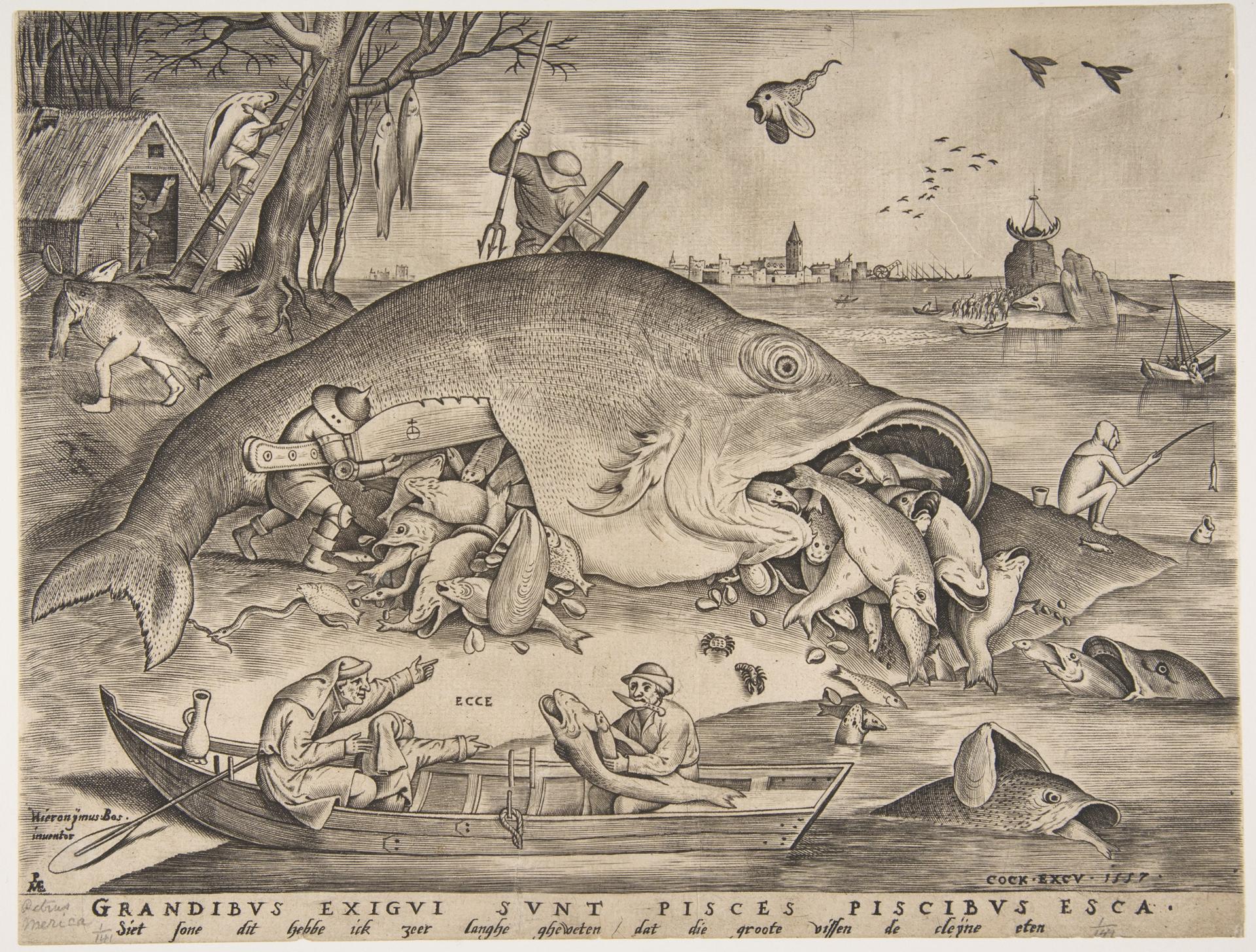
Big Fish Eat Little Fish (1557, Met-Objekt 1935)
Original title: Big Fish Eat Little Fish
kurzbeschreibung
Unlike related prints that confine the proverb to the fable alone, Pieter van der Heyden's 1557 engraving joins the parable of the big and little fish to a shore scene: a large fish lies on land and devours smaller ones, while people, a boat and a harbour landscape appear behind. This is the first of four states.
Description
A big fish dominates the foreground, swallowing several smaller ones; more fish lie scattered around it. Behind, people come ashore, fish hang in trees, and a fisherman sits in a boat. Trees, a house and a harbour make up the rural setting. The arrangement is dense with figures and details, and the rendering is monochrome with even light and strong contrasts.
Context
Van der Heyden made this engraving in 1557 in the Renaissance Netherlands, when copperplate prints circulated widely. The motif draws on a common fable of the time that addresses social hierarchy and the struggle to survive. Probably intended as a single sheet, the work was meant to convey moral lessons to an educated audience.
Impact
Its abundance of detail and clear symbolism make the print easy to remember. The contrast between the big fish and its small victims creates dramatic tension. The quiet landscape behind underscores the allegorical message by making the event seem everyday.
Technique
For this engraving, lines were cut into a copper plate and then printed. Fine lines and hatching capture details and shading precisely. The plate measures 22.9 x 29.7 cm, the sheet 26.1 x 33.7 cm, which suggests careful execution.
AI-generated description text
Source: Metropolitan Museum of Art · Public Domain (CC0 1.0)