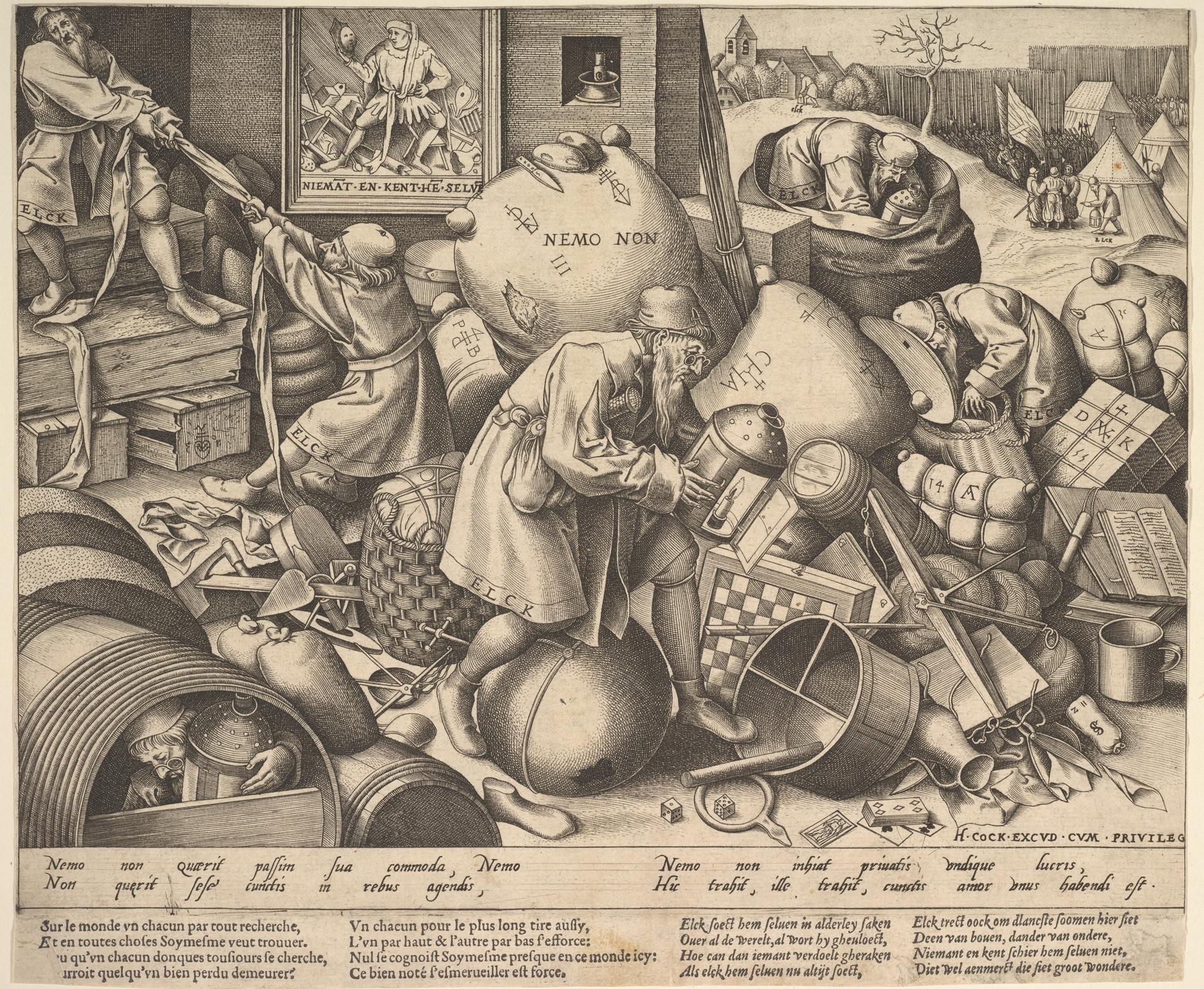
Everyman (ca.1558)
Original title: Everyman
kurzbeschreibung
Around 1558 Pieter van der Heyden made the engraving Jedermann, an allegorical scene crowded with people going about everyday tasks — sorting, packing, carrying. Further back, a lone figure climbs a staircase with a staff in hand. The print pairs engraving with letterpress text (first state of two, text version A).
Description
In the foreground several figures sort and pack goods; some carry baskets and sacks, others work with tongs and shovels. Up a staircase in the distance climbs a person holding a staff, with a townscape of buildings and a tower behind. A larger frame encloses an additional scene, where someone stands before a mirror in a furnished room. Greys and whites dominate the sheet, as is usual for a print. The layout is dense and rich in small details that catch the variety of activities.
Context
Pieter van der Heyden, a sixteenth-century Flemish engraver, is known for his reproductive prints after Pieter Bruegel the Elder. Jedermann dates from around 1558, when moralising allegories were widespread in Netherlandish art. Its source is the medieval morality play Elckerlijc (Everyman), which treats the transience of earthly life. The Latin text along the bottom points to the print's didactic purpose.
Impact
The crowded, detailed arrangement draws the eye into depth and invites repeated looking. Prevailing grey tones create a serious, reflective mood that suits the moral message. Everyday bustle and the calm figure in the background stand in tension with each other — a shift between activity and reflection.
Technique
The engraving's lines were cut into a metal plate and then printed on paper. The text was added by letterpress (relief printing), so two printing techniques are combined. The sheet measures 24.7 x 29.5 cm and survives as the first state of two, with text version A.
AI-generated description text
Source: Metropolitan Museum of Art · Public Domain (CC0 1.0)