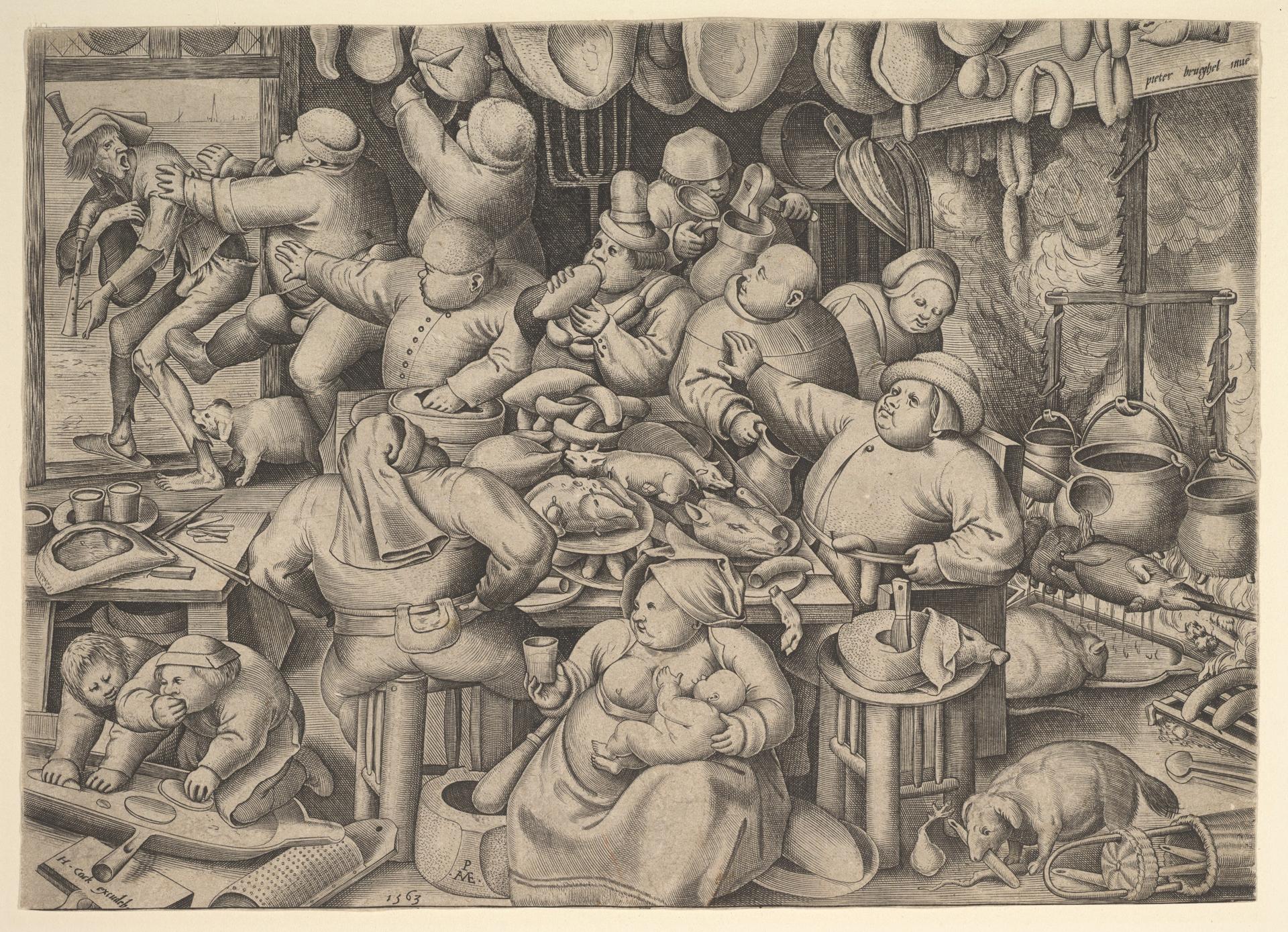
The Fat Kitchen (1563, Met-Objekt 1931)
Original title: The Fat Kitchen
kurzbeschreibung
A crowded kitchen scene awaits the viewer in Pieter van der Heyden's engraving 'The Fat Kitchen' from 1563. The print is in the first of three states and belongs to Renaissance printmaking.
Description
In the foreground, a woman sits with a child on her lap, holding a bottle; two more children sit on the floor beside her. Behind them, several figures handle bowls, pots, and food, while hams and meats hang from the ceiling. Some figures chat, others are busy with preparation. The layout feels compressed and full, creating a lively, even chaotic atmosphere. The print is not colored: it remains monochrome with even lighting.
Context
The Flemish engraver Pieter van der Heyden made this work in 1563. In Netherlandish art of the period, the motif of the 'fat kitchen' often stood for excess and gluttony. Moralizing scenes of everyday life were popular at the time. That the print survives in its first state attests to the artist's careful working method.
Impact
The overcrowded arrangement evokes a restless, almost oppressive feeling and underscores the abundance. Because every detail is precisely executed, repeated looking is rewarding: new particulars of the scene can always be discovered.
Technique
Engraving as a printmaking process relies on lines being incised into a metal plate and then printed. Precise lines and an even tonality characterize this print form. The present example is the first of three states, which suggests careful reworking of the plate.
AI-generated description text
Source: Metropolitan Museum of Art · Public Domain (CC0 1.0)