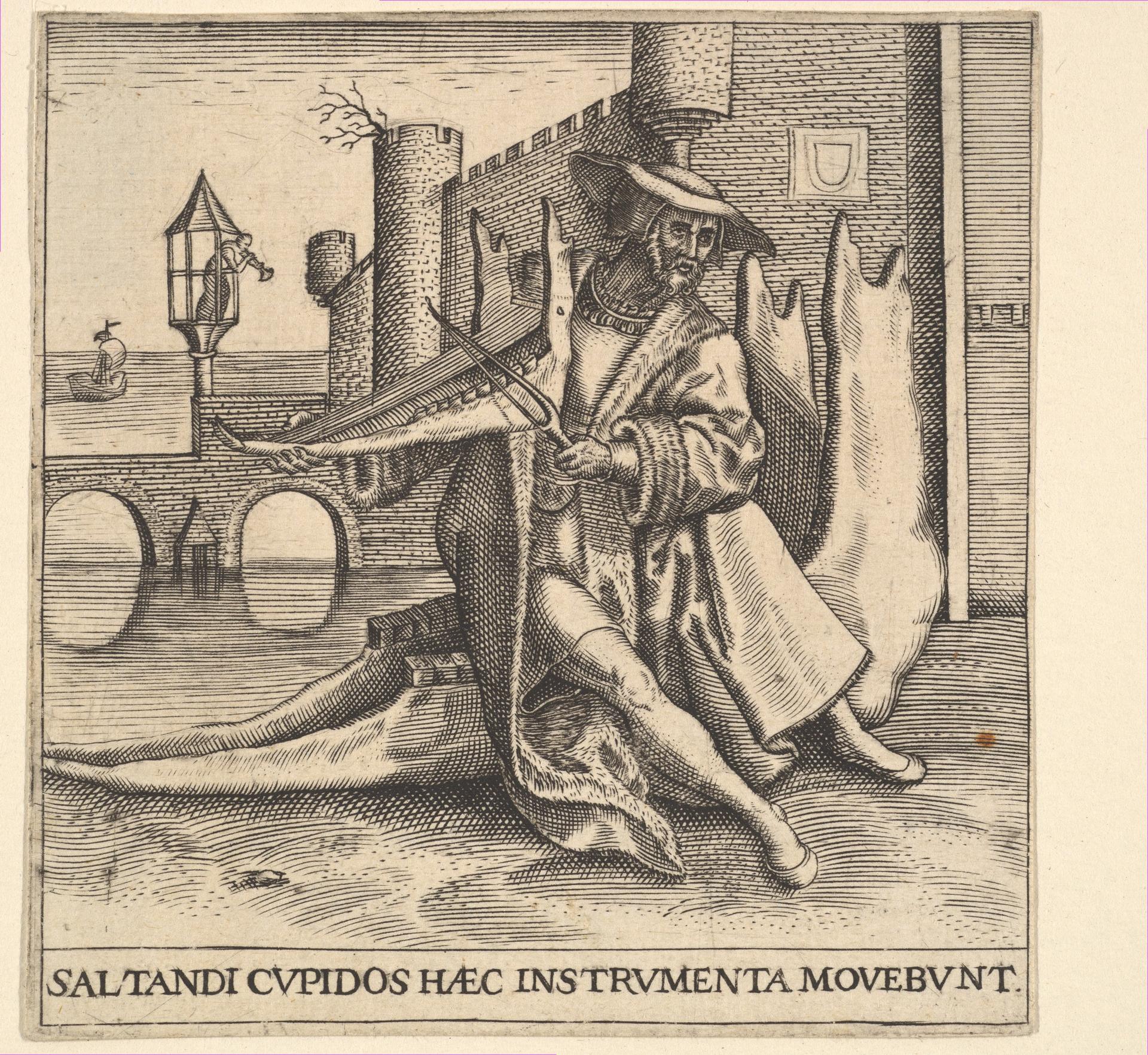
The Rich Man Playing Violin on a Jaw Bone (Engraving)
Original title: The Rich Man Playing Violin on a Jaw Bone
kurzbeschreibung
This undated engraving from the Renaissance by Johann Theodor de Bry depicts a richly dressed man seated on a skeleton, playing a stringed instrument made from a bone. The macabre subject is set within a detailed landscape.
Description
A man in a broad, flat cap and a fur-trimmed jacket sits cross-legged on a skeleton. In both hands he holds a bony bow and draws it across the instrument. Behind him rises a fortress with towers and a crenellated wall; to the left, a tower with a figure juts up, and a boat rests on the water. Along the lower edge runs the Latin inscription 'SALTANDI CUPIDOS HAE INSTRUMENTA MOVEBUNT'. The arrangement feels balanced, and the rendering is monochrome with delicate gradations.
Context
Johann Theodor de Bry came from the renowned de Bry family of artists, who worked as engravers and publishers in Frankfurt during the late 16th and early 17th centuries. The print was likely made in this period, even though it bears no date. Skeletons paired with musical instruments were among the common vanitas motifs of the Renaissance, underscoring the transience of life. The accompanying Latin text suggests a moralizing or satirical intent.
Impact
The juxtaposition of wealth and death evokes an unsettling, thought-provoking mood. Clear lines and the balanced layout give the print a calm, almost solemn presence. The contrast between the elegant musician and the skeleton in particular makes the work a poignant memento mori.
Technique
This print is an etching: the drawing was etched into a metal plate and then printed on paper. Fine hatching and shading create sculptural surfaces and spatial depth. The small format of about 9.4 x 9.2 cm attests to the high precision of printmaking in that era.
AI-generated description text
Source: Metropolitan Museum of Art · Public Domain (CC0 1.0)