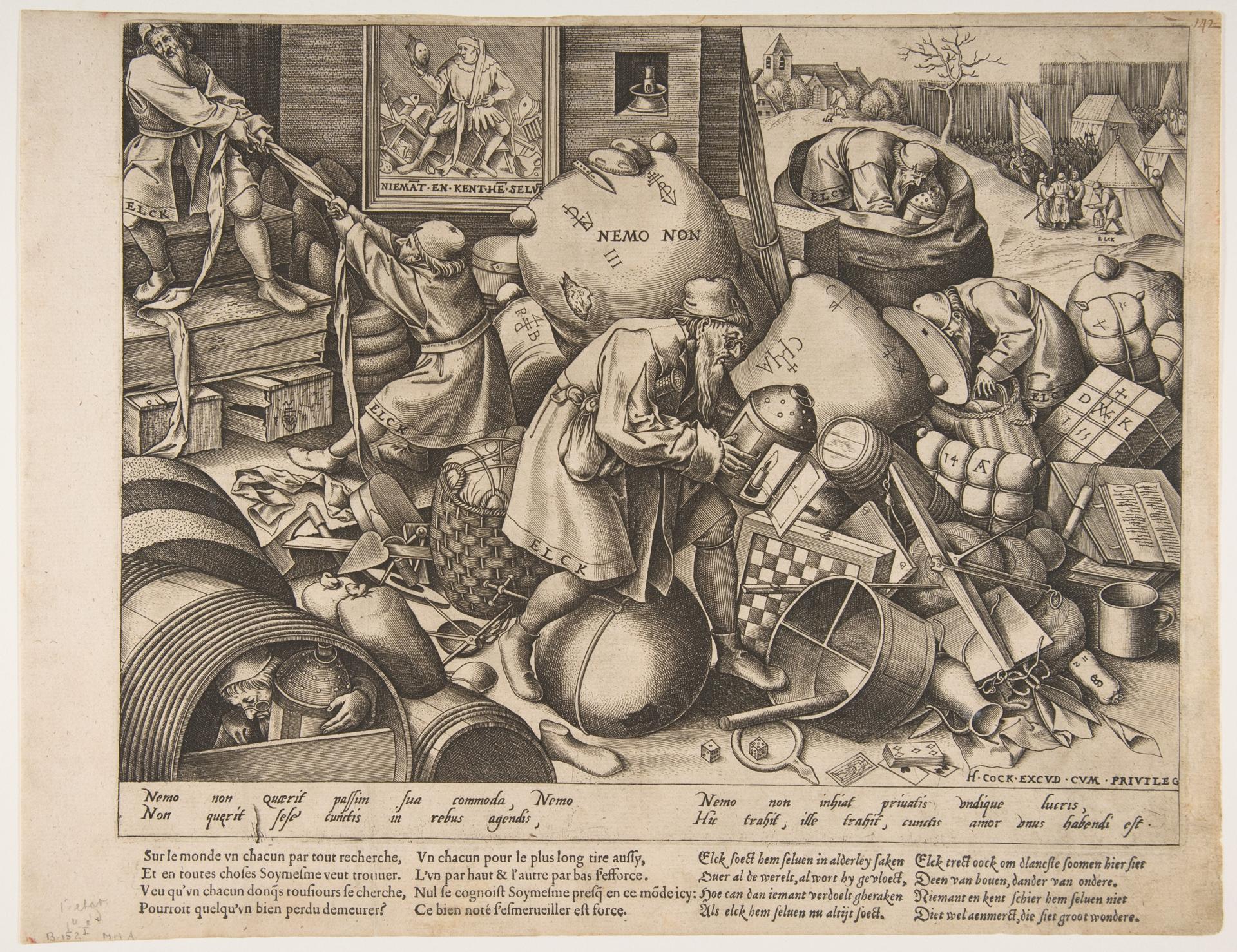
Everyman (ca. 1558)
Original title: Everyman
kurzbeschreibung
Pieter Bruegel the Elder's engraving Jedermann, made around 1558, takes up the medieval theme of a dying person who must give an account of his life. An allegorical gathering of figures and objects makes earthly transience palpable. The print combines an engraved image with printed text and survives in two versions.
Description
A bearded man in a long robe sits on a basket, an open book in his hands; around him everyday things lie scattered across the restless field — skittles, a chess piece, a cup and other gear. On the back wall hangs a portrait of a figure carrying a shield. To the right people walk along a path, while a figure on a platform holds a rope or band. The engraving stays monochrome, with sharp contours and densely packed detail typical of early prints.
Context
Bruegel's print dates from the years around 1558, when the Netherlands was going through religious and social tension. The subject goes back to the morality play Elckerlijc, which deals with the finiteness of life. The artist used printmaking to bring such didactic and allegorical images to a wider audience. The first version includes printed text that explains the image's message.
Impact
The dense row of figures and objects creates an oppressive mood and directs attention to the transience of earthly possessions. Clear outlines and an even distribution of light and dark give the sheet something matter-of-fact, almost instructional. The print thus works directly on the viewer, without dramatic heightening.
Technique
For printing, the motif was engraved into a copper plate and then pulled. A separately printed text is added, pointing to an early form of combined printing. Precise hatching and finely graded lines attest to Bruegel's craftsmanship in printmaking.
AI-generated description text
Source: Metropolitan Museum of Art · Public Domain (CC0 1.0)