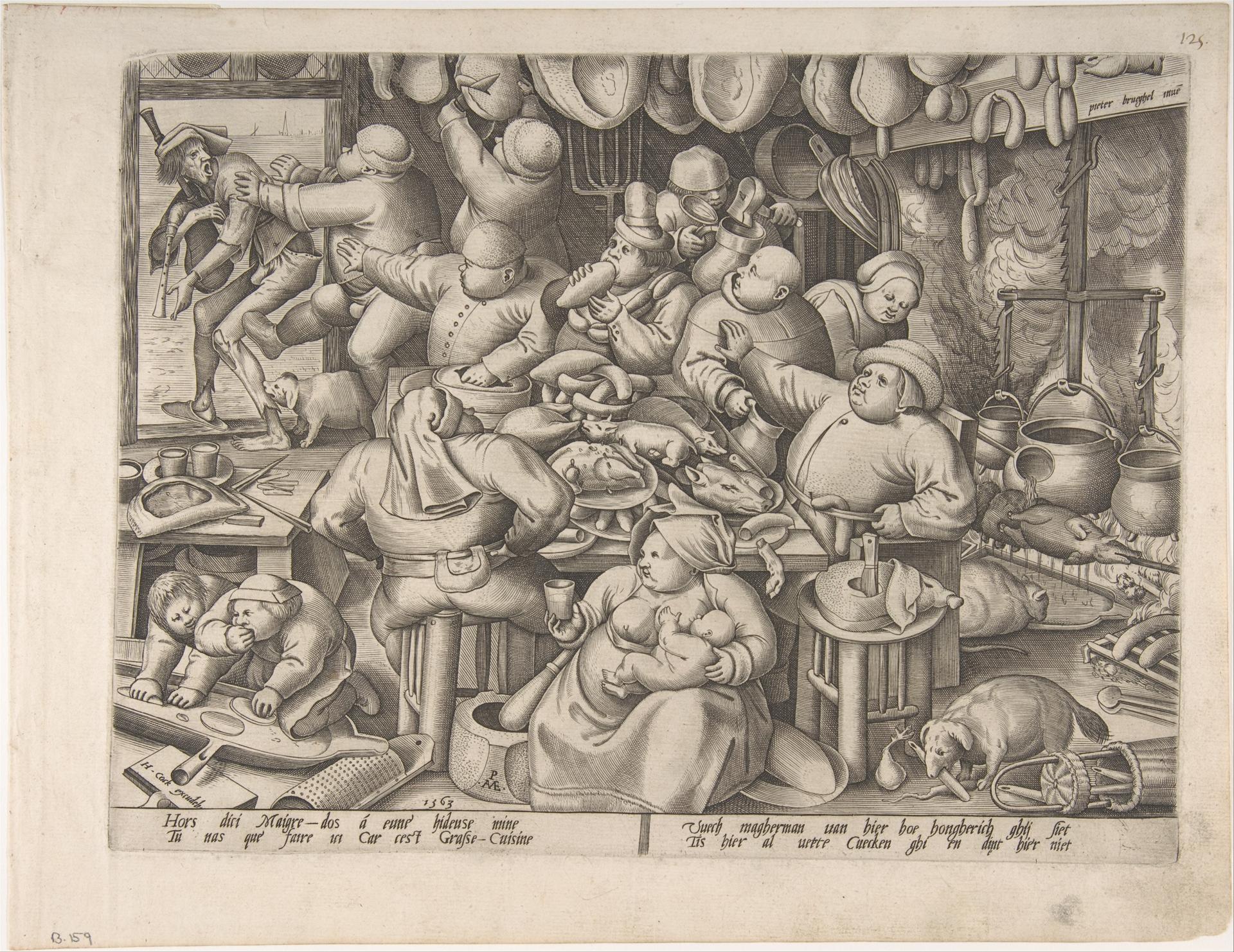
The Fat Kitchen (1563, Met-Objekt 1923)
Original title: The Fat Kitchen
kurzbeschreibung
People crowd into a tight space, roasting, cutting, carrying, and haggling. Pieter Bruegel the Elder made this engraving in 1563, and it presents the busy activity of an overcrowded market scene concerned with the preparation and sale of food. The print is regarded as an impressive testimony to Bruegel's eye for everyday life with its many small observations.
Description
At the front, a group of figures busy themselves among pots and supplies; some prepare dishes, others trade with customers. Above them, shelves full of vegetables and meat hang from the ceiling. The layout feels compressed and saturated with detail, with people and equipment seamlessly integrated into the whole. The engraving's gray tones distribute light evenly, without strong shadows, so that the sharp outlines of the figures stand out.
Context
At the time of its creation, the Netherlands was marked by social and economic tensions. The motif of the fat kitchen belongs to a tradition widespread in the sixteenth century that contrasts abundance with scarcity. Hieronymus Cock, one of Antwerp's leading print publishers, is thought to have been the publisher. Bruegel's view of both rural and urban daily life was new and influenced later generations of artists.
Impact
The abundance of figures draws the viewer into the action, which remains clear despite all the detail. Market work appears close and unvarnished here, without embellishment, offering immediate access to the everyday life depicted.
Technique
The print was executed as an engraving, a technique that allows fine lines and precise details. Even gray values and sharp contours result from this process. The present example is the first state, which speaks for the high quality of the printing plate.
AI-generated description text
Source: Metropolitan Museum of Art · Public Domain (CC0 1.0)