Avarice (Avaritia), from the series The Seven Deadly Sins
Original title: Avarice (Avaritia), from the series The Seven Deadly Sins
kurzbeschreibung
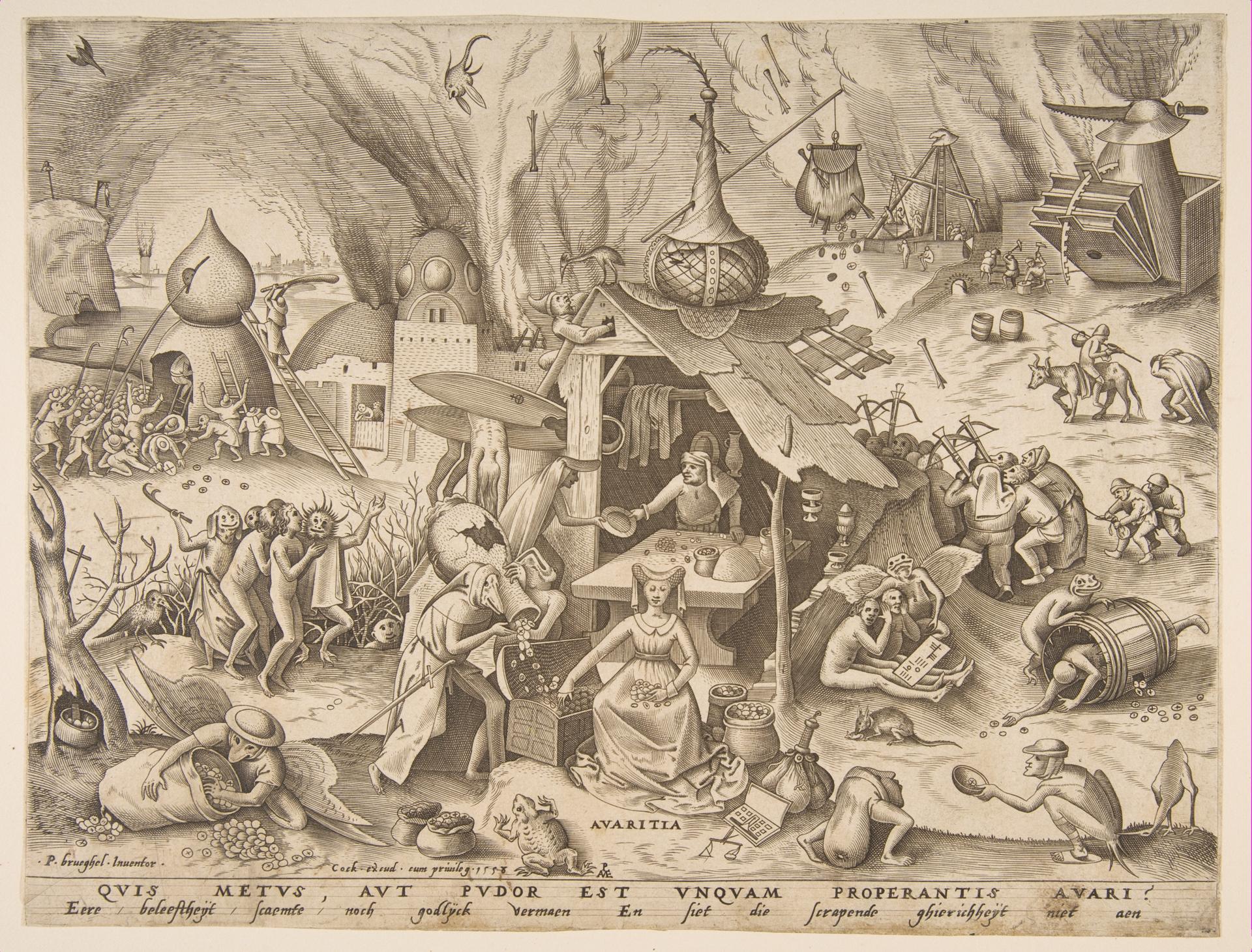
Pieter Bruegel the Elder made this engraving, Avaritia (Greed), in 1558 as part of his series The Seven Deadly Sins. The print presents greed as an allegorical scene: a woman sits at a table piled with gold coins, surrounded by figures who hoard riches and do business. This is the first state of two, with the sheet size usual for the series, 22.5 x 29.7 cm.
Description
A woman has taken her place at a table where gold coins and other valuables are heaped up. Around her, numerous figures are busy with the most varied forms of money-greed: they rake gold together, haul heavy bags, haggle over goods and stow away their treasures. Further across the image, scenes bring the social consequences of avarice before our eyes — people sinking into the ground, ruined houses, mutilated animals. Figures and symbolic details fill the surface densely and unfold a multilayered narrative of the sin.
Context
The series The Seven Deadly Sins was produced in 1558, at a time when Bruegel was already working for the Antwerp publisher Hieronymus Cock, who issued the prints. Bruegel supplied the preparatory drawings, which professional engravers transferred to copper. The series continues a moralizing pictorial tradition widespread in the sixteenth century, which presented vices as cautionary examples for viewers. Bruegel's prints combine satirical sharpness with scenes of everyday life and allegorical elements.
Impact
The dense layout creates an oppressive mood that draws the viewer into the confused bustle of greed. Precise lines and an even distribution of light and shadow direct the eye to the many details, which on longer looking reveal ever more facets of avarice. The moral message unfolds directly and emphatically through the drastic portrayal of consequences.
Technique
The sheet is executed as an engraving, an intaglio process in which lines are incised into a metal plate and then inked with printing color. The sharp, exact lines and the monochrome tonality characterize this technique. The present first state differs from later impressions in details that were altered in reworkings.
AI-generated description text
Source: Metropolitan Museum of Art · Public Domain (CC0 1.0)