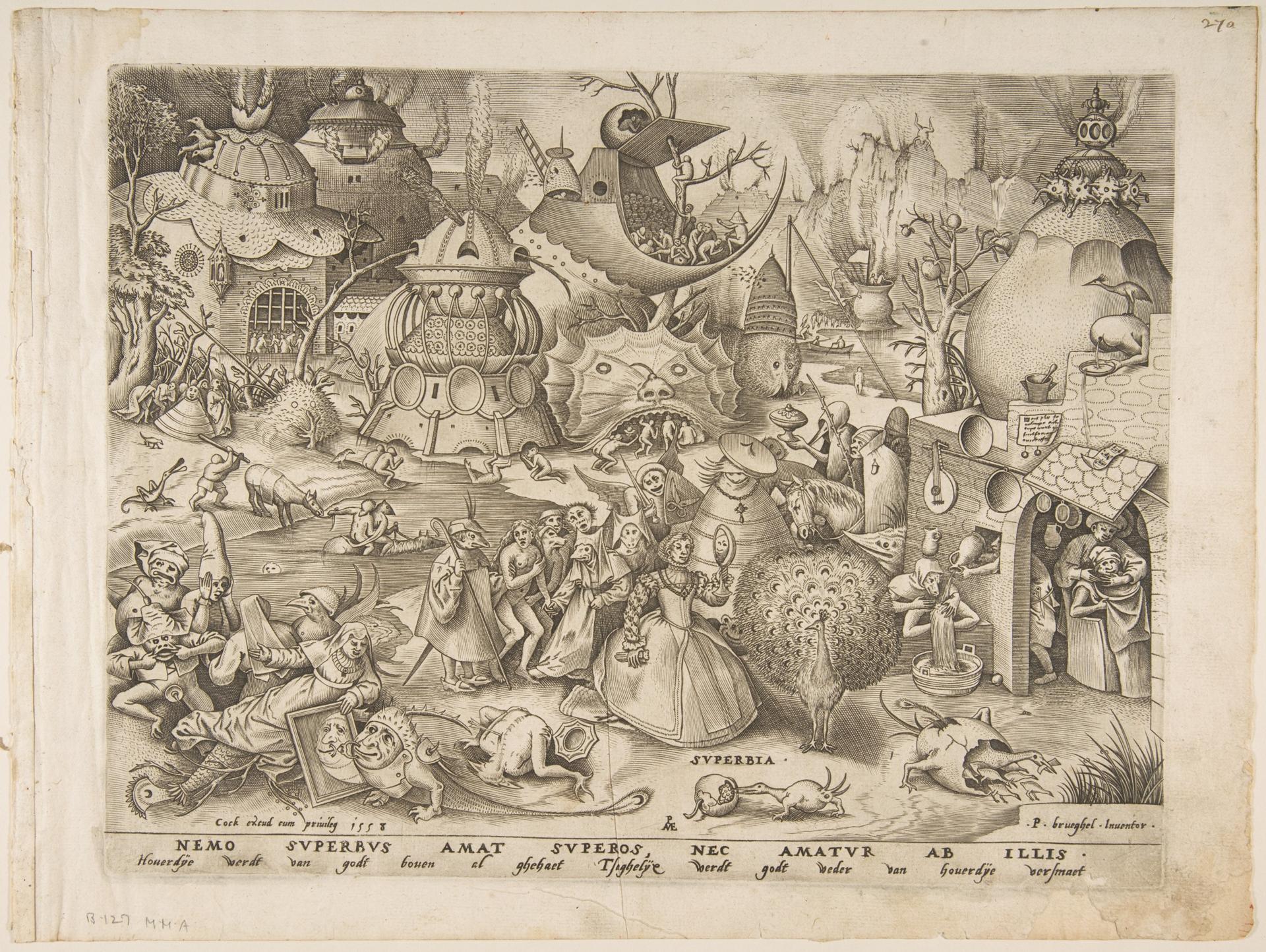
Pride (Superbia) from The Seven Deadly Sins
Original title: Pride (Superbia) from The Seven Deadly Sins
kurzbeschreibung
Unlike the other sheets in Pieter Bruegel the Elder's 1558 series The Seven Deadly Sins, the engraving Pride (Superbia) presents the allegory of arrogance within a wide-ranging scene of figures. At the center stands the lavishly dressed embodiment of Superbia, surrounded by people in various encounters that unfold before a landscape with buildings.
Description
Superbia's figure holds the middle of the sheet, recognizable by her costly garment and elaborately styled hair. Around her, numerous figures are scattered—some chatting, others pursuing pleasures or falling into quarrels. Grand buildings rise in the distance, while trees, mountains, and a river structure the landscape. The lively interaction of the figures underscores Superbia's dominant position. Black and white without intermediate tones, carefully drawn lines, and even lighting make the contours stand out sharply.
Context
Bruegel's series The Seven Deadly Sins was created around 1558 and published by the Antwerp printer Hieronymus Cock. The prints were intended as moralizing allegories that denounced the vices of their own time. In them, Bruegel combined his observation of everyday life with a fantastic visual language in the spirit of Hieronymus Bosch. Unusual for the period: Bruegel executed the etchings himself, while many artists otherwise only contributed designs.
Impact
The dense arrangement and detailed execution immediately draw the viewer's gaze. The central Superbia exerts a commanding presence that further heightens the surrounding scenes of vanity and discord. Even lighting and precise lines produce a clear, almost graphic aesthetic that carries the sheet's moral claim.
Technique
A burin was used to incise the lines into the copper plate; from the depth of the engraving emerge sharp, fine contours and a rich linear pattern. The renunciation of tonal gradations in favor of black and white sharpens the graphic effect and the precision of the reproduction.
AI-generated description text
Source: Metropolitan Museum of Art · Public Domain (CC0 1.0)