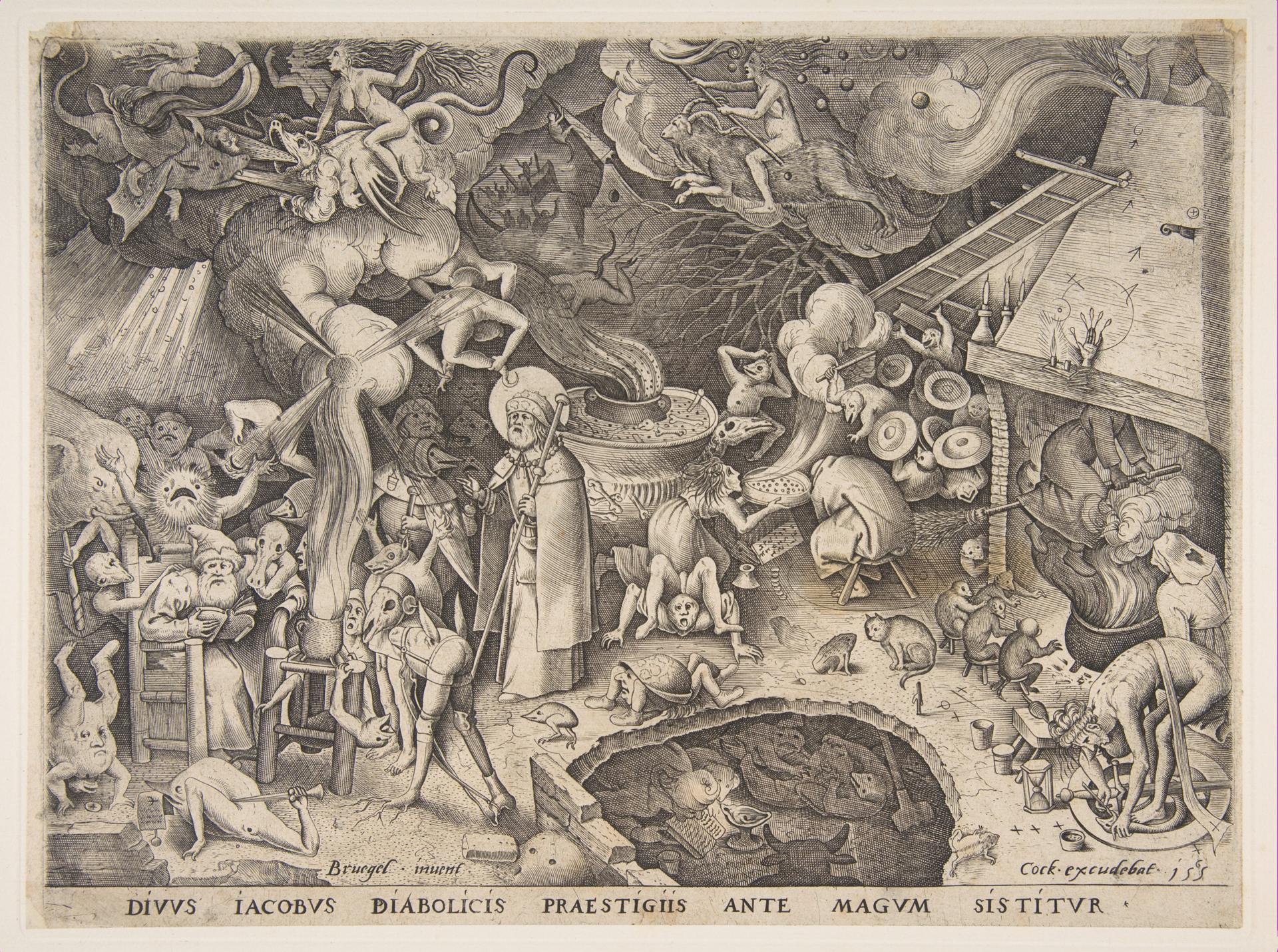
St. James and the Magician Hermogenes (1565, Met-Objekt 1904)
Original title: St. James and the Magician Hermogenes from The Story of the Magician Hermogenes
kurzbeschreibung
Pieter Bruegel the Elder made this etching in 1565; it presents Saint James confronting the magician Hermogenes. The black-and-white print belongs to a series on the legend of Hermogenes. Crowds of figures and symbolic elements fill the sheet, making the struggle between Christian faith and sorcery vivid.
Description
At the heart of the image stands Saint James, a staff in his hand, surrounded by figures in every conceivable pose and occupation. People, animals, and fabulous creatures float through the air, all within a cave-like setting. Around a large cauldron carried by a dragon-like being, figures have gathered for ritual acts. Further back, some people examine objects on a table, while others work at a machine. The layout is dense and narrative, full of details that drive the story forward.
Context
The etching dates from 1565, when Bruegel was known for his detailed, often moralizing images. The tale of Hermogenes, a magician who opposed Saint James, was widely circulated in the sixteenth century and emphasized Christianity's triumph over pagan practices. Bruegel created this sheet within a series about the power of faith and the overcoming of evil. The medium of print made such stories accessible to a broad audience.
Impact
What grips the viewer is the dense arrangement with its multitude of figures, pulling one right into the action. The close grouping and fantastic beings create a mysterious, almost unreal atmosphere. Clear lines and precise execution give the sheet depth and encourage repeated looking.
Technique
The sheet is executed as an etching, marked by sharp lines and fine textures. This is the first of three states, suggesting careful reworking by the artist. The technique allowed for delicate details and subtle gradations of shading that contribute to the narrative density of the scene.
AI-generated description text
Source: Metropolitan Museum of Art · Public Domain (CC0 1.0)