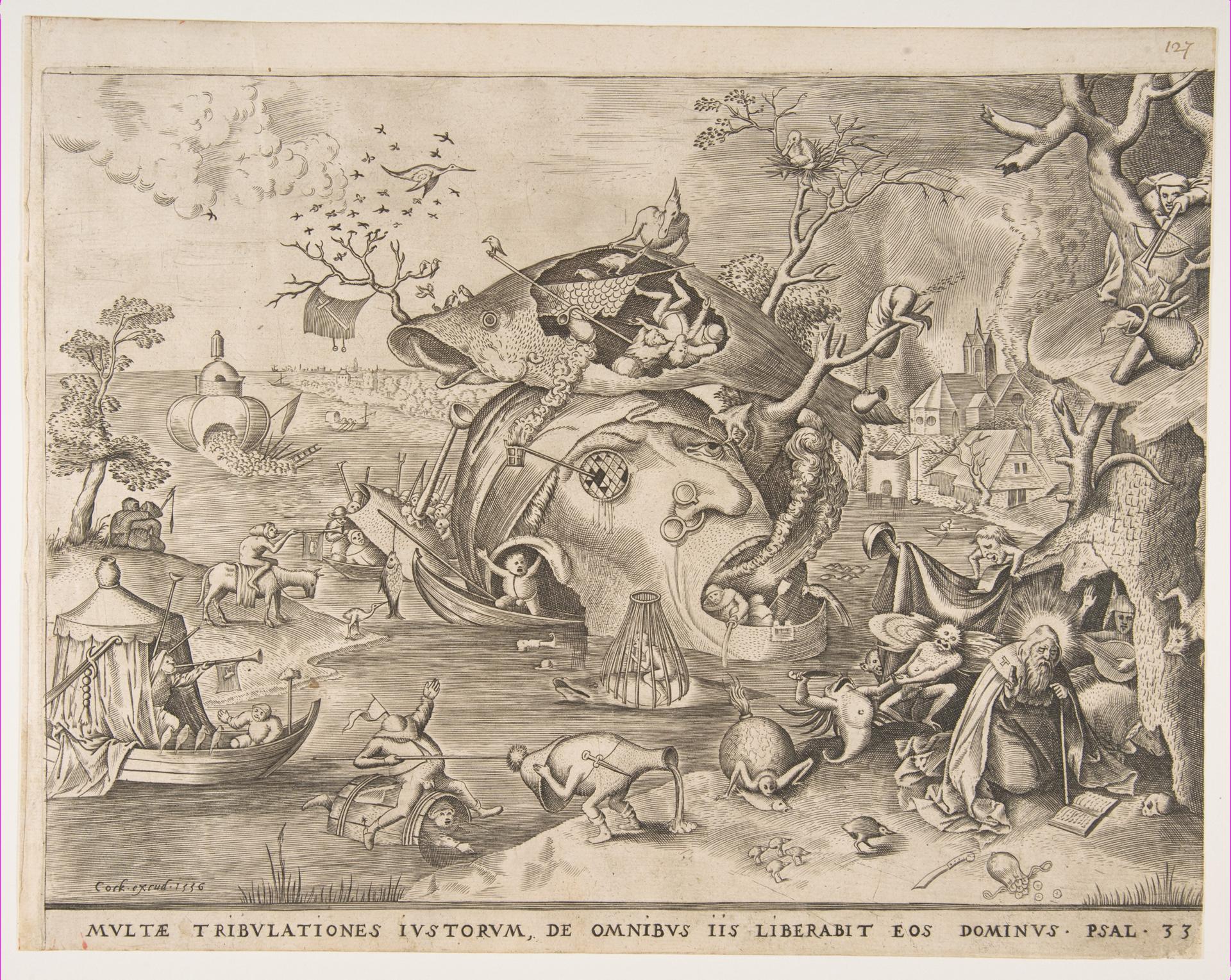
The Temptation of St. Anthony (1556)
Original title: The Temptation of St. Anthony
kurzbeschreibung
Unlike related depictions of Saint Anthony, Pieter Bruegel the Elder's 1556 etching does not rely solely on the temptation scene but places the hermit saint within a landscape teeming with diabolical creatures. Measuring 26.2 by 33.9 cm, the sheet combines realistic landscape elements with symbol-laden fantasy beings.
Description
A gigantic, humanoid creature with a gaping maw dominates the layout; figures and objects protrude from it. People in fighting or fleeing poses surround this central figure, while trees, a village, and a city form the backdrop. The arrangement of figures follows a dense, complex pattern that embodies the variety of temptations. Gray tones define the sheet, with even light prevailing and no striking shadows.
Context
When Bruegel made this print in 1556, the iconographic tradition of Saint Anthony was heavily influenced by Hieronymus Bosch. Bruegel adopted motifs such as fabulous creatures and grotesque hybrids but developed them in his own style. The etching falls into his early period, before painting came to the fore. It belongs to a series of prints distributed through the publisher Hieronymus Cock.
Impact
An oppressive, surreal atmosphere arises from the dense succession of bizarre figures, making the struggle against inner turmoil visible. Even lighting and precise linework draw the eye to the grotesque details without creating dramatic depth. As a result, the etching feels more narrative than emotionally charged.
Technique
For this etching, the drawing was incised into a metal plate, which was then etched with acid. The fine line and detailed passages are characteristic of sixteenth-century printmaking. The acid technique allows for subtle gradations in gray tones.
AI-generated description text
Source: Metropolitan Museum of Art · Public Domain (CC0 1.0)