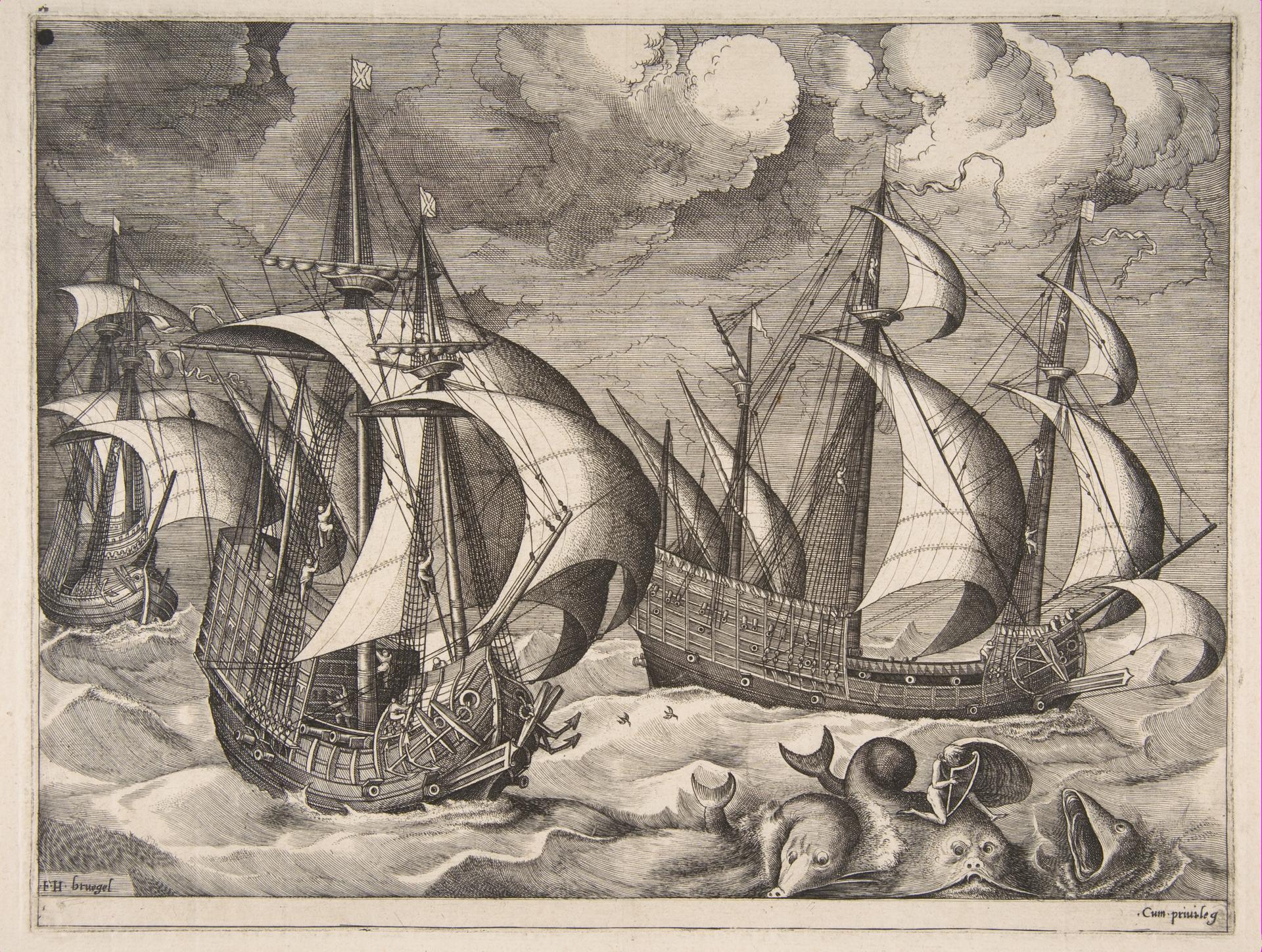
Three Caravels in a Rising Squall with Arion on a Dolphin from The Sailing Vessels
Original title: Three Caravels in a Rising Squall with Arion on a Dolphin from The Sailing Vessels
kurzbeschreibung
Pieter Bruegel the Elder made this engraving, Three Caravels in a Rising Squall with Arion on a Dolphin, between 1561 and 1565. The sheet measures 26.1 x 53.8 cm and is the first state of six. It shows three sailing ships on a restless sea, paired with the mythological figure of Arion riding a dolphin.
Description
Three caravels appear at different stages of movement: sails partly set, partly lowered. Along the lower edge emerge two sea monsters, one with a human head and covered in shells. More vessels can be seen in the distance, also caught by the waves. The sky is overcast, the waves pile up, giving the image a dramatic, perilous character. The arrangement feels symmetrical: the ships occupy the centre, the monsters line the bottom edge.
Context
Bruegel's engraving was made around 1561–65, when the Netherlands was a leading maritime and trading power. It belongs to a series of ship depictions that reflect the maritime culture of the Renaissance. Sea monsters and mythological figures such as Arion were common in the art of the period, linking real seafaring with fantastic motifs. Bruegel was known for his detailed, often moralising images that addressed both natural forces and human concerns.
Impact
The churning waves and menacing sea monsters create a tense, dramatic mood. The black-and-white technique heightens the effect of light and shadow and emphasises the danger of the scene. The combination of realistic ship depiction and fantastic elements draws the viewer in and encourages close looking.
Technique
Lines are engraved into the copper plate and then printed on paper. Fine hatching produces graduated grey tones and renders waves and ships in rich detail. The first state of six shows the original version before later revisions.
AI-generated description text
Source: Metropolitan Museum of Art · Public Domain (CC0 1.0)