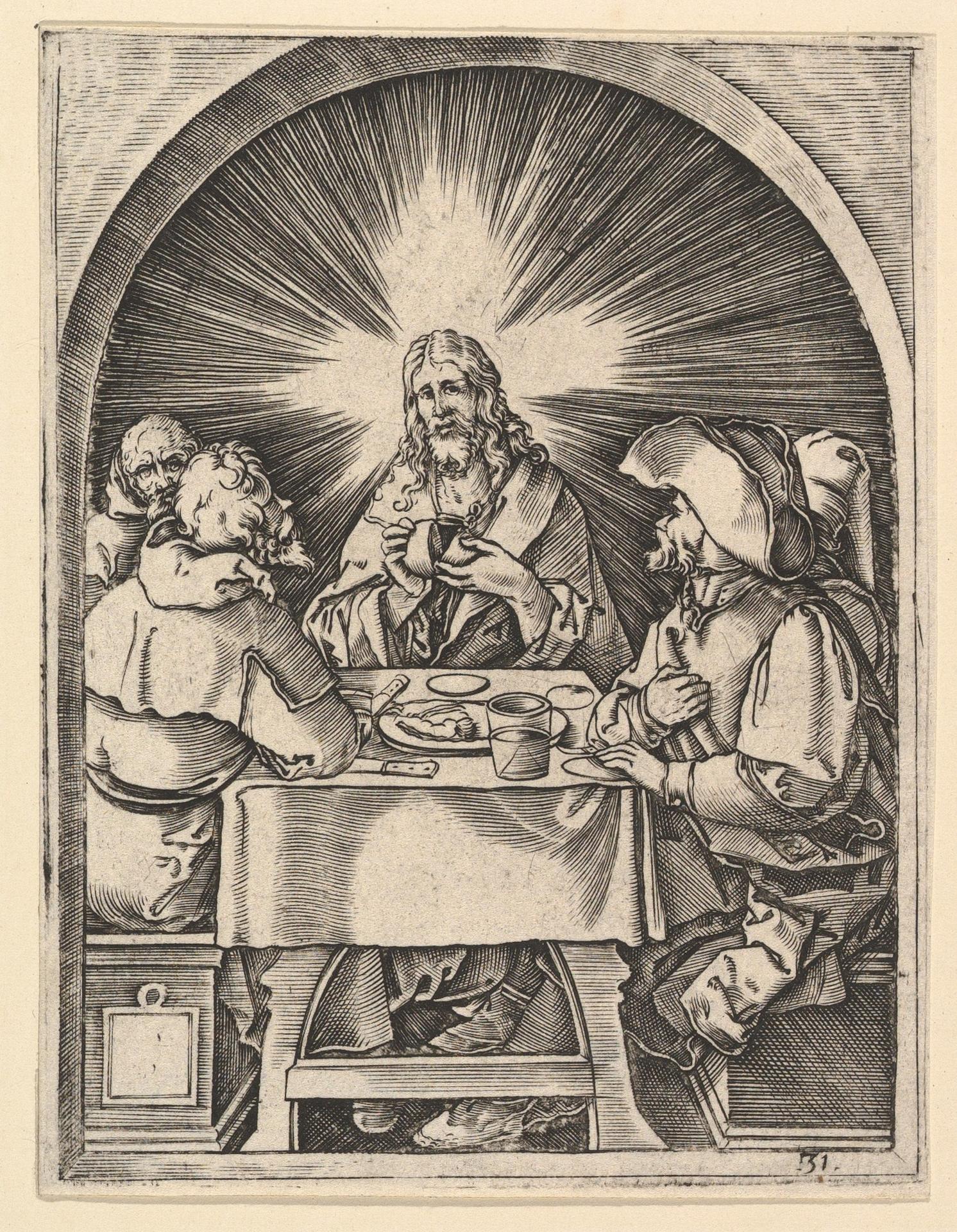
Christ at Emmaus, from "The Passion of Christ"
Original title: Christ at Emmaus, from "The Passion of Christ", after Dürer
kurzbeschreibung
Marcantonio Raimondi engraved 'Christ at Emmaus' as part of his 'Passion of Christ' series, based on a design by Albrecht Dürer. Made between about 1500 and 1534, the print captures the biblical moment when Christ appears to two disciples in Emmaus and breaks bread. The impression survives in the second of three states.
Description
Christ sits at the center of a table, his head ringed by a glowing halo, holding a chalice. Facing him are the two disciples; one also holds a glass, while the other rests his head on his hand. Plates, cups, and a loaf of bread on the table point to the meal. The figures' garments follow traditional forms and suggest a historical period. The layout is symmetrical: Christ as the focal point, the disciples flanking him.
Context
Raimondi, an Italian Renaissance engraver, gained fame for his reproductive prints after other artists' designs. The 'Passion of Christ' series derives from Dürer's woodcut series of the same name, which Raimondi translated into engraving. Such copies spread Dürer's compositions throughout Europe and enhanced his international reputation. This print dates from Raimondi's Roman years, when he worked with Raphael, among others.
Impact
Fine lines and strong light-dark contrast give the sheet a devotional, almost intimate mood. The symmetrical arrangement and the restrained gestures of those present underscore the gravity of the moment when Christ reveals himself to the disciples.
Technique
For this engraving, lines were cut into a copper plate and then printed. The second of three states shows already reworked plates, with finer details and richer shading. The sheet measures approximately 13 by 9.9 centimeters and belongs to a series of small devotional images.
AI-generated description text
Source: Metropolitan Museum of Art · Public Domain (CC0 1.0)