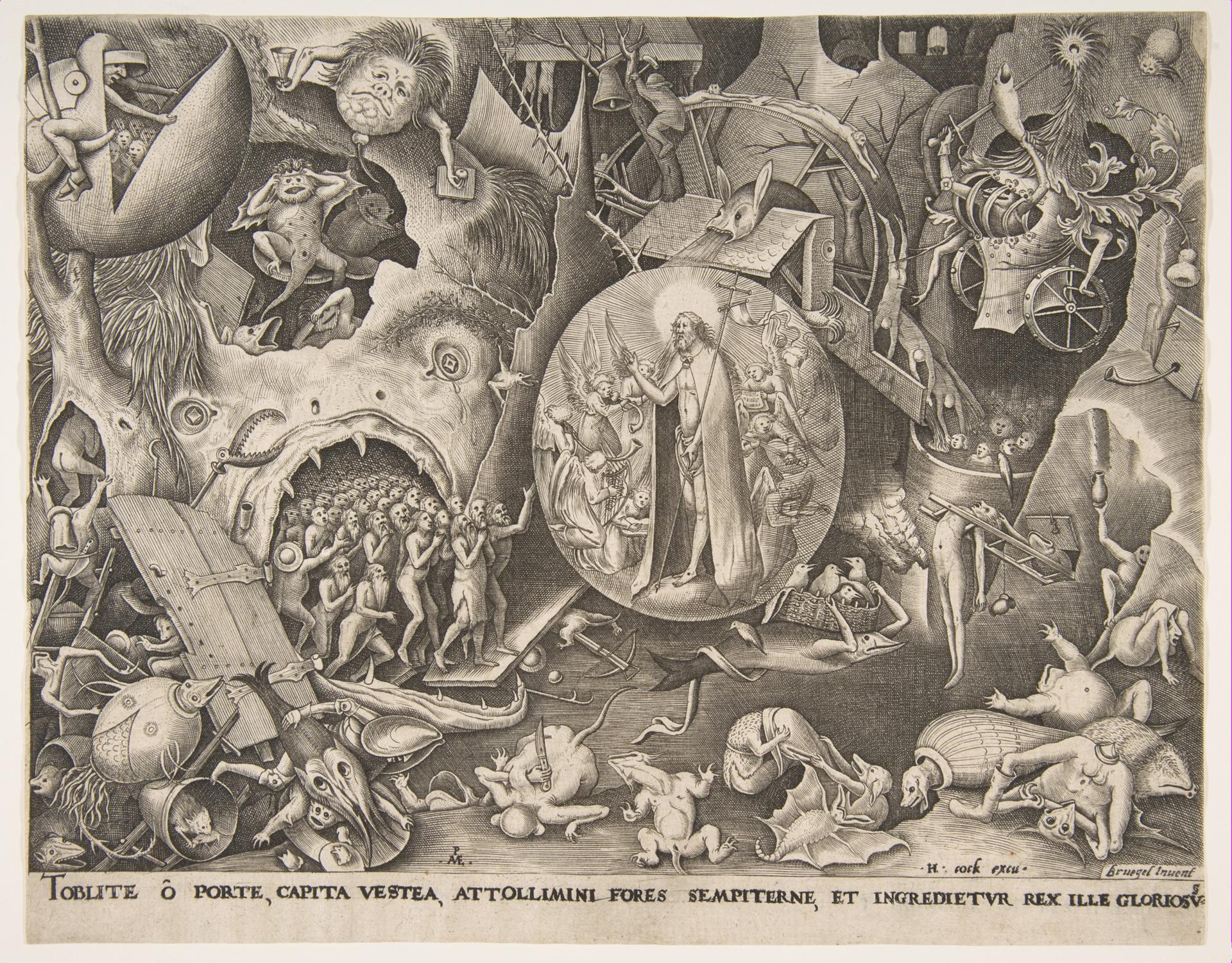
The Descent of Christ Into Limbo (ca. 1561)
Original title: The Descent of Christ Into Limbo
kurzbeschreibung
Created around 1561, Pieter Bruegel the Elder's engraving 'The Descent of Christ into Hell' (Der Abstieg Christi in die Vorhölle) takes up the apocryphal tale of Christ's descent after the Crucifixion into the underworld to redeem the souls of the righteous. This first-state impression measures 23 by 29 cm and ranks among the finely executed prints of the sixteenth century.
Description
A semicircular cave architecture anchors the centre of the sheet. Within it, Christ, wearing a crown and a long robe and surrounded by angels, floats downward into the depths. All around, angels, spirits and other beings crowd together in a dense, almost chaotic throng. Many details—animals, plants and objects—point to the underworld. Further back appear additional figures and signs that embody the inhabitants of limbo. Dark, gloomy tones dominate the whole, with bright and dark areas set sharply against each other to heighten the dramatic tension.
Context
The engraving was made during the years of the Counter-Reformation, when depictions of the Limbus Patrum were widespread in Catholic iconography. Its sources were the apocryphal Gospel of Nicodemus and medieval mystery plays that popularised the subject. Bruegel, otherwise known for detailed landscapes and scenes of peasant life, here proves his ability to translate theological content into a multi-layered pictorial structure. The print was published by Hieronymus Cock, one of the leading print publishers in the Netherlands.
Impact
The dense crowd of figures and the strong contrasts of light and dark create an oppressive yet captivating mood. The precise linework and detailed execution invite prolonged looking and underline the theological depth of the subject. The viewer is drawn into the confused underworld and experiences the act of redemption at first hand.
Technique
For this engraving, the lines were cut with a fine needle into a metal plate, which was then inked and printed on paper. Bruegel achieved sharp, exact lines that bring out the details and shading of the scene. The first state of the print reproduces the plate without later reworking, thus preserving the original quality of the work.
AI-generated description text
Source: Metropolitan Museum of Art · Public Domain (CC0 1.0)