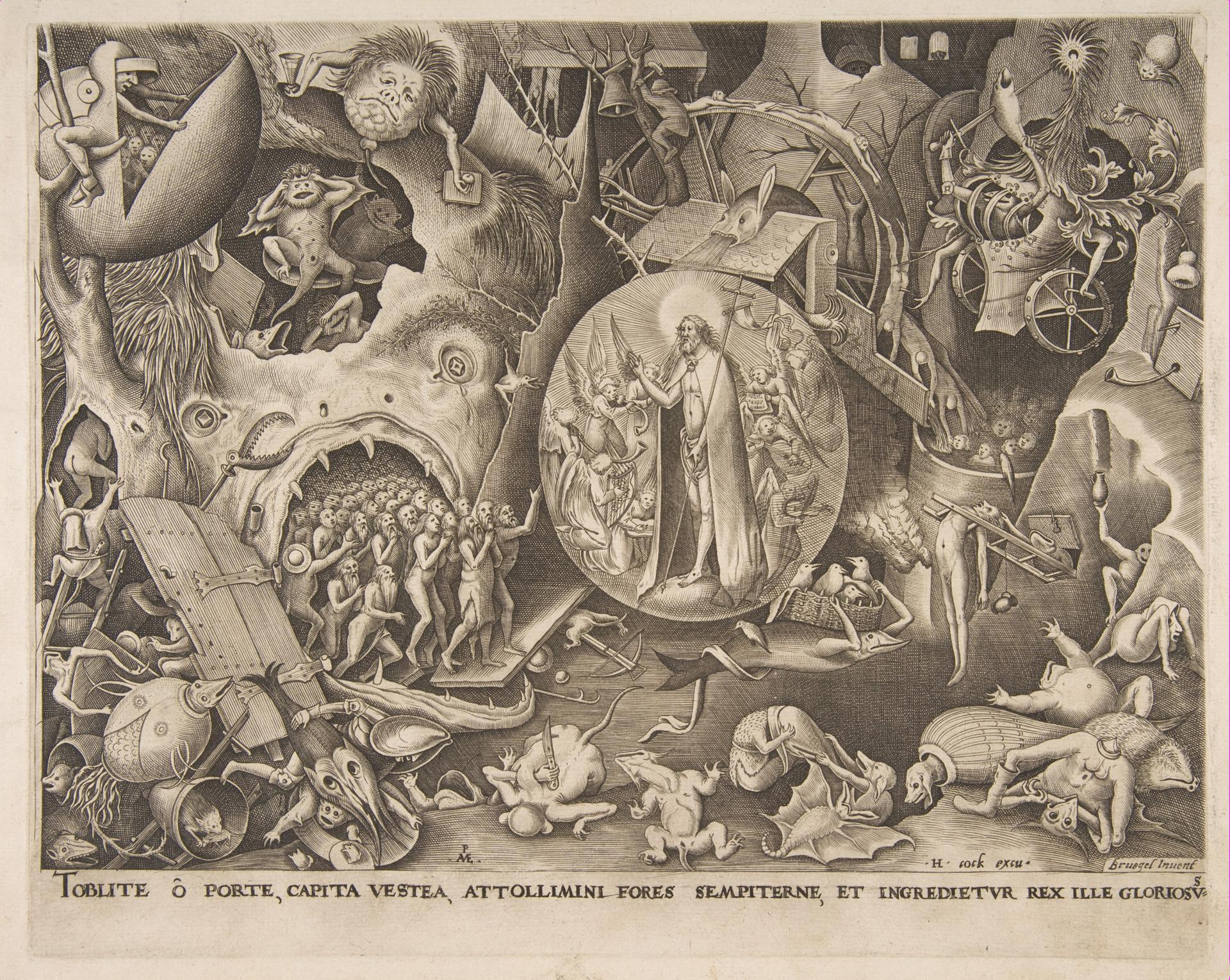
The Descent of Christ Into Limbo (1551)
Original title: The Descent of Christ Into Limbo
kurzbeschreibung
In this 1551 copper engraving by Pieter Bruegel the Elder, Christ frees the souls of the dead from limbo. The print is the first of two states and measures 26.2 x 34.5 cm.
Description
At the center stands Christ in a white robe, holding a scepter and surrounded by angels. On the left, a monster opens its huge, toothed mouth, and human figures emerge from it. On the right, more figures are scattered in various poses—some lie on the ground, others appear to be fighting. Deeper in the image, additional scenes and figures suggest regions of hell or other spiritual states. A Latin text along the bottom edge, likely a biblical quotation, concludes the print. The layout is dense and animated, with numerous figures across several levels.
Context
The engraving dates from 1551, when Bruegel was working in Antwerp under the influence of Hieronymus Bosch. The subject of Christ's descent into limbo goes back to apocryphal writings and medieval legends. Publishers such as Hieronymus Cock helped circulate the engraving. Among Bruegel's early works, this sheet is one of the first to take up a religious theme.
Impact
The crowded multitude of figures creates an oppressive mood and underscores the drama of the event. Precise linework and gradations between light and shadow give the print a sculptural depth that draws the viewer into the scene.
Technique
The image was produced as a copper engraving: the design is incised into a copper plate and then printed on paper. The monochrome reproduction uses fine lines and hatching to bring out light and shadow. The first state of the print stands out for its particularly clear and detailed rendering.
AI-generated description text
Source: Metropolitan Museum of Art · Public Domain (CC0 1.0)