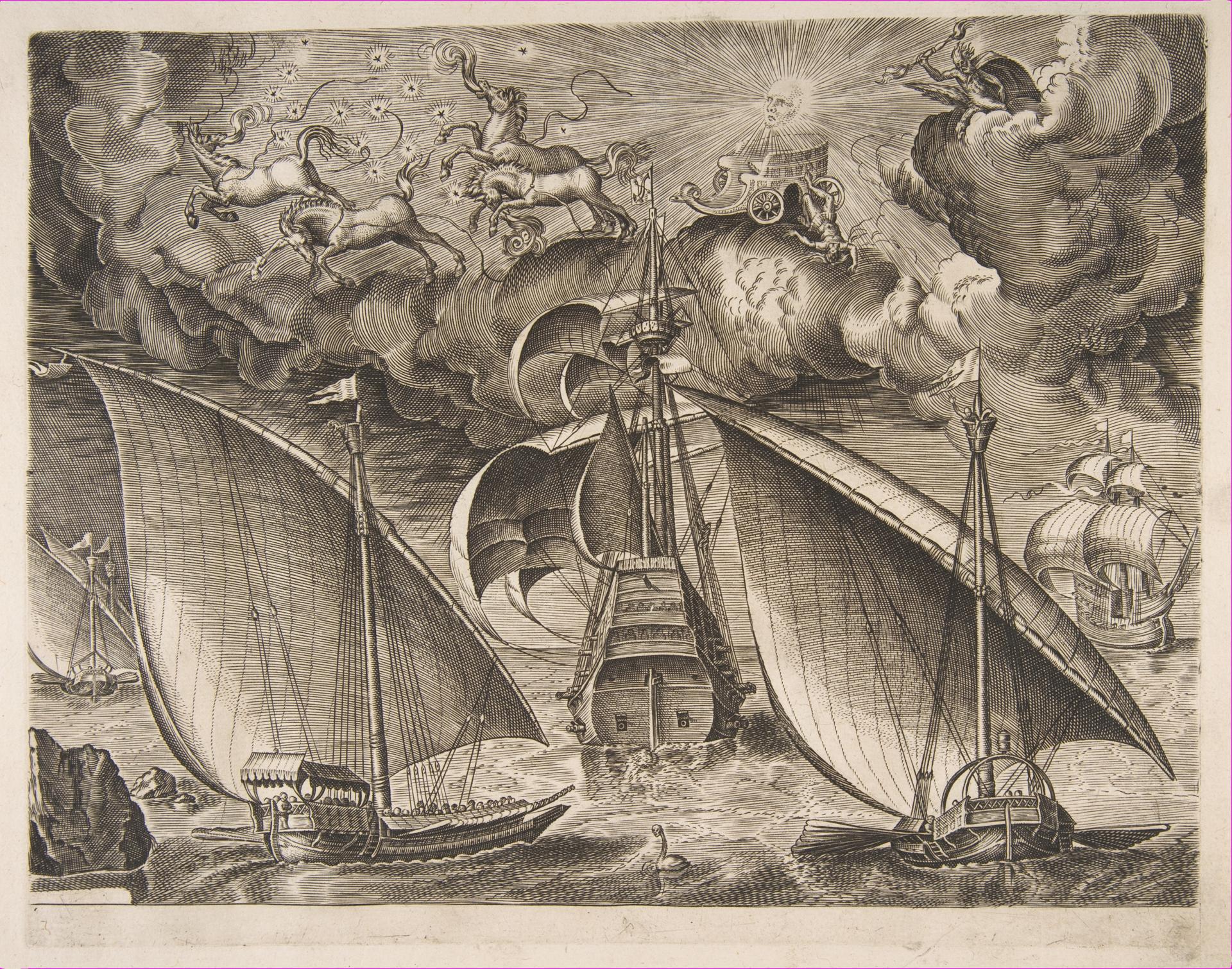
Two Galleys Sailing Behind an Armed Three-Master with Phaeton and Jupiter in the Sky, from the series of Ships
Original title: Two Galleys Sailing Behind an Armed Three-Master with Phaeton and Jupiter in the Sky, from the series of Ships
kurzbeschreibung
Phaeton, unable to control his father's sun chariot, plunges from the sky above a Zeeland seascape where several vessels cross the water. Pieter Bruegel the Elder made this engraving between 1561 and 1565; a large sailing ship sets the tone, smaller boats trail in its wake, and high above, the mythological drama of Phaeton and Jupiter unfolds.
Description
Two slender galleys cut their paths in the foreground, closely followed by an armed three-master whose forest of masts and expanse of sail dominate the middle of the image. Further back, two more vessels appear. Above the water, clouds pile up, and from them emerge two horses and a chariot bearing a figure, crowned by a radiant halo. Fine, densely set lines and hatching hold everything in black and white.
Context
This sheet takes its place within the series of ships that Bruegel issued in the 1560s. Hieronymus Cock, one of Antwerp's leading print publishers and a frequent collaborator with Bruegel, was responsible as publisher. The combination of precise seafaring detail with an allegorical or mythological sky matched the taste of those years.
Impact
Care in rendering the rigging and a massively piled cloudscape give the print a solemn, almost stage-like tension. Because the sober shipping meets a mythological sky, the view gains depth and leaves room for the viewer's own imagination.
Technique
The sheet is executed as a copper engraving in intaglio. Hair-fine lines and hatching model the movement of waves and the depths of the clouds. What survives is the first of two states, which matters to collectors.
AI-generated description text
Source: Metropolitan Museum of Art · Public Domain (CC0 1.0)