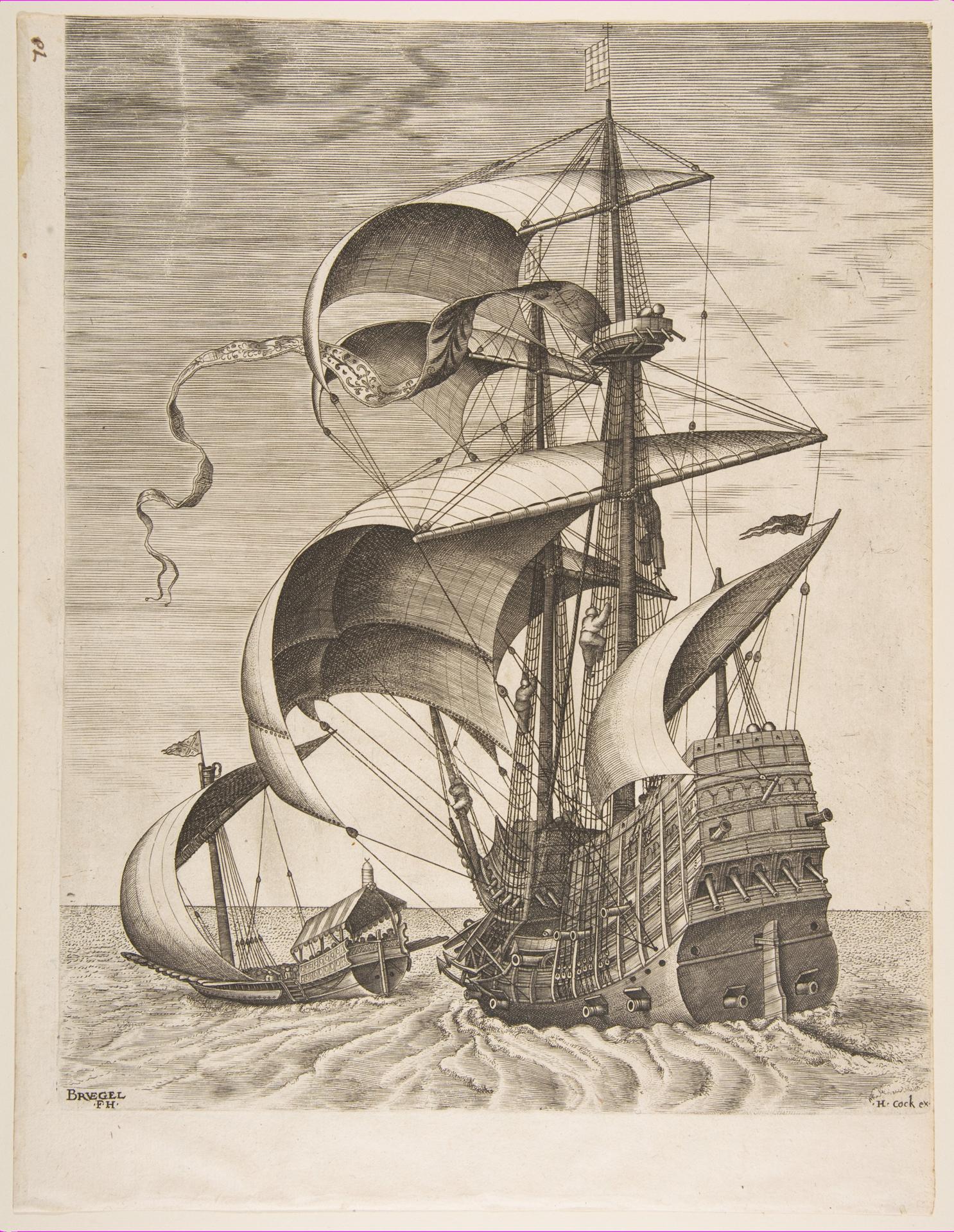
Armed Three-Master on the Open Sea Accompanied by a Galley, from the series Sailing Vessels
Original title: Armed Three-Master on the Open Sea Accompanied by a Galley, from the series Sailing Vessels
kurzbeschreibung
Pieter Bruegel the Elder made this etching between 1561 and 1565. It shows an armed three-master on the open sea, followed by a smaller galley. The print belongs to the 'Sailing Ships' series and is the second of three states. It measures 31.7 x 24.6 cm.
Description
A large three-master with billowing sails dominates the foreground. Behind it sails a wooden galley, also equipped with cannons, suggesting military use. The sky remains empty except for a few clouds. The etching works solely in shades of gray created by the linework. The arrangement feels balanced: the larger ship in front, the smaller one behind, while the three-master's spars and rigging are rendered precisely.
Context
This etching belongs to a series of sailing ships that Bruegel produced in the early 1560s. At that time the Netherlands were under Spanish rule, and seafaring served both trade and war. Bruegel, otherwise known for landscapes and peasant scenes, here took up a maritime subject that was common in printmaking of those years. The series was published by Hieronymus Cock, a leading publisher in Antwerp.
Impact
The precise linework brings out the ships' technical details clearly. The calm, balanced layout and the graduated gray tones give the sheet an objective, almost documentary character. The viewer is encouraged to look closely.
Technique
For this etching, lines were incised into a metal plate and bitten with acid. The second state of three may show reworking or corrections compared with the first. The process allows fine, even lines and accurate reproduction of details, as is typical of Renaissance printmaking.
AI-generated description text
Source: Metropolitan Museum of Art · Public Domain (CC0 1.0)