Armed Four-Master Sailing Towards a Port from The Sailing Vessels
Original title: Armed Four-Master Sailing Towards a Port from The Sailing Vessels
kurzbeschreibung
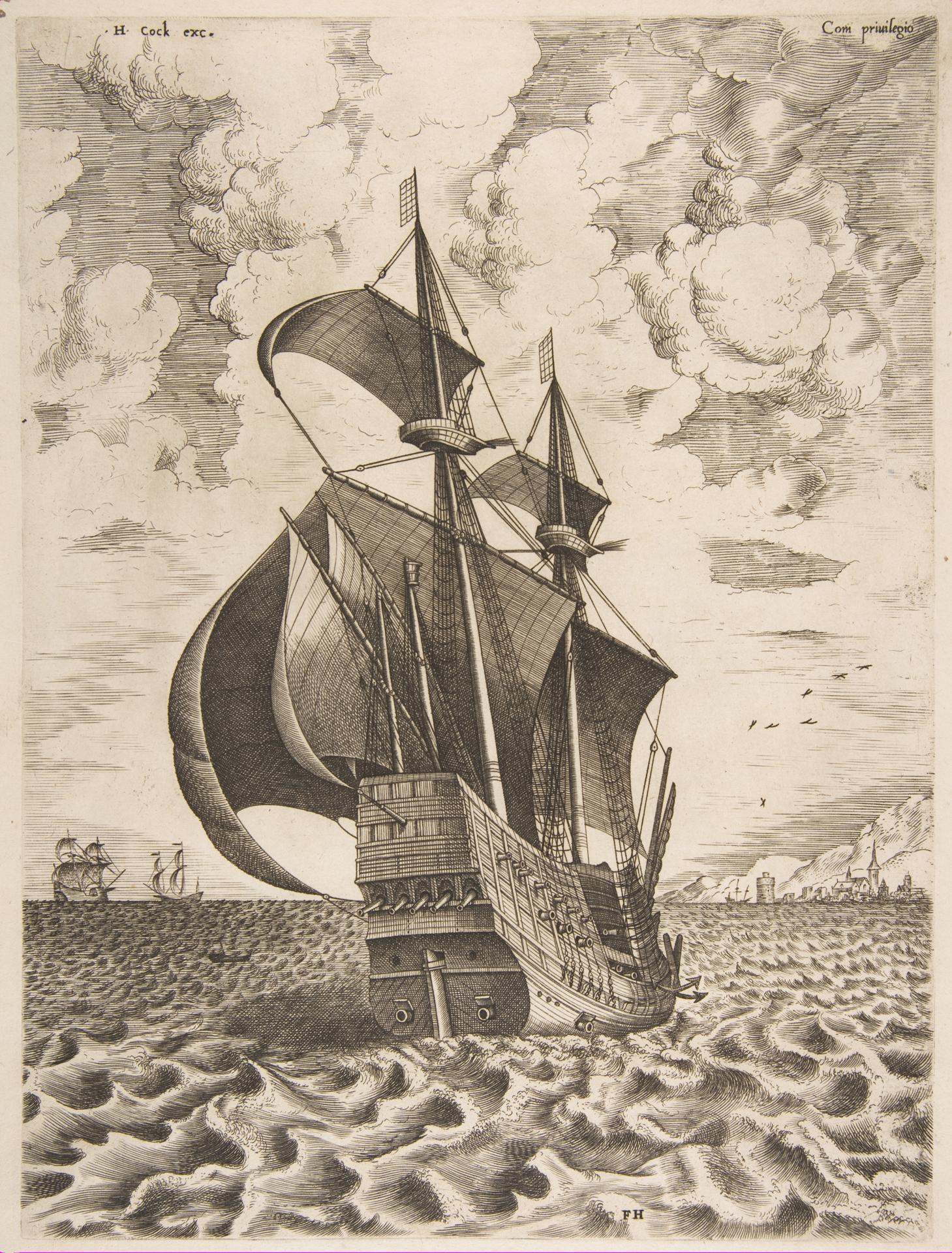
A four-masted warship plunges down a swell toward a harbor, the focal point of this engraving by Pieter Bruegel the Elder from 1561–65. The sheet survives in the second of four states, setting the vessel within a busy sea dotted with other craft and a coastal landscape.
Description
Four masts carry a dense web of sails hung from yards and rigging; hull, beams, and platforms are drawn in minute detail as the ship drives over a wave toward port. Other vessels spread across the water behind it, and beyond them a coast with buildings and mountains. Clouds cover the sky, birds are visible in the air, and the undulating water gains movement from tight line work. At the top edge appear the inscriptions 'H. Cock exc.' and 'Com privilegio' beside the initials 'FH'.
Context
This print belongs to a series of ship depictions that Bruegel made in the early 1560s. Hieronymus Cock, a leading Antwerp print publisher, acted as publisher, his signature 'H. Cock exc.' inscribed at the top. The addition 'Com privilegio' refers to a royal printing privilege that protected against reprints. In the Netherlands of those years, among the leading maritime powers, ship imagery aroused great interest in art.
Impact
Rigging and waves are rendered with great precision, making both technical care and maritime motion palpable. The elaborately worked ship meets a calm coastal backdrop, and from this contrast arises an atmosphere that remains still yet in motion. The viewer is thus drawn into the sailing world of the sixteenth century.
Technique
For the engraving, lines were incised into a copper plate and then printed on paper. In the second of the four states, subsequent reworking can be seen, sharpening the details of ship construction and waves. The process yields fine, exact lines suited to rendering wood, canvas, and water.
AI-generated description text
Source: Metropolitan Museum of Art · Public Domain (CC0 1.0)